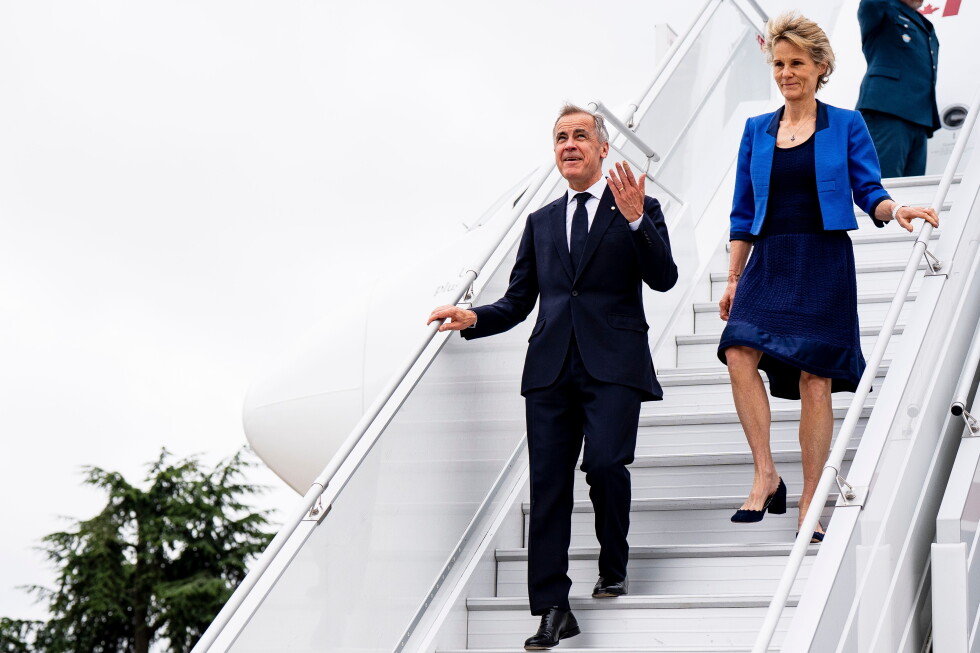
PARIS (AP) — Canadian Prime Minister Mark Carney, who gained international recognition for his bold rhetoric earlier this year, is expected to adopt a more restrained approach toward U.S. President Donald Trump during the upcoming summit in Europe.
Carney gained widespread attention following his speech at the World Economic Forum in Davos, Switzerland. During the event, he criticized the coercion of smaller nations by powerful countries and declared an end to the global rules-based order. His remarks overshadowed those of Trump and were well-received internationally.
The upcoming Group of Seven summit in France, starting Monday, carries significant importance as it precedes the scheduled review of the U.S.-Mexico-Canada Agreement (USMCA) on July 1. The agreement has been a cornerstone of North American trade since the early 1990s, integrating the economies of the United States, Mexico, and Canada. While Trump has hinted at not renewing the deal, more than 70% of Canada’s exports rely on access to the U.S. market, making its preservation critical.
According to Canadian historian Robert Bothwell, the U.S. poses a substantial challenge for Carney, given Canada’s heavy economic reliance on its southern neighbor. “Trump is more of a problem for Carney than anybody else because we are more exposed to the United States than anybody else,” Bothwell stated.
As tensions rise between the U.S. and Canada, Trump prepares to attend the G7 summit following a UFC event at the White House for his 80th birthday. Recent incidents, such as the abrupt cancellation of a planned meeting between Ontario Premier Doug Ford and the U.S. Chamber of Commerce, highlight the strained relations. Vic Fedeli, a minister in Ford’s government, suggested that if Trump influenced the cancellation, Ford should view it as a “badge of honor.”
Trump reiterated this week that the U.S. does not require Canadian resources, prompting Carney to aim for a doubling of Canada’s non-U.S. exports over the next decade. Carney has indicated that Trump’s trade policies are deterring investment.
In related news, the opening of a major Canadian bridge across the Detroit River, previously threatened by Trump, has been delayed due to unresolved issues.
The current trade tensions, fueled by Trump’s suggestion that Canada should become the 51st U.S. state and a trade war, have agitated Canadians. Carney’s political rise was partly based on his promise to confront Trump. U.S. Trade Representative Jamieson Greer pointed out that Canada and China were the only nations to retaliate against the U.S. during the trade conflict, which remains a significant issue in negotiations.
Daniel Béland, a political science professor at McGill University, noted that Carney seems to have softened his stance to avoid further deterioration of U.S.-Canada relations. “There is a clear tension between what Prime Minister Carney said in his Davos speech about middle powers standing up to hegemons and his attempt to nudge the U.S. administration ‘in the right direction’ with regard to the USMCA review and trade policy more generally,” Béland observed.
Carney has downplayed recent comments from Trump regarding Canada becoming the 51st state. Both Canada and Mexico are advocating for the USMCA to be extended for another 16 years, but Trump has hinted at his preference for an annual review over the next decade.
Carney arrived in Paris on Friday and is scheduled to meet with French President Emmanuel Macron before the summit. He will also travel to Ireland to discuss trade diversification away from the U.S., marking his ninth European visit since assuming office in March 2025.
Béland also emphasized the ongoing economic ties, stating that the U.S. “will clearly remain Canada’s largest trading partner for the predictable future,” a reality Carney must consider while attempting to reduce Canada’s trade dependency on the U.S.