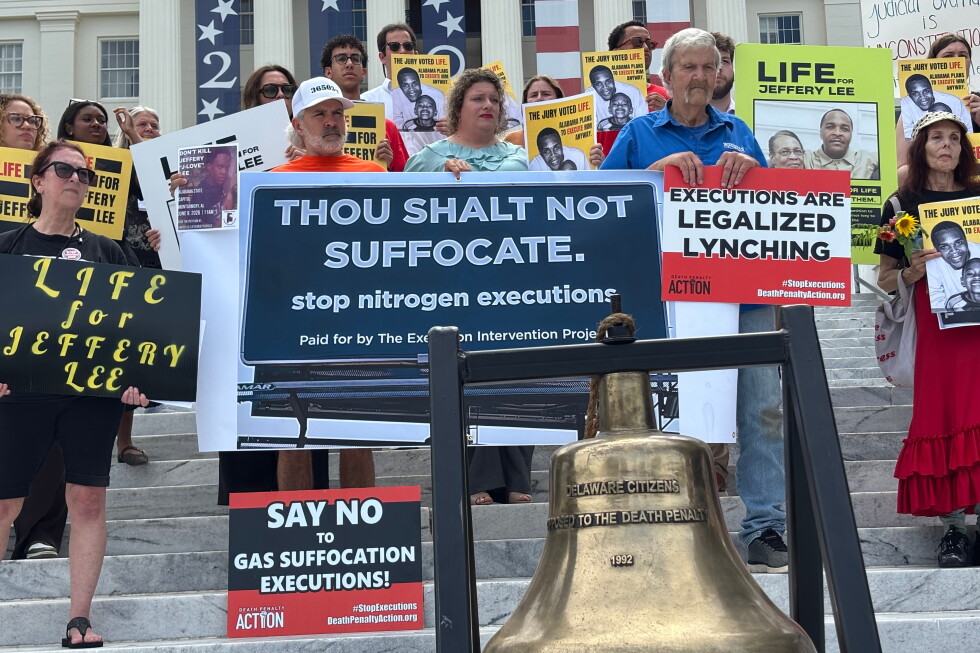
In a significant legal development, a federal judge has permanently barred Alabama from executing a death row inmate using nitrogen gas, a method the state has favored since 2024. This ruling follows a reversal of a previous decision by an appeals court, marking a pivotal moment in the debate over execution practices in the United States.
Legal Ruling and Its Implications
U.S. District Judge Emily Marks delivered the decision, citing the U.S. Constitution’s prohibition against cruel and unusual punishment. Her ruling came just hours after the appeals court overturned her initial finding that the nitrogen gas method was constitutional. As a result, Alabama is currently unable to execute Jeffrey Lee, age 49, using this controversial method. Lee was slated for execution on Thursday.
The ruling temporarily halts Alabama’s use of nitrogen gas, a method the state has vigorously supported, pending further legal scrutiny. This case is likely to escalate to the U.S. Supreme Court, which has yet to deem any state’s execution method unconstitutional.
State and Legal Reactions
Alabama Attorney General Steve Marshall’s office has filed an appeal against this decision, though no immediate comments were made. Similarly, Lee’s legal representatives have not issued a statement. In her ruling, Judge Marks noted that the appeals court deemed the method to pose “a substantial risk of serious harm,” and stated the state could opt for Lee’s preferred method of execution, a firing squad, as inmates are required to propose an alternative method.
“Therefore, Lee has shown by a preponderance of the evidence that the protocol constitutes cruel and unusual punishment in violation of the Eighth Amendment,” Marks wrote.
Details of the Execution Method
Alabama’s nitrogen gas execution method involves fitting a respirator over the inmate’s face and replacing oxygen with pure nitrogen, leading to death by asphyxiation. To date, nitrogen gas has been used in eight executions in the U.S., with seven in Alabama and one in Louisiana. Lee would have been the ninth.
The 11th U.S. Circuit Court of Appeals recently highlighted the potential suffering involved, stating that the three-minute period before an inmate loses consciousness is “intolerable,” given the likely suffering under Alabama’s protocol.
Public and Expert Opinions
The ruling was well-received by opponents of the death penalty and critics of nitrogen gas as an execution method. Bernard Harcourt, a Columbia University Law School professor, remarked, “Three minutes of conscious suffocation is torturous. If that doesn’t violate the constitution, let alone international law, nothing would.” He represents other Alabama inmates contesting the method’s constitutionality.
Rev. Jeff Hood, who has served as a spiritual adviser during two nitrogen executions, expressed hope that this decision could signal the end of the method’s use nationwide.
Historical Context and Legal Challenges
In her comprehensive 26-page ruling, Judge Marks acknowledged the ongoing legal disputes surrounding execution methods. “Were Alabama to adopt firing squad as a method of execution, that method would likely be challenged as well,” Marks noted. She also emphasized the inherent risks of pain involved in any execution method, stating, “The Constitution does not guarantee a painless death, and human life cannot be purposefully extinguished without some risk of pain.”
Jeffrey Lee is incarcerated at Holman Correctional Facility in Atmore, convicted of two counts of capital murder for the 1998 pawnshop killings of Jimmy Ellis and Elaine Thompson. Despite a jury recommending life imprisonment by a 7-5 vote, a judge overrode their decision, sentencing Lee to death. Alabama ended the practice of judicial override in death penalty cases in 2017, as detailed in this report.