Thousands of military flight operations could soon become routine across a chain of small American islands in the western Pacific — a region the U.S. military is rapidly transforming into a critical theater of operations. The Air Force’s latest proposal signals just how seriously the Pentagon is investing in its ability to project power near China’s doorstep.
The Department of the Air Force has published a notice of intent to prepare an environmental impact statement covering proposed training and flight operations at four airfields across three islands in the Commonwealth of the Northern Mariana Islands — an unincorporated U.S. territory in the northwest Pacific. The airfields targeted in the proposal are Saipan International Airport, Tinian International Airport, a major WWII-era airfield known as Tinian North Field, and Rota International Airport.
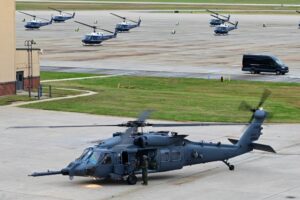
The Air Force envisions conducting more than 6,000 aircraft operations each year across all four locations combined, with individual airfields potentially supporting up to 1,200 fixed-wing and 320 rotary-wing operations — such as takeoffs and landings — annually under the primary proposal. A secondary alternative scenario would allow for even higher numbers: up to 1,400 fixed-wing and 384 rotary-wing operations per airfield per year.
The Strategy Behind the Plan
The proposal is rooted in the Air Force’s Agile Combat Operations concept — commonly referred to as ACE. The strategy focuses on spreading forces across airfields so that no single base becomes a decisive vulnerability. The idea is that by staying mobile and distributed, the military can keep sustaining operations even when an adversary attempts to shut down those operations by striking a central hub. The ACE framework has taken shape largely in response to China’s expanding military capabilities and growing missile arsenal.
The notice describes the four Northern Mariana Islands airfields as offering
“a unique opportunity”
to support this concept, citing infrastructure that ranges from
“fully developed commercial airfields to expeditionary operating locations.”
Their proximity — within a few dozen nautical miles of one another — allows training scenarios that mirror the complexity of real distributed operations while keeping transit times short. The islands also sit less than 100 nautical miles north of Guam, home to major U.S. military installations, making them well-positioned for staging and deploying forces.
According to the notice, the three airfields
“collectively provide a training environment that enables [the Air Force] to exercise distributed operations, test and employ tailorable force packages, strengthen sustainment and maneuver capabilities, and enhance operational resilience.”
What the Exercises Would Look Like
Planned training events would vary in scale — small, medium, and large — and take place several times per year over periods of a few weeks each. Each exercise could draw up to 1,000 personnel per airfield and require as much as 550,000 gallons of fuel per site. Temporary expeditionary infrastructure would be installed at training locations, and operations would involve munitions such as chaff and flares, along with pre- and post-exercise support activities.
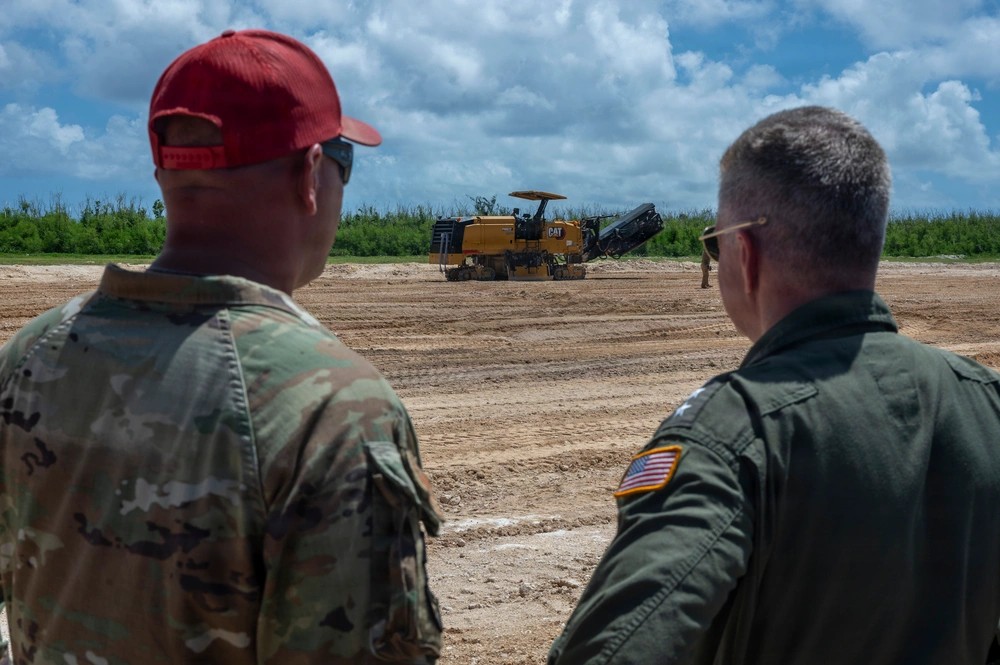
Much of this activity builds on years of groundwork already laid. Tinian North Field, which had sat dormant since World War II and was largely overtaken by vegetation, began undergoing refurbishment in late 2023. Beyond the airfield itself, the Air Force has also upgraded port and road infrastructure, fuel pipelines, airfield surfaces, and utilities to support expanded operations across Tinian.
Funding Pressures and Local Concerns
The push to activate these islands has not been without friction. Within the Air Force, questions have emerged about resourcing and funding, particularly as demands on the force have grown following the conflict with Iran. At the community level, island residents hold mixed views. While some see the military investment as an economic opportunity, others have doubts about whether the increased activity will genuinely benefit local populations — and whether the Pentagon will be transparent and responsive to community concerns throughout the process.
To gather public input, the Department of the Air Force is holding meetings this month on Saipan, Tinian, and Rota. Residents and stakeholders can submit written comments through November 29. The department expects to release a draft environmental impact statement for public review in fall 2027, with a final version scheduled for mid-2028.