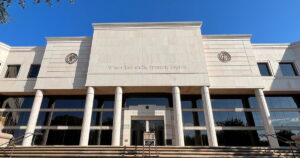
Supreme Court to Examine Legality of Geofence Warrants in Landmark Case
In a digital age where technology often outpaces legislation, the Supreme Court is poised to deliberate on the constitutionality of geofence warrants. This discussion arises from the case of Okello Chatrie, whose cellphone data was pivotal in his apprehension for a bank robbery in Virginia, raising questions about privacy and law enforcement’s reach.
Chatrie managed to escape initially with $195,000 from a suburban Richmond bank. However, he was later identified using a geofence warrant served to Google, which provided location data of devices near the crime scene. This method of investigation, which establishes a virtual perimeter to gather data, has sparked debate over its alignment with the Fourth Amendment’s protection against unreasonable searches.
The Supreme Court is now tasked with determining the legality of such warrants, given the technological advancements unforeseen by the nation’s founders. Their decision could set a precedent for how digital privacy is managed in future law enforcement activities.
Geofence warrants invert traditional methods, where typically, a suspect is identified before a warrant is issued. In contrast, these warrants are used to identify individuals present at a crime location, irrespective of their involvement. While prosecutors advocate for their effectiveness in solving cases lacking clear visual evidence, civil rights advocates argue they breach privacy rights by subjecting numerous innocents to data searches.
These warrants have also been instrumental in identifying perpetrators of significant events, such as the January 6 Capitol riot and other violent crimes across states like California and North Carolina. However, the potential for expanded use of these warrants without stringent oversight remains a concern for privacy advocates.
In Chatrie’s case, the warrant led to the discovery of nearly $100,000 in his home, resulting in a guilty plea and a 12-year sentence. Nonetheless, his legal team contested the warrant’s validity, claiming it violated privacy by indiscriminately collecting data from individuals near the bank. The prosecution countered by stating Chatrie had consented to location tracking via Google’s services.
A federal judge acknowledged the privacy breach but admitted the evidence, noting the officers’ reasonable belief in the warrant’s legitimacy. The Richmond appeals court upheld the conviction, although a separate ruling in New Orleans deemed geofence warrants broadly unconstitutional.
This case echoes the Supreme Court’s 2018 decision, which favored a defendant tracked without a warrant via cellphone tower data. Central to both cases is whether individuals have a reasonable expectation of privacy under the Fourth Amendment. Chief Justice John Roberts previously highlighted the significant technological shifts and the extensive data collection capabilities of modern cellphones.
As the court prepares to hear arguments in Chatrie’s case, the outcome will likely influence future interpretations of privacy rights amid evolving digital technologies.