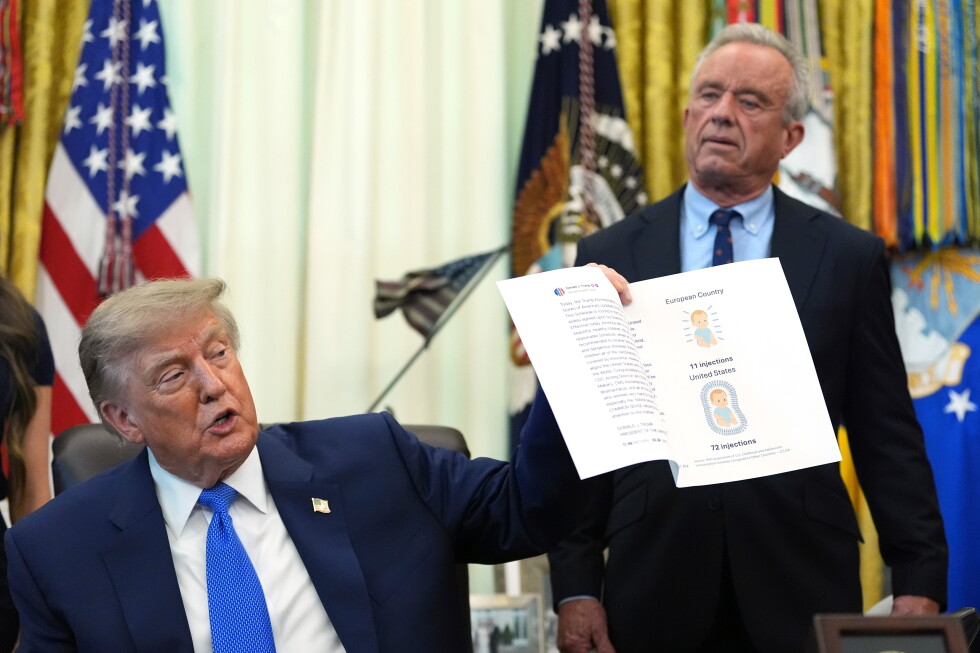
President Donald Trump’s recent executive order has reignited the debate over childhood vaccination schedules. The order promotes a controversial adjustment to the current immunization process, which contradicts established medical consensus.
Trump’s directive proposes that the combined measles, mumps, and rubella (MMR) vaccine be split into three separate vaccinations, each administered individually. This approach also suggests that all childhood immunizations be given in separate medical visits, challenging the extensive research that supports the safety and efficacy of the current vaccine schedule. The order tasks the Department of Health and Human Services with exploring these changes and presenting a plan to make separate measles, mumps, and rubella vaccines available, a choice not currently offered in the U.S.
Public health officials have voiced concerns that these changes could increase the risk of children contracting vaccine-preventable diseases by delaying full immunization. Moreover, the scientific community has repeatedly confirmed through numerous studies that there is no connection between vaccines and autism, a theory Trump has previously suggested.
Dr. Andrew Racine, president of the American Academy of Pediatrics, criticized the order, stating it promotes unnecessary fear and confusion. “Science about vaccines and their efficacy has not changed,” he asserted, emphasizing the stability in the distribution of viruses and pathogens.
Senator Bill Cassidy, chair of the Senate health committee and a medical doctor, disapproved of the order, stating emphatically, “I’m a doctor. This executive order is wrong. The President does not have the expertise to make these changes.”
Authority Over Vaccine Policy
While the executive order urges changes to vaccine schedules, states retain the power to mandate vaccinations for schoolchildren. The order advises states to consider updating their laws to align with the administration’s revised schedule. A previous attempt to reduce recommended vaccines, initiated by the Department of Health and Human Services, was blocked by a federal court.
The role of the Centers for Disease Control and Prevention (CDC) in approving federal vaccine recommendations remains critical. Dr. Erica Schwartz, the newly confirmed CDC director, is expected to oversee vaccine policy. However, legal experts suggest that Trump’s authority might enable him to override Schwartz’s decisions if disagreements arise.
White House officials did not provide supporting studies for the proposed vaccine schedule changes, indicating that the decision aligns with Trump’s personal views and referencing select international practices.
Continued Focus on Autism Research
Health Secretary Robert F. Kennedy Jr., known for his anti-vaccine stance, has been tasked with revising vaccine policy since the start of Trump’s administration. Despite the lack of evidence linking autism to vaccines, Trump has pressured Kennedy to identify an environmental cause for rising autism rates.
As schools reopen amidst a measles outbreak, Trump’s executive order comes at a contentious time. The potential for increased vaccine hesitancy is a concern among medical professionals, especially given the decline in kindergarten vaccination rates and the rise in exemptions in recent years.
The ongoing discussion over this executive order highlights the complex intersection of public health, policy, and personal beliefs, as the nation continues to navigate the challenges of vaccine administration.