In a significant development in Wisconsin’s ongoing legal battle over union rights, a state appeals court reinstated a pivotal 2011 anti-union law, much to the dismay of unions and public workers. As the unions prepare for an appeal, the case is anticipated to progress to the Wisconsin Supreme Court, now under liberal control.
The contentious 2011 legislation, known as Act 10, remains effective as it has been since its inception. It was initially deemed unconstitutional in 2024, but that decision was paused pending an appeal. The recent court ruling maintains the status quo while the legal proceedings continue.
Reinstatement of the Anti-Union Law
The 2011 state law, which sparked prolonged protests and placed Wisconsin at the forefront of a national debate on union rights, was initially advocated by Republicans. Act 10 significantly curtailed the collective bargaining rights of most public employees, restricting their ability to negotiate for higher wages and other conditions. Additionally, it compelled increased employee contributions toward health insurance and retirement benefits.
Proponents of the law argue it empowers local governments with greater control over their workforces, allowing for necessary cost reductions. They warn that repealing the law could lead to financial ruin for schools and local governments, which have utilized the law to augment funding through elevated employee benefit contributions.
Conversely, critics contend that the legislation has undermined schools and governmental bodies by stripping employees of their bargaining rights concerning pay and work conditions. Christina Brey, representing the unions involved in the lawsuit, expressed confidence in the merits of their case and emphasized the commitment to regaining full collective bargaining rights.
“Wisconsin is better when all employees have a say in our workplaces, whether about class sizes in our schools, safety on the job, hours or any other number of areas,” Brey stated. “Public service workers across the state won’t stop until we regain free, fair and full collective bargaining rights to negotiate with our employers.”
Political and Legal Repercussions
Former Republican Governor Scott Walker, who played a crucial role in enacting the law, hailed the court’s decision as a victory for taxpayers and elected officials managing public institutions. Walker’s efforts in pushing the legislation propelled him to national prominence, albeit briefly, during an unsuccessful presidential campaign.
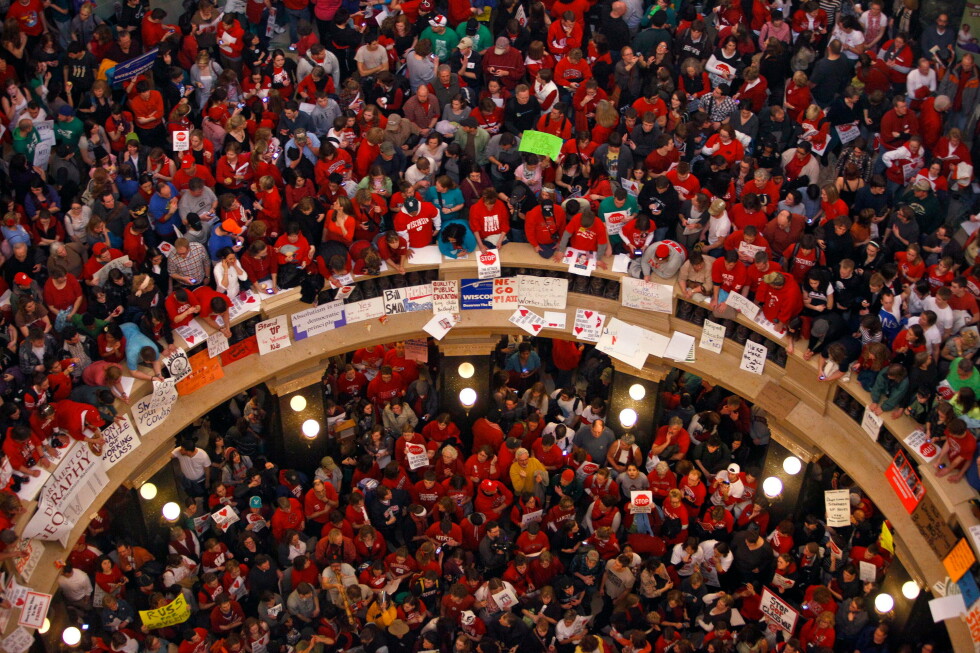
Despite the massive protests at the state Capitol that drew up to 100,000 participants, the Republican-dominated Legislature approved the law. Act 10 effectively dismantled most public unions’ collective bargaining abilities, limited negotiations to inflation-tied wage increases, prohibited automatic union dues deductions, mandated annual union recertification votes, and increased public workers’ financial contributions for benefits.
The law has withstood several legal challenges over the years, but this appeal is the first since the Wisconsin Supreme Court gained a liberal majority in 2023. The lawsuit, initiated by seven unions and three union leaders, argues that Act 10’s exemptions for certain public safety workers are unconstitutional. However, attorneys for the Legislature and state agencies maintain that these exemptions are legally sound and have been upheld by previous courts.
Appeals Court Decision and Dissent
The three-judge appeals court ruled in a 2-1 decision to overturn a 2024 ruling by Dane County Circuit Judge Jacob Frost, affirming that the law does not infringe upon the Wisconsin Constitution’s equal protection guarantees. The court emphasized the necessity of respecting legislative fiscal policy decisions.
Appeals Court Judge Shelley Grogan concurred with the verdict, questioning the timing of the lawsuit, which was filed shortly after the Supreme Court’s shift to liberal control. Grogan asserted that legal challenges based on previously rejected arguments should not be reconsidered solely due to changes in the court’s composition, cautioning against using the judiciary to advance political agendas.
Meanwhile, Appeals Court Judge Lisa Neubauer, the panel’s sole liberal, dissented, agreeing with the lower court’s stance. She criticized the Legislature for making “arbitrary and irrational distinctions” by selectively removing collective bargaining rights from certain public employees while exempting others.