In the annals of military history, certain battles stand out for their intense combat and significant outcomes. The Battle of Hue during the Vietnam War is one such pivotal conflict. Amidst this brutal urban warfare, a uniquely formidable vehicle, the M50 Ontos, played a crucial role, showcasing its surprising effectiveness despite being nearly phased out of service.
The Onset of Conflict
As 1968 dawned, the North Vietnamese Army launched the Tet Offensive, a coordinated series of surprise attacks against South Vietnam. One of the central targets was the culturally and politically significant city of Hue. On January 30, eight battalions of NVA troops infiltrated the city, catching U.S. and South Vietnamese forces off guard due to a Lunar New Year ceasefire.
The NVA quickly seized the northern Citadel and much of the southern city, leaving only two small compounds in allied hands. American Marines, arriving as reinforcements, were thrust into fierce urban combat, a type of warfare not encountered since the Korean War.
Urban Warfare Challenges
The NVA transformed Hue’s infrastructure into formidable defensive positions, utilizing buildings as bunkers and creating interlocking fields of fire. The Marines, initially constrained by rules of engagement designed to protect civilians and historical sites, found their conventional tactics met with severe resistance and heavy casualties.
The battle demanded innovative solutions, and the M50 Ontos emerged as a key asset. This vehicle, once dismissed by the Army for its perceived shortcomings, proved invaluable in the cramped, hostile streets of Hue.
The M50 Ontos: An Unlikely Hero
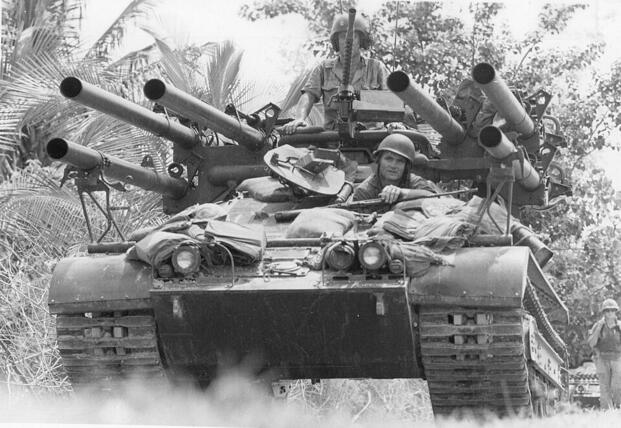
Weighing only 9 tons, the Ontos was equipped with six 106mm recoilless rifles, allowing it to deliver substantial firepower in tight spaces where heavier tanks struggled. Designed originally as a tank destroyer, it was repurposed effectively in Hue for infantry support, demolishing enemy fortifications and providing cover for advancing Marines.
Marine Capt. Collin Casey noted that the Ontos served as a “building buster,” aiding infantry in breaching enemy defenses without exposing themselves to direct fire. The vehicle’s beehive rounds, containing thousands of steel darts, were particularly feared by the NVA, contributing to the Ontos’ reputation on the battlefield.
Strategic Impact
The Ontos, alongside the heavier M48 Patton tanks, played a decisive role in the battle. They enabled the Marines to make meaningful advances, despite the challenging urban environment. The Ontos’ ability to quickly disable enemy positions and create breaches for infantry assaults was instrumental in the eventual recapture of Hue.
As Col. Bob Thompson, who commanded forces during the battle, asserted, “We would have won; it would have taken us longer, and we would have sustained greater casualties” without the Ontos and tanks.
A Legacy of Innovation
Despite its success in Hue, the M50 Ontos was retired shortly after the war, having never been used for its original purpose. However, its role in the Battle of Hue solidified its place in Marine Corps history as an effective and innovative combat vehicle. The Ontos’ performance during this urban conflict continues to be studied in military doctrine, highlighting the importance of adaptability in warfare.
Today, surviving Ontos vehicles can be found in museums, serving as reminders of the complex and dynamic nature of military engagements and the inventive solutions that can arise from necessity.