U.S. Marine Corps 2026 Strategy: Balancing Immediate Response and Future Innovations
The 2026 U.S. Marine Corps Aviation Plan (AVPLAN) sets forth a bold vision for future readiness. Released in February, this strategic document outlines the Marine Corps Aviation’s commitment to balancing immediate crisis response with a forward-thinking approach to modernization, leveraging data-driven initiatives and technological advancements.
Described by officials as a significant leap from its predecessor, the 2026 AVPLAN moves from broad strategic guidance to specific, measurable goals. It emphasizes the development of capabilities essential to the Marine Air-Ground Task Force and the integration of Artificial Intelligence/Machine Learning (AI/ML) to outpace adversaries. Lt. Col Marianne “LOB” Carlson, a key strategist, told Military.com, “We are remaining globally responsive to crises around the world, and that is the Marine Corps’ bread and butter. We are the global 911 force.”
Carlson, who has extensive experience as a UH-1Y pilot, emphasized the dual challenge of maintaining crisis response capabilities while modernizing for future engagements. “One of the purposes of the AVPLAN is to give a comprehensive look at how we’re going to do both—how we are going to respond anywhere around the world, but also look at transforming for the next-generation sites, wherever that may be,” she explained.
Introducing Project Eagle
Central to the AVPLAN is Project Eagle, a framework designed to guide Marine aviation towards a future that is more survivable, distributed, data-enabled, and lethal. It serves as the bridge between strategic guidance and specific program development, supporting the Marine Corps’ modernization efforts across multiple Future Years Defense Programs (FYDPs).
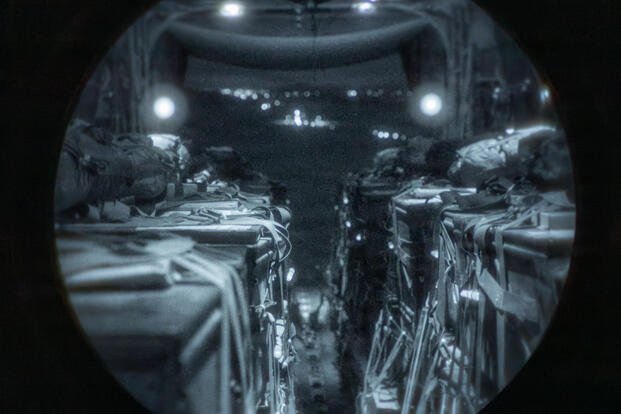
Project Eagle is supported by five main lines of effort (LOEs): Concepts, Functions, Transformation & Innovation, Resourcing, and Roadmaps. These LOEs are essential for achieving resilience and lethality across military operations. Carlson highlighted the importance of operational concepts like Distributed Aviation Operations and Decision-Centric Aviation Operations, emphasizing their role in overcoming geographical and cognitive challenges.
Embracing AI for Operational Excellence
AI is a cornerstone of the AVPLAN, driving efficiency and decision-making in aviation sustainment. Carlson noted the rapid evolution of AI technology, stating, “The exponential growth of AI technology is forcing us, encouraging us, enabling us to move very quickly.” The aim is to streamline processes such as aviation supply and aircraft maintenance, allowing Marines more bandwidth for critical decision-making.
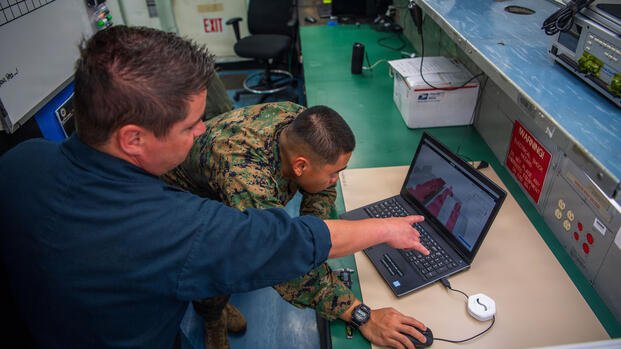
AI tools, collectively managed under the AI agent known as Agent Alfred, are designed to enhance efficiency in various areas, from maintenance to operations. Carlson explained, “But if I can make a Marine more efficient in ordering a part, in fixing an aircraft, in creating a schedule or a training plan, then that’s one step closer to achieving decision advantage in a future operational environment or battlefield.”
“Technology is an enabler, it is and it always will be,” Carlson said. “But at the end of the day, war is a human endeavor. Fighting is a clash of human wills. We’ll never, in my personal opinion, have robot wars because you’ll always have a human as part of that.”
Carlson underscored the role of technology as a facilitator rather than a replacement for human involvement in military operations. The AVPLAN reflects this philosophy, aiming to equip Marines with advanced tools while preserving the essential human element of warfare.