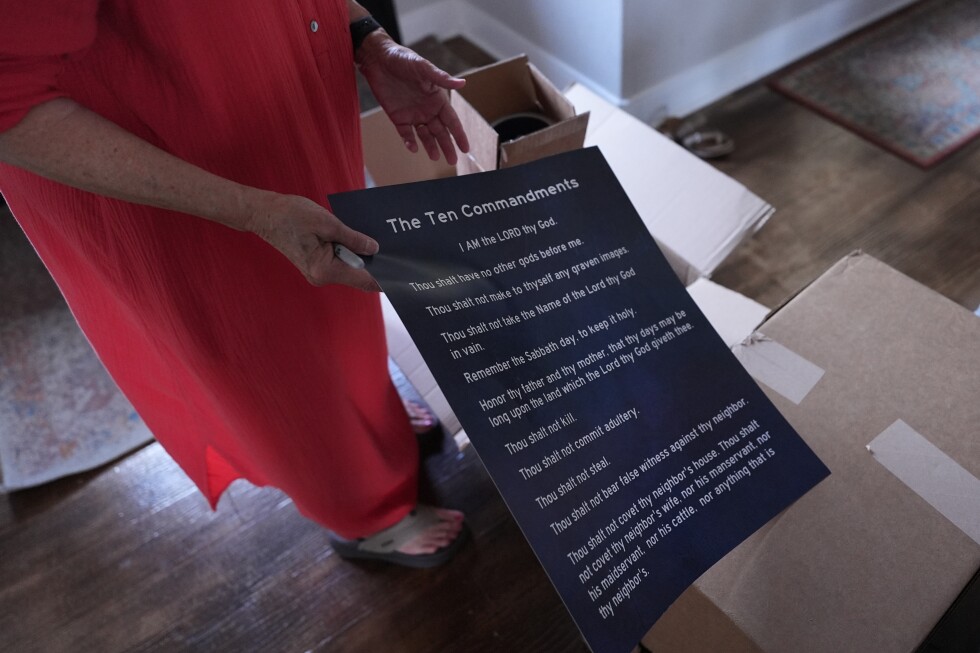
In a significant development for religious education in public schools, recent court decisions have given new momentum to efforts mandating the display of the Ten Commandments in classrooms across the United States. This move is part of a broader push by advocates to integrate religious elements into educational settings, including the introduction of Bible stories into required reading lists for students.
The initiative gained traction last year in Texas, where a U.S. appeals court recently upheld a law requiring the Ten Commandments to be displayed in every classroom, despite ongoing debates surrounding its implications. This ruling is seen as a win for conservative groups who argue that such displays do not infringe upon the rights of students or parents of varying faiths.
State Legislative Moves
Several states, predominantly in the Southern U.S., have introduced similar measures. Louisiana was the first to enact such a requirement in 2024, followed soon after by Arkansas and Texas. Most recently, Alabama’s Governor Kay Ivey signed a law mandating the display of the Ten Commandments in public school classrooms from grades 5 through 12, as well as in communal areas like cafeterias.
In Texas, the law signed by Governor Greg Abbott in September requires the Ten Commandments to be posted in every public school classroom, contingent on the availability of donated posters. This has led conservative organizations and individuals to actively distribute these posters to schools statewide.
An analysis by the Associated Press revealed that at least 30 legislative measures across various states proposed similar requirements, with all bills introduced by Republican lawmakers in GOP-majority states. However, only a few have progressed beyond committee endorsements, with some bills allowing for optional displays or incorporating the Ten Commandments into educational curricula.
Judicial Support and Opposition
The 5th U.S. Circuit Court of Appeals in New Orleans recently overturned a lower court’s decision, allowing schools in Texas to proceed with displaying the Ten Commandments. The court’s 9-8 ruling stated that the mandate does not infringe upon the rights of students or their families, noting, “No child is made to recite the Commandments, believe them, or affirm their divine origin.”
This decision has been met with disappointment from groups like the American Civil Liberties Union, who argue that it undermines the First Amendment’s separation of church and state. They stated, “The First Amendment safeguards the separation of church and state, and the freedom of families to choose how, when and if to provide their children with religious instruction.”
Earlier this year, the same appeals court allowed Louisiana to implement a similar law, with the state’s Attorney General Liz Murrill praising the decision and noting that it supported their legal stance.
Broader Religious Education Debate
The debate over religious content in schools extends beyond the Ten Commandments. In 2024, Texas approved an optional Bible-focused curriculum for elementary schools, with a pending proposal to make Bible stories part of the required reading curriculum.
In Oklahoma, a former education official required public schools to integrate Bible teachings into lesson plans for grades 5 through 12, leading to legal challenges from parents and educators. Despite this mandate, many schools chose not to comply.
Moreover, efforts in Oklahoma to establish the country’s first publicly funded religious charter school were halted by the state Supreme Court, with the case now awaiting a decision from the U.S. Supreme Court.
Future Developments
Those opposing the Texas law, including the ACLU, have indicated plans to appeal the 5th Circuit’s decision to the U.S. Supreme Court.
___
Contributions to this report were made by Associated Press writers Audrey McAvoy in Honolulu, Geoff Mulvihill in Haddonfield, New Jersey, Sean Murphy in Oklahoma City, and Kim Chandler in Montgomery, Alabama.