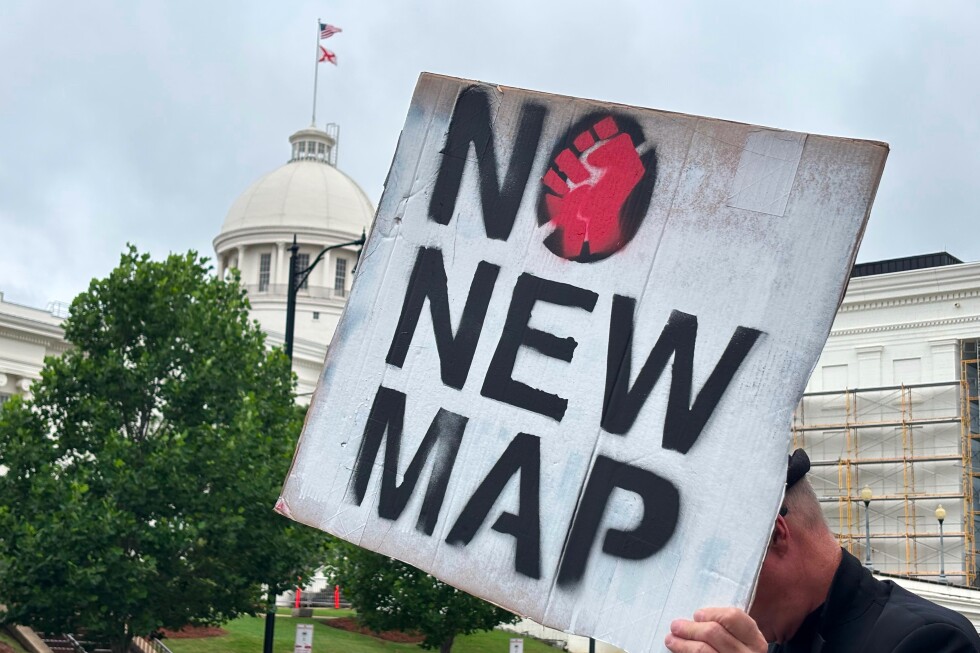
In a significant legal development, Alabama’s attempt to alter its congressional map, potentially benefiting Republicans in upcoming elections, has been thwarted by federal judges. This decision marks a pivotal moment in the state’s ongoing redistricting battle, emphasizing the contentious issue of race-based gerrymandering in the United States.
A trio of judges issued a preliminary injunction against Alabama’s proposed map, citing intentional racial discrimination due to the map’s design, which included only one district with a Black majority. Instead, the judges mandated the use of a court-ordered map for the 2024 elections, which provides for two districts where Black residents are a majority or nearly so.
The judges expressed their concern, stating, “Ultimately, we cannot see our way clear to requiring Alabamians to cast their votes in the 2026 elections under a districting plan tainted by intentional race-based discrimination.”
This ruling is a setback for the Republican Party, which aimed to use the new map to potentially reclaim a seat currently held by Democratic U.S. Rep. Shomari Figures.
Alabama’s Attorney General Steve Marshall, a Republican, announced plans to appeal to the U.S. Supreme Court, arguing that the judges’ decision lacked justification. He described the blocked map as “blandly unobjectionable.”
“Know this — in my mind, it is not a matter of whether we win this case, only when,” Marshall stated emphatically.
On the other hand, Rep. Figures welcomed the court’s decision, noting, “This is a significant step in the right direction, but there is still a long way to go before this fight is settled.”
This legal decision is part of a broader narrative following the U.S. Supreme Court’s ruling that weakened the federal Voting Rights Act, affecting multiple Southern states like Alabama and Louisiana. This decision has catalyzed Republican efforts to redraw districts with significant minority populations that traditionally support Democrats.
Alabama’s Redistricting Dispute: A Longstanding Issue
The controversy over Alabama’s congressional districts has persisted for several years. In 2023, a court found that the map designed by Republican state legislators diluted Black citizens’ voting power. Given that the state’s Black population is around 27%, the court insisted on a map with two districts where Black voters were in the majority or close to it, which was utilized in 2024.
Following a U.S. Supreme Court ruling regarding Louisiana’s districting, Alabama officials sought to implement their 2023 map. The Supreme Court allowed the injunction against this map’s use to be lifted but required further review by the three-judge panel.
During a recent hearing, the panel identified “undisputed evidence” of racial discrimination and decided that the special primaries should proceed with the previously approved districts.
The judges emphasized that using the existing districts would prevent a costly and complex voter reassignment operation, noting, “Candidate and voter confusion is troublesome and warrants significant consideration, but we do not see that a preliminary injunction will worsen it. To the contrary, we expect a preliminary injunction to lessen it.”
Deuel Ross, representing the NAACP Legal Defense Fund, stated that the ruling “again vindicated the constitutional rights of voters in the Black Belt, and our clients look forward to voting under a fair map this fall.”
Implications Beyond Alabama: A National Redistricting Trend
Other states have also reviewed their primary schedules to accommodate the need for congressional redistricting following the Supreme Court’s decision. For instance, Louisiana postponed its congressional primaries originally set for May 16 to later in the summer to re-evaluate its U.S. House map.
In South Carolina, state legislators are contemplating holding new primaries in August to potentially bolster Republican representation. Meanwhile, Tennessee quickly enacted new district boundaries after the Supreme Court’s decision, which could enable Republicans to capture all nine seats in the state, impacting Memphis’ previously Black-majority district and allowing new candidates to enter the race.
Since former President Trump’s call for redistricting in Texas, several Republican-led states have adopted new voting maps, albeit some face legal challenges. Democrats are countering by redrawing districts in states like California and anticipate gains in Utah from court-mandated district changes.