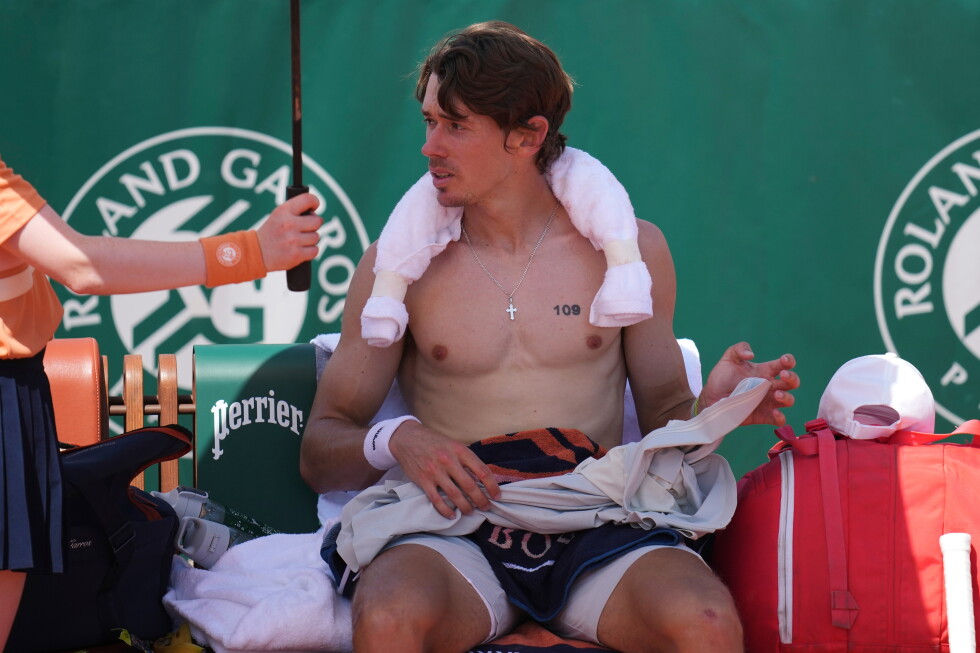
The French Open at Roland Garros is witnessing unprecedented heat levels, reminiscent of the scorching conditions during the 2024 Paris Olympics. Players and spectators alike are grappling with temperatures soaring to 33 degrees Celsius (91 Fahrenheit), much higher than typical for late May in Paris.
Such intense heat is altering the dynamics of the clay-court Grand Slam in its first week, affecting both comfort and gameplay. Iga Swiatek, a four-time French Open champion, remarked on the challenge, noting the difference in conditions compared to the Olympics, despite the use of different balls back then. “It is much different. Maybe it was that hot in the Olympics but the balls were different, so I wouldn’t treat it as the same tournament,” she explained after her first-round victory over Emerson Jones.
To cope, players are using ice packs during breaks, while fans find relief under sprinklers. Even the workers watering the courts are occasionally dousing eager spectators. Daria Kasatkina, who advanced past Zeynep Sonmez, acknowledged the toll of the heat, saying, “You can suddenly just get out of the bench and feel that your focus dropped. So this is a battle which you have to also win. … Whoever adapts better to today’s conditions gets it.”
A retirement and medical timeout
The extreme weather claimed its first casualty when Canadian Gabriel Diallo retired during his match against James Duckworth, citing the oppressive heat. Similarly, Andrey Rublev and Ignacio Buse both required medical attention during their lengthy contest. Buse took a medical timeout to replenish salts and minerals, while Rublev sought treatment later. The extreme conditions also affected a ball girl, who needed assistance off the court.
Heat protocol
While the French Open is generally cooler than the Australian Open and U.S. Open, it has implemented an extreme weather policy akin to these tournaments. Matches may see 10-minute cooling breaks if the Wet Bulb Globe Temperature (WBGT) hits 30.1 degrees Celsius (86 Fahrenheit). Play is suspended if the WBGT surpasses 32.2 degrees Celsius (90 Fahrenheit), which corresponds to an air temperature of about 38 degrees Celsius (100 Fahrenheit).
Fast-court players like the heat
Not all players are troubled by the heat; some see it as an advantage. Australian Alex de Minaur, after defeating Toby Samuel, commented on the favorable conditions for aggressive play, “I’ve always preferred hot and lively conditions to chilly on a clay court, because I feel like I can bring a little bit more of my all-court tennis on this type of surface.”
American Alex Michelsen, who bested Alexander Shevchenko, echoed this sentiment, appreciating the speed of the game under such conditions. “It’s definitely good for us Americans,” Michelsen stated. “Generally we’re big serve, big forehand, big ground game and like to play offense. When it’s super hot, the ball is moving through the air very fast. … I was so happy when I saw the forecast.”
For more updates on tennis, visit AP Tennis.