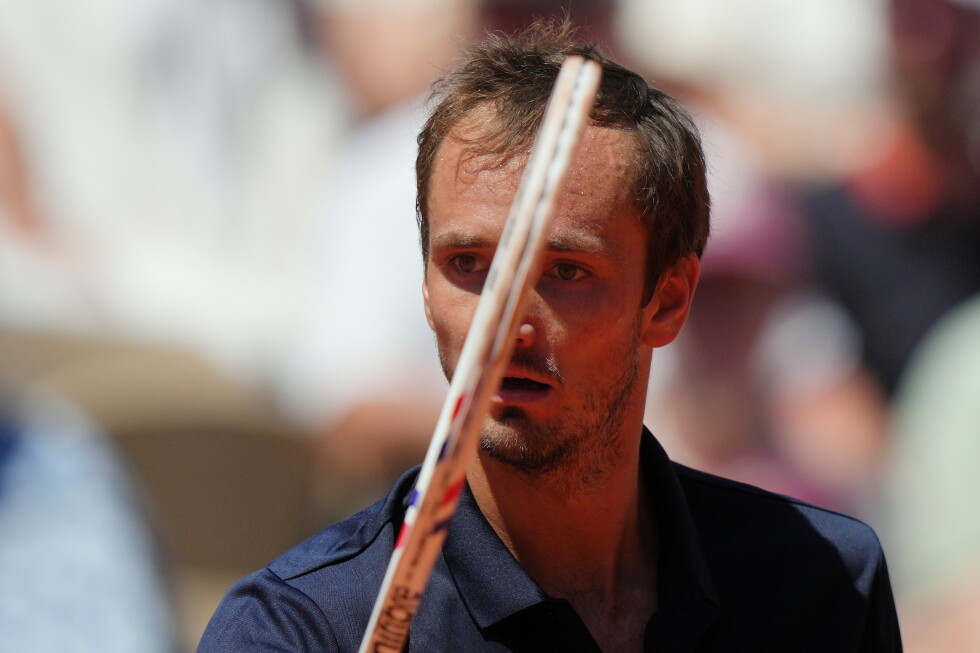
As the French Open intensifies the global tennis scene, emotional outbursts on the court are becoming a focal point. With the season in full swing, instances of players losing their temper, such as during the recent performances of Daniil Medvedev and Daniel Altmaier, are drawing attention.
Mental resilience is a critical factor in tennis, a sport where players often find themselves grappling with their emotions. Russia’s Daniil Medvedev and Germany’s Daniel Altmaier have recently made headlines for their on-court frustrations, a phenomenon not unfamiliar to tennis enthusiasts who recall the fiery temperament of John McEnroe.
What triggers these emotional eruptions? Former top-five player Andrey Rublev, known for his own bouts of anger, explains: “It’s not about tennis… It’s just the thing (in) tennis you are alone and they are watching you.” Rublev’s coach, Marat Safin, notably confessed to breaking 1,055 rackets during his career.
Medvedev, who has a similar temperament, recently faced a remarkable defeat at the Monte Carlo Masters, losing 6-0, 6-0 to Matteo Berrettini. His frustration peaked as he smashed his racket multiple times on the clay before discarding it in a nearby trash bin. “When I broke the racket, I kind of didn’t (want to),” Medvedev admitted, reflecting on the moment. The incident highlighted his struggle to regain composure during the match.
At a tournament in Hamburg, Altmaier’s temper also flared as he smashed his racket and kicked it into the stands, narrowly avoiding harm to spectators.
Federer, Serena, and Djokovic: Emotional Journeys
Even legends like Roger Federer, Serena Williams, and Novak Djokovic have had their moments of emotional volatility. Federer, once prone to racket-smashing as a junior, matured into a paragon of composure. Serena, in contrast, famously faced penalties at the 2009 U.S. Open for an outburst, while Djokovic was disqualified from the 2020 U.S. Open after accidentally hitting a line judge with a ball.
Sabalenka’s Battle with Emotions
Top-ranked Aryna Sabalenka has worked hard to control her on-court emotions. “My emotions were destroying my game,” she confessed, acknowledging the need for emotional control to improve her performance.
Other players, like Coco Gauff and Jessica Pegula, prefer to handle their frustrations away from the public eye. Pegula shared, “I go find some place that’s like maybe not near people and then I can break a racket.”
Quiet Control: The Case of Osaka
Naomi Osaka, known for her calm demeanor, revealed a shift from her earlier years when she struggled with her attitude. She now manages her frustrations discreetly: “I actually do curse a lot on the court,” she said, adding that she does so quietly to avoid penalties.
Sorana Cirstea, recently breaking into the top 20, succinctly summarized the emotional struggles faced by tennis players: “It’s such a mental sport. Also, to be able to sustain that mentality for three long hours with all the adrenaline and the pressure, sometimes you don’t handle it the best. We are human.”
For more tennis news, visit AP Tennis.