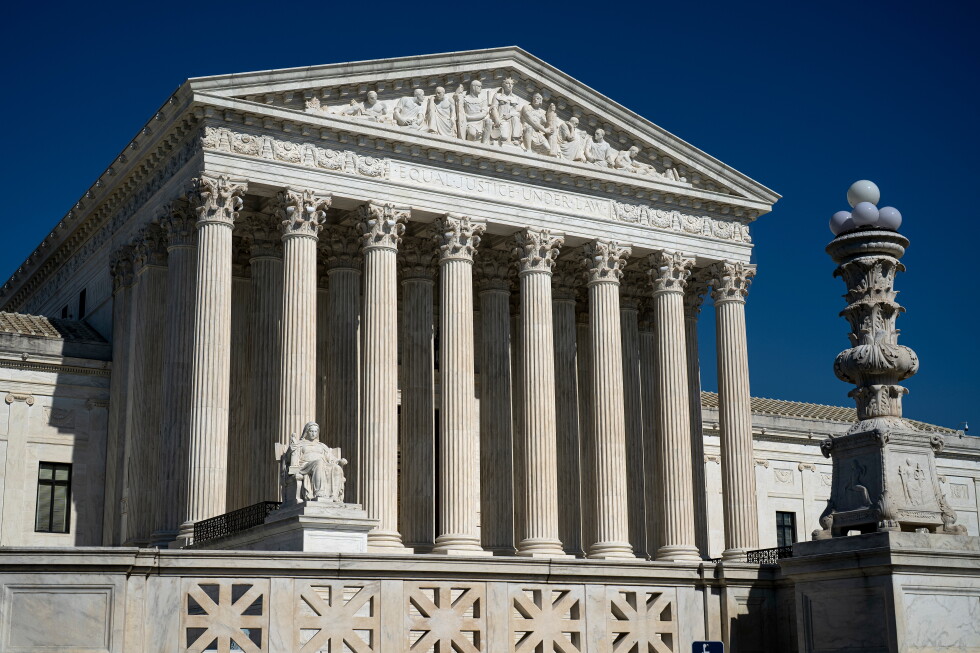
Alabama has turned to the nation’s highest court with a request to employ a congressional map that critics argue favors Republicans, despite a lower court’s determination that the plan discriminates against Black voters. The state’s leaders are pushing for this map to be used in the upcoming elections.
An emergency appeal was filed by Alabama’s Republican officials with the Supreme Court following a three-judge panel’s decision. The panel had earlier refused to permit the state to use a map drawn three years ago, which has a Black majority in only one out of seven congressional districts. Instead, Alabama was directed to use a map established by the court for the 2024 elections, which features two districts with a Black majority or nearly so.
Alabama Attorney General Steve Marshall insisted that the state did not engage in intentional discrimination against Black residents and advocated for elections to be conducted with a map devised by lawmakers rather than judges.
This appeal is part of the ongoing consequences from a recent Supreme Court ruling that struck down a Black-majority district in Louisiana, thereby impacting the federal Voting Rights Act. The decision has prompted Republicans in several Southern states, including Alabama, to revisit the configuration of voting districts with significant minority populations traditionally electing Democrats.
The current redistricting efforts are part of a broader Republican initiative, supported by former President Donald Trump, aimed at maintaining their slim majority in the House for the upcoming elections.
The legal battles over Alabama’s congressional maps have spanned several years. In 2023, a three-judge panel found that the map created by Republican lawmakers diluted Black voting strength intentionally. Given the state’s demographic makeup, with roughly 27% of its population being Black, the court ruled that there should be two districts where Black voters are the majority or nearly so. This court-determined map was used in 2024.
Following the Supreme Court’s decision in the Louisiana case, Alabama sought to implement the 2023 state-drawn map. The Supreme Court’s conservative majority agreed to lift the block on this map’s use, remanding the case to the three-judge panel for reevaluation in light of the Louisiana ruling.
During this interim period, Alabama held its primaries on May 19, and Republican Governor Kay Ivey scheduled new special primaries for August 11 in the affected districts.
Upon further consideration, the judicial panel reaffirmed its initial stance that there was “undisputed evidence” of intentional racial discrimination, a conclusion that was independent of the Supreme Court’s ruling on the Voting Rights Act. Consequently, it ordered that the special congressional primaries proceed under the previously approved court districts.
The court-established map facilitated the election of U.S. Rep. Shomari Figures, a Black Democrat, in 2024. However, state Republicans are advocating for a map that would potentially allow the GOP to reclaim a congressional seat in southern Alabama.
Alabama is requesting the Supreme Court’s intervention by Monday as it gears up for the August special vote.
For further information on the U.S. Supreme Court, visit AP’s Supreme Court coverage.