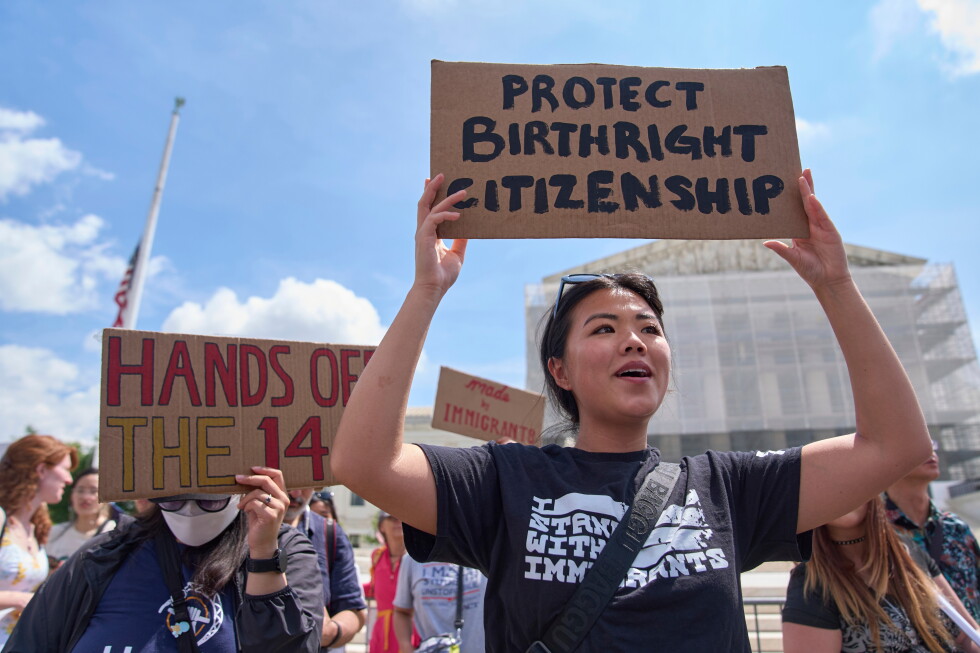
The debate over birthright citizenship in the United States, a topic that has sparked significant controversy, is set to reach the Supreme Court. As the Trump administration challenges this long-standing principle, the nation watches closely.
According to Donald Trump, the practice of granting automatic citizenship to those born on U.S. soil is “a disgrace.” Similarly, Stephen Miller, a prominent White House adviser, labeled it “the gravest and most preposterous of all constitutional abominations.” Meanwhile, Vice President JD Vance described it as “the dumbest immigration policy in the world” during a 2025 statement.
Trump has often claimed that the United States is unique in its practice of birthright citizenship, a statement that has been repeatedly debunked. In a recent interview, he reiterated this false assertion.
The Historical Foundation of Birthright Citizenship
Since the ratification of the 14th Amendment in 1868, birthright citizenship has been a fundamental aspect of U.S. law, originally intended to secure citizenship for former slaves. The landmark case of Wong Kim Ark further extended this right to children born to immigrants. Subsequent rulings have affirmed that all individuals born in the U.S. are citizens, with few exceptions, such as children of foreign diplomats.
For many years, this principle was not seen as contentious. Even Republicans, including former President Ronald Reagan, have historically embraced immigration’s contributions to American society. At a 1984 naturalization ceremony, Reagan acknowledged the efforts of new immigrants, stating, “And all of them have added to the sum total of what your new country is.”
The Current Controversy and Supreme Court Involvement
Opposition to birthright citizenship has become a central theme in Trump’s campaign narrative, especially amidst rising concerns over illegal immigration. Trump argues that birthright citizenship serves as a “magnet for illegal immigration,” citing networks that facilitate “birth tourism” for non-citizens seeking U.S. citizenship for their children. Legal disputes have emerged over the interpretation of the 14th Amendment’s “subject to the jurisdiction thereof” clause, with some advocating that it allows denying citizenship to children of illegal immigrants.
During recent Supreme Court deliberations, even conservative justices have raised questions about this legal interpretation, indicating a complex path ahead for the administration’s challenge.
Global Perspectives on Birthright Citizenship
Contrary to Trump’s assertions, the U.S. is not alone in practicing birthright citizenship. While the norm globally is to tie citizenship to parentage, numerous countries, especially in the Americas, offer unrestricted birthright citizenship. Examples include Canada, Mexico, and several Central and South American nations. Other countries, such as Germany and Australia, employ a combination of factors to determine citizenship, including birthplace and parental nationality.
___
For more fact-checking resources, visit AP Fact Checks.