China’s PL-16 Missile: A New Player in Air-to-Air Warfare
In a rapidly evolving landscape of military technology, China’s latest air-to-air missile, the PL-16, emerges as a potential game-changer in the Asia-Pacific region. With its enhanced range and advanced propulsion system, this missile could offer the People’s Liberation Army a significant advantage in potential conflicts, according to defense experts.
The PL-16, a beyond-visual-range missile, is poised to compete with the U.S. military’s AIM-260 Joint Advanced Tactical Missile (JATM) developed by Lockheed Martin. Analysts suggest that the PL-16 improves upon China’s earlier missile generations, featuring an estimated flight distance between 200 and 300 kilometers (124 to 186 miles) and incorporating a dual-pulse or variable-thrust rocket motor. This technology enables a secondary burst of speed, enhancing its effectiveness in long-range engagements.
Lockheed Martin’s JATM is also designed for extended flight distances beyond visual range, with expectations of reaching at least 200 kilometers. The PL-16’s capabilities, particularly its ability to target large, slower-moving aircraft, could significantly alter the dynamics of aerial combat. Malcolm Davis, a senior analyst at the Australian Strategic Policy Institute, emphasizes the importance of maneuverability and guidance at extended ranges. He notes that the PL-16 aims to neutralize critical airborne assets such as early warning and control platforms, refueling tankers, and reconnaissance aircraft.
“The People’s Liberation Army Air Force’s strategy here is clear – take out the key combat enablers for the U.S. Air Force and the U.S. Navy, as well as allied forces, and the U.S. and its allies can no longer project naval air power,” Davis remarked.
The development of the PL-16 highlights an ongoing race between China and the U.S. in the realm of beyond-visual-range air-to-air missiles. The speed at which each country can produce and deploy these technologies is crucial. “The JTAM was a response to the PL-15, so there is an interesting race between China and the U.S. on beyond-visual-range air-to-air missiles underway,” Davis added. “The key challenge is how quickly the U.S. can get JATM into production, because the Chinese will be moving very fast with PL-16 production.”
The geopolitical implications of such advancements are significant, particularly concerning long-standing tensions around Taiwan and territorial disputes in the South China Sea. U.S. military bases in Guam, Hawaii, and Japan remain strategically important in the event of an Indo-Pacific conflict.
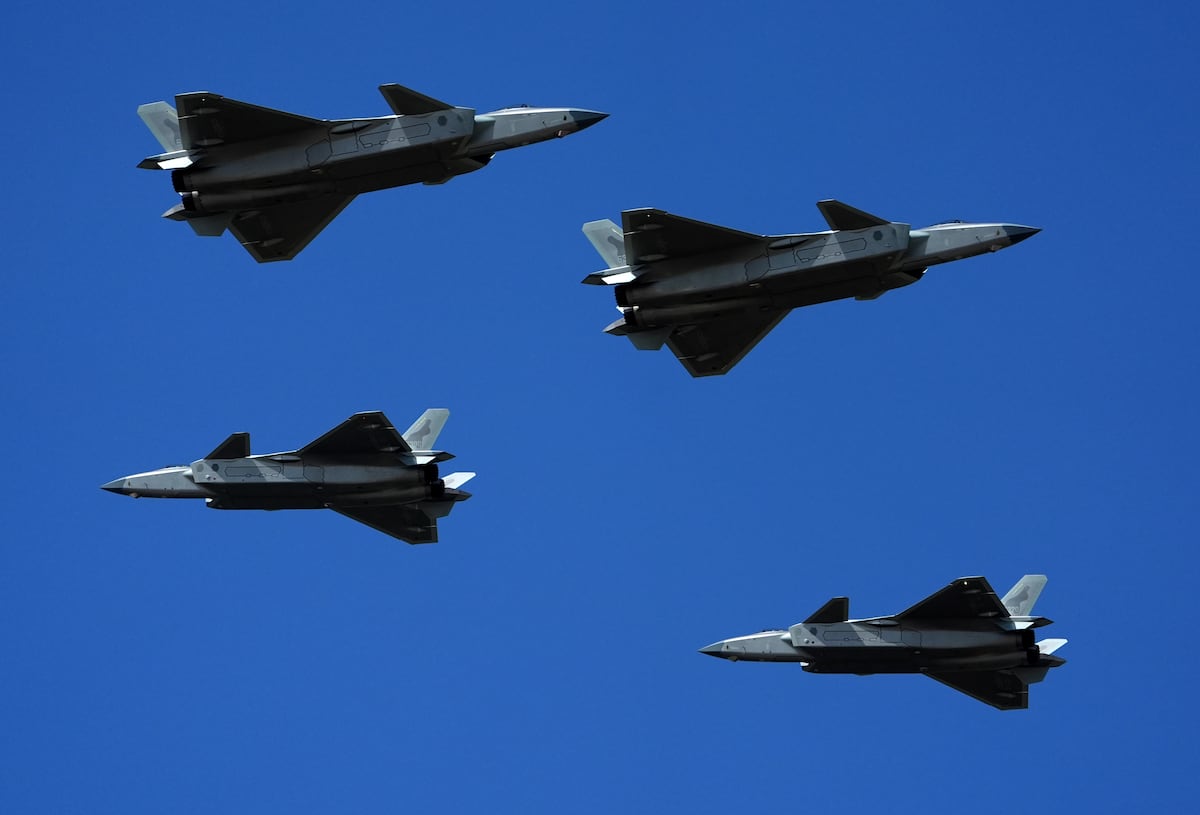
Enrico Cau, an associate researcher at the Taiwan Strategy Research Association, expressed concerns about the PL-16’s impact on larger aircraft like the B-52 bomber, though he remains uncertain about its effectiveness against smaller, more agile platforms. The missile’s design allows it to fit within the weapon bays of Chinese stealth fighters such as the J-20 and the forthcoming J-35.
According to Huang Chung-ting, an associate research fellow at the Institute for National Defense and Security Research in Taipei, a J-20 equipped with PL-16s could engage more targets and sustain longer combat operations. “This means a J-20 can engage not only one or two more targets but also has a greater capacity to remain in the combat zone after the initial attack, rather than having to retreat after running out of missiles,” Huang explained.
Despite the lack of official confirmation from Beijing regarding the PL-16’s development, analysts rely on leaked information, including images from a Chinese military aviation seminar. A post on Imgur.com describes the missile as being four meters long, with a diameter of 203 millimeters, and weighing 200 kilograms. The PL prefix stands for “Pi Li,” meaning “thunderbolt” in Chinese.
The PL-16 follows the PL-15, which has been in service for over a decade and can travel 200 kilometers—twice the range of its predecessor, the PL-12, and more than three times that of the PL-11. While Huang acknowledges the potential of a new air-to-air weapon, he cautions that current online information does not fully verify the PL-16’s specifications or confirm its operational status.
As the development and deployment of these advanced missile systems progress, the balance of aerial military power in the Asia-Pacific region may be poised for a significant shift.