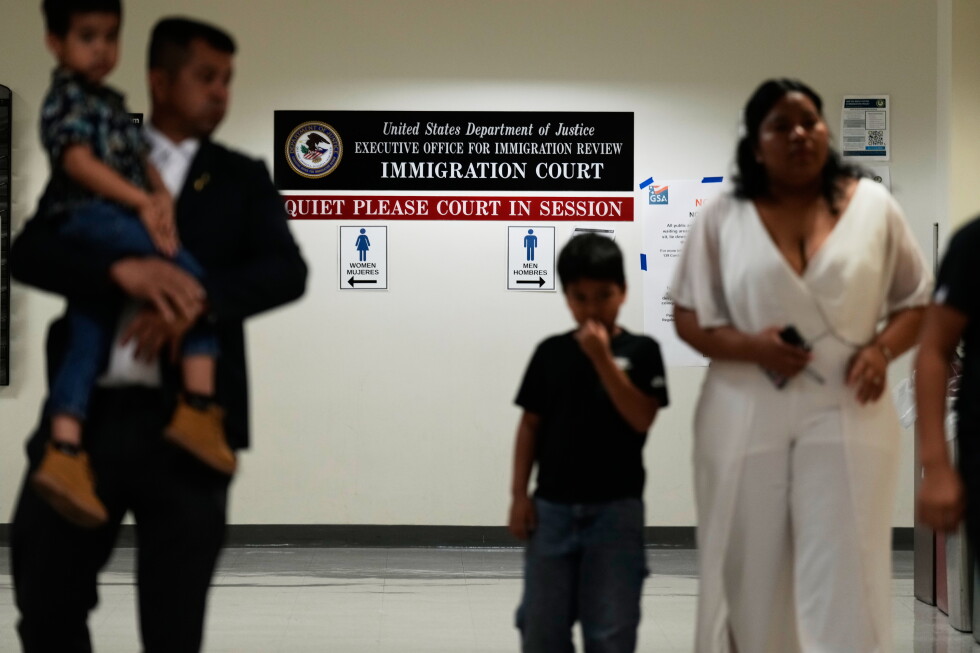
Facing monumental backlogs, the U.S. immigration courts are resorting to expedited processes, leading to an unprecedented rise in immigrants missing hearings and receiving immediate deportation orders. The Trump administration’s measures to alleviate decades-old delays have resulted in a significant number of no-shows at these hurried court sessions.
Immigration judges across the nation are handling extensive workloads, with some days seeing “mega” master hearings where dozens to hundreds of cases are assigned to individual judges. June witnessed more than 1,300 such hearings, a nearly threefold increase from the same month the previous year, according to Mobile Pathways, a nonprofit organization that monitors immigration court data.
Amidst this accelerated pace, the time granted for immigrants to prepare for their legal proceedings has drastically reduced, often leaving them with just over a month instead of the usual six months. Consequently, many are missing their scheduled hearings, leading to deportation orders and the abandonment of any asylum claims.
Bartlomiej Skorupa, chief operating officer of Mobile Pathways, remarked, “The combination of collapsed lead times and packed hearing blocks is a schedule designed for people not to have their case heard. The data shows valid claims are closed before being adjudicated.”
Proponents of stringent immigration policies view these quick hearings as necessary to address longstanding procedural issues. Andrew Arthur from the Center for Immigration Studies stated, “There’s no credibility in the system that never reaches an end,” though he expressed concern about potential impacts on judicial performance, warning, “You don’t want to put so many cases on that the judges get burned out or that there’s a danger of denying due process to anybody.”
Immigration courts under pressure
On “mega” hearing days in Harlingen, Texas, attendees, including immigrants, their families, and attorneys, often wait outside for hours before entering the crowded courtrooms. Detained children are escorted by shelter case managers and legal advocates. Although not a new practice, such hearings have become more frequent since mid-May.
In a recent session, Judge Delia Gonzalez had around 90 cases scheduled, with over 20 individuals not appearing. Despite the no-shows, she couldn’t address all cases within the day, rescheduling those who had been waiting for over eight hours. Former immigration judge Elizabeth Young commented, “There’s a real limit to how many cases a judge can hear with any care in one morning. When you cram that many hearings into a single docket, you’re working through a list, not holding court.”
Some immigrants, including those defrauded by unreliable attorneys or lacking legal representation, sought more time to prepare but were denied. A Colombian asylum seeker, who had presented over 1,500 pages of evidence, was among those whose request for additional time was declined. Most hearings concluded in under five minutes.
No tolerance for absenteeism
In West Valley City, Utah, Judge Brock Taylor was assigned 159 cases in one day. By noon, he had ordered the removal of multiple individuals from various countries who failed to appear, citing proper notification. In Chicago, attorney Peter Meinecke recounted a case where his client was issued a removal order after missing a hearing due to an accident that left him wheelchair-bound.
Mobile Pathways reported that the rate of missed hearings doubled from 20% to 40% between January and June 2025. Deportation orders have surged, with nearly 79,000 issued this June compared to 33,000 in January. Once issued, a deportation order often leads to asylum claims being deemed “abandoned.” The current rate of abandoned cases is almost five times the historical average, with New York and Chicago experiencing even higher rates.
Katie Fleming from the Acacia Center for Justice warned, “That’s a recipe for disaster, because more people are going to be ordered removed in absentia who truly have a valid case.”
In some instances, deportation orders have been issued to individuals present in the court building but unsure of where to seek assistance, as noted by Alex McGriff from the National Immigrant Justice Center.
Backlog reduction versus rising caseloads
Advocates for more efficient immigration processes argue that the current strategy saves time and reduces backlogs. Arthur stated, “It really is economizing the judge’s time. It is increasing the number of final orders that are going out, so that’s decreasing the backlog entirely.” For the first time in a decade, the backlog has decreased, with pending cases dropping from 3.7 to 3.5 million in fiscal year 2025.
However, attorneys like Jaime Diez in Brownsville, Texas, are struggling to keep up with the intensified pace, often handling significantly more cases than before. Diez expressed concern, saying, “Due process is being thrown out of the window. It’s very worrisome, I don’t know how long it’s going to last.”