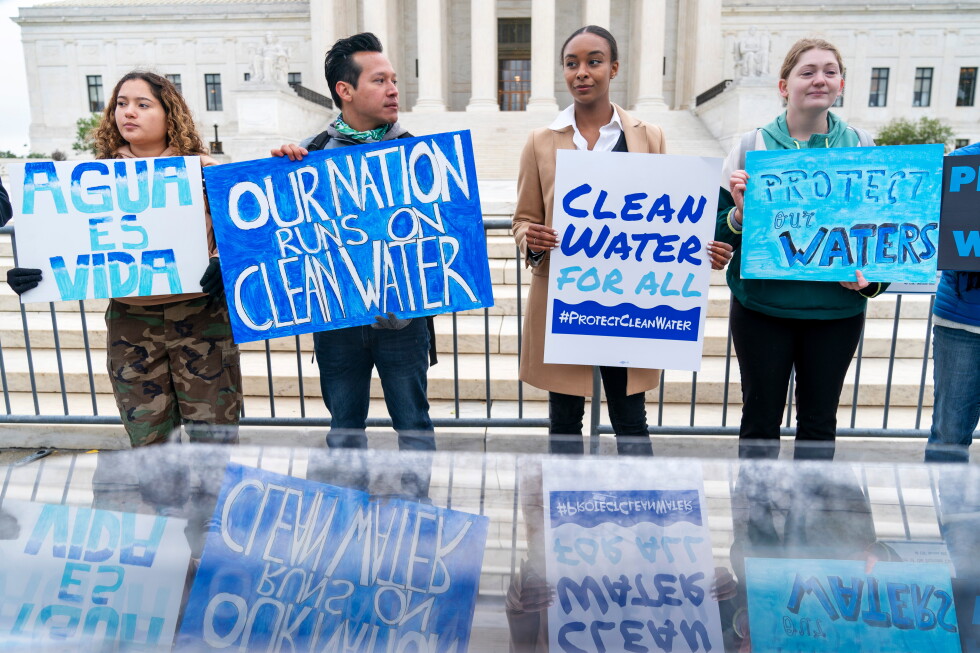
In a pivotal legal challenge, conservative legal activists, aligned with Elon Musk’s AI company, are questioning a fundamental aspect of U.S. law enforcement: the ability of private entities, individuals, and local authorities to bring lawsuits for breaches of significant laws. Their contention, backed by the Trump administration, is rooted in the belief that the Constitution grants the president and federal agencies the exclusive right to enforce federal laws, a power they argue Congress should not have delegated through citizen suits embedded in environmental and other laws.
Environmental advocates warn against losing this decades-old mechanism crucial for imposing penalties and curbing illegal activities. For instance, citizen suits have been instrumental in securing millions from major polluters and ensuring the removal of lead pipes in Flint, Michigan, following its water crisis.
Currently, four federal cases, including one recently filed, are advancing as the conservative majority in the Supreme Court increases the likelihood of success for those opposing citizen suits. Their strategy is to win initial federal cases and create appellate court disagreements to persuade the Supreme Court of the issue’s national significance.
A Supreme Court Poised to Revisit Citizen Suits
The potential for the Supreme Court to take up this matter has been anticipated since a 2000 opinion that invited such a challenge. Richard Lazarus, a Harvard professor specializing in environmental law, remarked, “Many of us who worked in this area have been waiting basically 26 years for this shoe to drop.”
Lazarus referenced past comments by Justice Anthony Kennedy, who highlighted in a Clean Water Act case the complex issues citizen suits pose regarding executive power. Similarly, Justice Antonin Scalia had critiqued these suits for delegating law enforcement to private citizens without explicitly questioning their constitutionality.
The debate centers on who should collect penalties and have control over enforcement—the government or private citizens. The government can preempt a citizen suit by taking sufficient action itself, though citizen involvement can persist. Penalties from such suits are directed to the U.S. Treasury.
Challenges from Prominent Legal Entities
Efforts to centralize enforcement powers have intensified, receiving crucial federal backing. The Pacific Legal Foundation, having succeeded in recent Supreme Court cases, is spearheading a constitutional challenge through a Tennessee federal court case involving the Clean Water Act and the town of Springfield.
Sean Radomski, representing the Pacific Legal Foundation, argued that government accountability is compromised when unelected activists frequently instigate legal defenses. His focus is on suits where fines benefit the Treasury, contrasting with civil rights cases where damages are awarded directly to victims.
Elon Musk’s AI Company Enters the Legal Arena
Musk’s xAI is similarly contesting a lawsuit by the NAACP over unpermitted gas turbines near Memphis. Supporting Musk’s company, the Trump administration argues that disabling the AI, crucial for national security, is not a prudent enforcement action.
Earthjustice, representing the NAACP, criticized the administration for prioritizing company operations over legal compliance. Laura Thoms from Earthjustice noted the administration’s stance as an unprecedented veto against citizen suits.
Implications of Legal Changes on Environmental Protection
Citizen suits were integrated into environmental laws recognizing the federal government’s limited resources and potential conflicts of interest as a polluter. This external enforcement is deemed essential, especially under an administration that has weakened environmental protections and constrained enforcement to critical scenarios.
Thoms warned of increased corruption risks if the president gains unilateral enforcement power, potentially favoring allies. She stressed that without citizen suits, vulnerable communities would lack recourse against local pollution, emphasizing the broader societal impact.
With the Supreme Court’s current composition, some experts like David Adelman of the University of Texas School of Law now consider the success of these challenges plausible, reflecting the court’s inclination to uphold extensive executive control over federal law implementation.
___
The Associated Press receives support from the Walton Family Foundation for coverage of water and environmental policy. The AP is solely responsible for all content. For all of AP’s environmental coverage, visit https://apnews.com/hub/climate-and-environment