French Military Seeks Innovation on the Modern Battlefield
The landscape of warfare is shifting rapidly, as the French Army’s Future Combat Command explores innovative strategies to regain tactical advantage amidst increasing battlefield transparency. Gen. Bruno Baratz, the head of the command, emphasizes the need to reintroduce “opacity” to counteract the effects of modern surveillance and weaponry.
Challenges of a Transparent Battlefield
Modern warfare technologies have transformed the battlefield into a perilous “zone of death,” with powerful weapons and continuous observation making offensive maneuvers exceedingly risky, according to Baratz. This situation echoes the tactical gridlock of World War I, where advancements in artillery and machine guns limited maneuverability at a great cost.
Both Ukraine and Russia have experienced a halt in maneuvering along their frontlines due to persistent drone surveillance, which exposes forces to potential destruction when they attempt to amass.
Exploring Deceptive Tactics
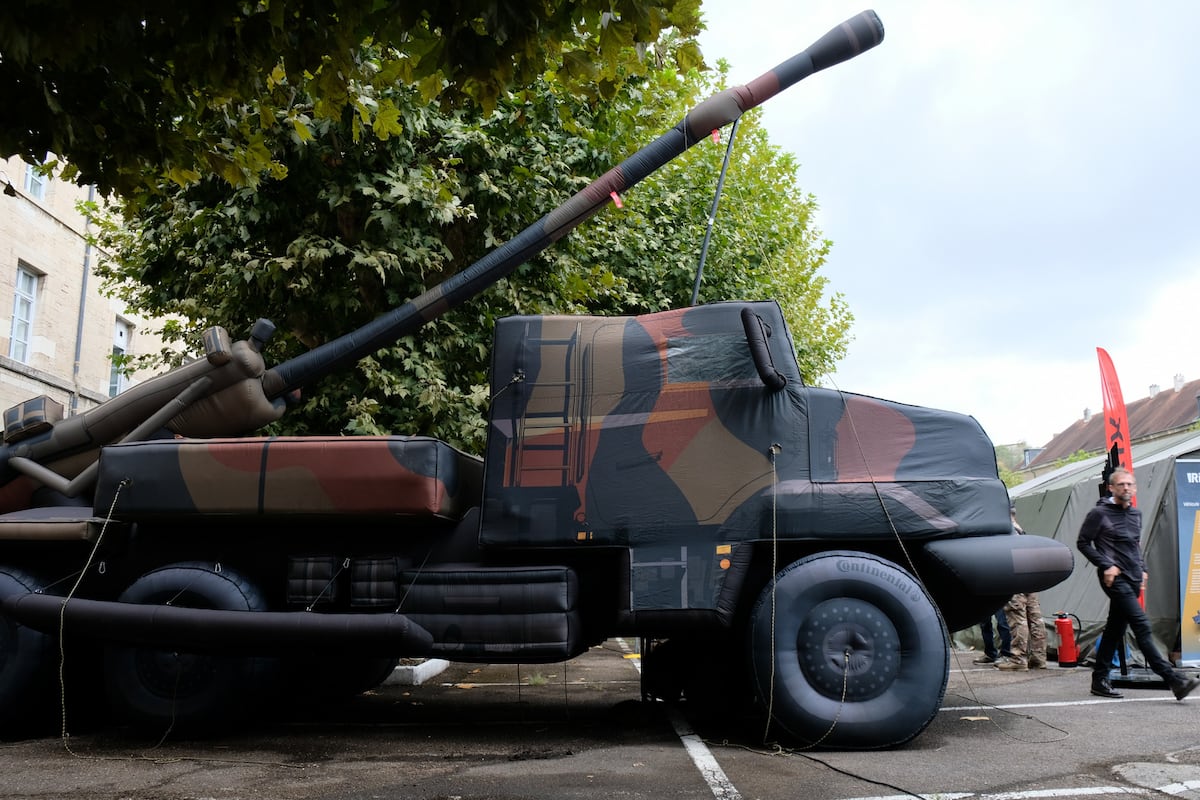
To address these challenges, the French Army is investigating various forms of deception, such as physical decoys and electromagnetic manipulation. During a recent innovation day at the 7th Armored Brigade in Besançon, inflatable replicas of military equipment, like the Caesar howitzer and VBL light armored vehicle, were showcased as part of these efforts.
Baratz highlighted the significance of electronic and cyber warfare in disrupting adversaries’ operations. He posed critical questions: “How can we blind the adversary? How do we mislead him about our intentions?”
Technological Innovations on the Horizon
Emerging technologies, including quantum communications and multi-spectral image analysis, offer promising avenues to counteract battlefield transparency. These advancements, often driven by artificial intelligence, could revolutionize military operations in ways previously unimaginable.
Despite rapid technological progress, the military faces challenges in keeping pace with civilian telecommunications advancements, particularly in bandwidth and data transmission capabilities.
Adapting to Rapid Change
The Future Combat Command is shifting away from traditional top-down approaches, encouraging regiments to experiment with new technologies. This grassroots innovation strategy is supported by “subsidiarity credits,” with increased funding planned in the 2027 defense budget.
Baratz mentioned that the military is exploring areas like robotics, autonomous vehicles, and battlefield-energy generation, partnering with companies to develop technologies such as electric scooters and motorcycles.
Embracing the Unknown
As technological advancements continue at an unprecedented pace, the potential shape of future combat remains uncertain. Baratz encapsulated the sentiment of the evolving battlefield: “All of this is the combat of the future. It’s the future combat that remains hard to imagine, because technology is moving so quickly that I’m incapable of telling you what things will look like in one or two years.”