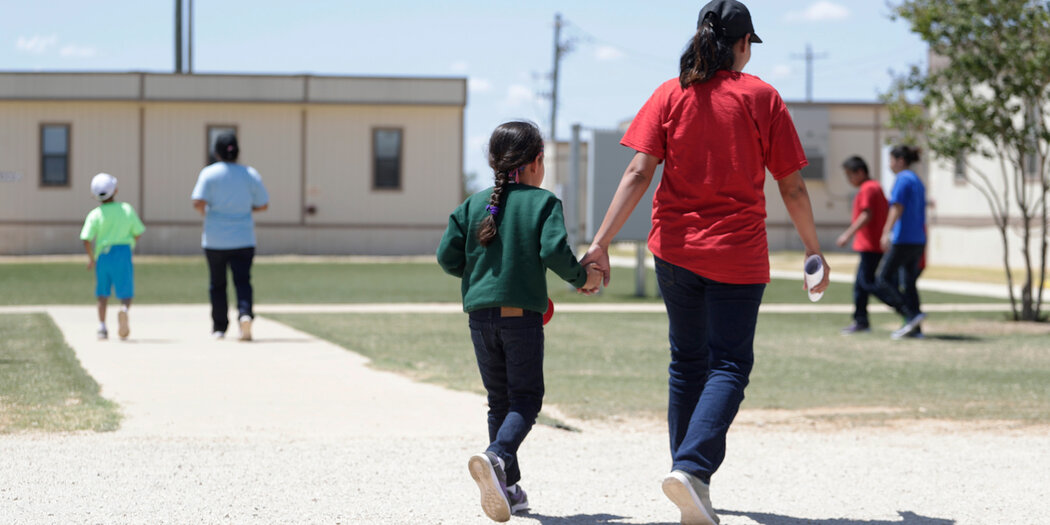
With a sweeping budgetary decision, Congress has allocated a monumental $45 billion for the construction of new immigration detention centers in the U.S., including facilities designated for families. This increase in detention capacity emerges amidst growing concerns over the conditions undocumented children face while in detention.
The budget bill’s implications extend to the treatment of families undergoing deportation proceedings, raising questions about the Flores settlement, a 1997 legal agreement that dictates the care of immigrant children in U.S. custody.
Does ICE put families into detention?
Under the Biden administration in 2021, the practice of detaining families with children was largely ceased, favoring alternatives to detention like electronic monitoring and case-management programs. These alternatives proved effective, with a reported 99 percent compliance rate among families during immigration check-ins, while also being less costly compared to traditional detention.
The Trump administration, however, is reviving extensive family detention, alongside policy adjustments aimed at increasing the number of immigrant children in federal custody. Changes include ending programs for lawfully paroled individuals and terminating Temporary Protected Status for nationals from several countries. Moreover, the administration has revised its policy to allow arrests in previously off-limits locations like churches, schools, and during immigration court hearings.
Who is in family detention?
In the context of immigration detention, “families” often refer to mothers accompanied by their children, as fathers are typically separated and housed in adult facilities. The detention of children with their mothers has been shown by public health experts to result in adverse physical and mental health effects. Research conducted at Texas’s reopened Karnes County family detention center highlighted issues such as inadequate medical care, malnutrition, and inappropriate mental health evaluations, concluding that “there is no humane way to detain children and no version of family detention that is acceptable.”
Despite these findings, the report acknowledges that children will likely remain in detention and suggests several measures, including providing trained pediatric medical personnel, screening for contagious diseases like tuberculosis and flu, and addressing malnutrition.
Are children in immigration detention receiving adequate care?
Evaluating the treatment of undocumented children in federal custody is challenging due to the administration’s resistance to oversight of detention facilities, including those housing children. Internal oversight offices within the Department of Homeland Security (DHS) have been effectively closed, halting over 500 active investigations. The Office of Civil Rights and Civil Liberties has reported instances of due process violations, inappropriate use of force, and sexual misconduct in ICE facilities.
A DHS spokesperson stated that the Office of the Immigration Detention Ombudsman is being streamlined to eliminate enforcement obstacles. This office, which handled over 10,000 formal complaints annually, also conducted routine inspections of detention facilities to preempt potential issues. Meanwhile, investigations by DHS’s inspector general are experiencing significant delays.
While Congress plays a vital oversight role, the administration has restricted congressional access to these facilities.
What is the Flores settlement?
The Flores settlement is a 1997 legal accord that establishes specific protections for immigrant children in U.S. custody, including:
- Detention duration limited to 20 days for children.
- Prompt release to a family member or responsible adult.
- Safe and sanitary conditions.
- The least restrictive setting feasible for holding children.
- Access to basic necessities like toilets, drinking water, and medical care.
- Appropriate supervision to safeguard minors.
- Contact with family members.
Judge Dolly Gee of the U.S. District Court for the Central District of California oversees the settlement, which requires ICE family detention centers to adhere to ICE’s internal 2020 Family Residential Standards. However, internal DHS watchdogs have investigated allegations of non-compliance with these standards.
Does the Flores settlement still govern the treatment of undocumented children in custody?
The Biden administration enacted new regulations for migrant children in the custody of the Department of Health and Human Services, terminating the Flores settlement for that department’s operations. Nevertheless, terms applicable to ICE remain in effect.
In May, the Trump administration’s Department of Justice moved to terminate the Flores settlement entirely, arguing that new legislation and agency policies render it obsolete. In response, immigration lawyers filed a lawsuit in June to preserve the settlement, citing interviews with detainees that highlight human rights issues. Notably, 40 out of 90 families interviewed by RAICES at detention centers reported medical neglect, including a case of a nine-month-old losing eight pounds in a month.
The newly approved budget bill fails to comply with some of the Flores settlement’s provisions, such as the 20-day detention limit for children.
Who will be responsible for the new detention facilities?
Primarily, for-profit companies will manage these facilities. Even before the legislative increase in detention beds, ICE had contracted with two private prison companies to expand detention capacity for undocumented children and families. Existing centers were set to expand, while previously shuttered locations under the Biden administration would reopen to accommodate increased detention needs. By June 29, 2025, ICE facilities housed 57,861 detainees, a 51% increase from 38,265 in June 2024, resulting in facilities being 45% over capacity. Currently, 90% of detainees are held in centers operated by for-profit firms.
In March, CoreCivic — one of the largest private prison firms — reopened the South Texas Family Residential Center in Dilley, Texas, with the capacity to house 2,400 undocumented immigrants, including many children. Previously, this facility housed families under both the Trump and Biden administrations but transitioned to holding only adults before closing in 2024. CoreCivic is expected to earn $180 million annually from managing the facility.
Additionally, Geo Group, a for-profit firm linked to Trump border czar Tom Homan and Attorney General Pam Bondi, agreed to transition the Karnes County Immigration Processing Center to accommodate mixed populations instead of only adult males. Previously housing families during the first Trump administration, Karnes ceased this practice under Biden. Geo Group projects $79 million in annualized revenue during its first full operational year.