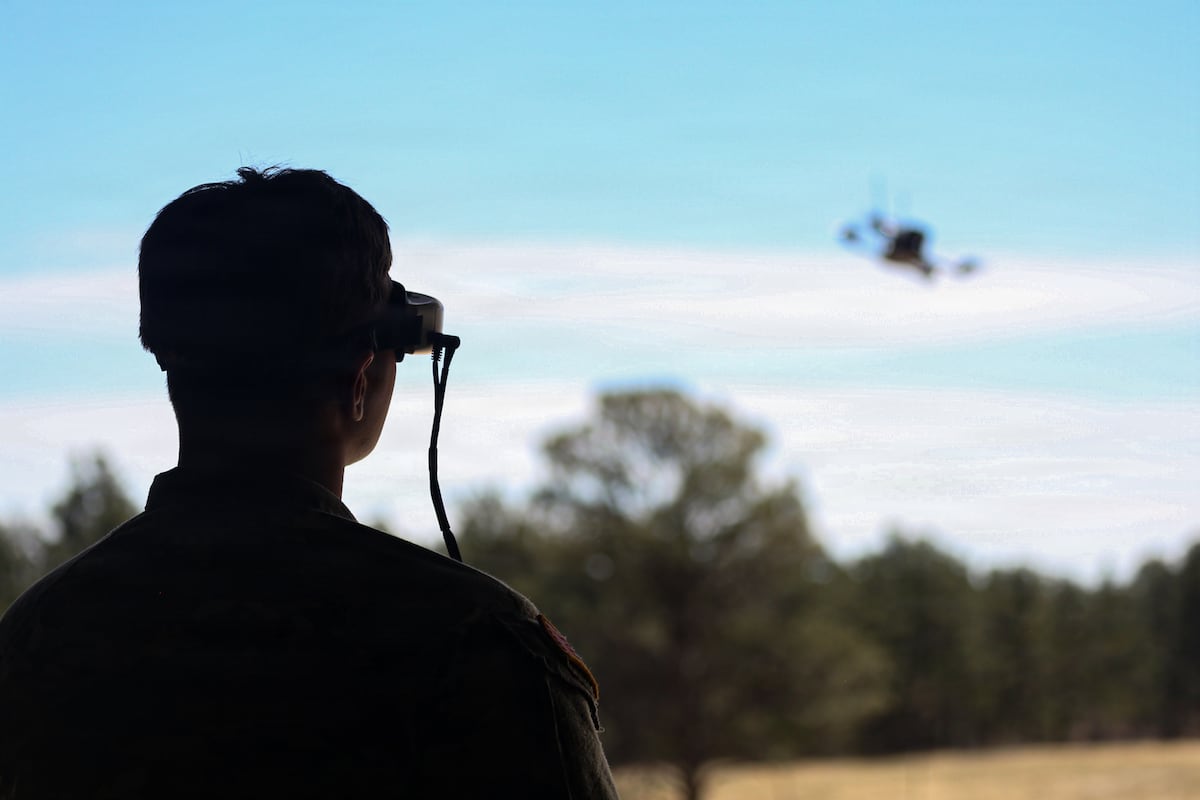
The U.S. Army just ran one of its most unconventional military exercises in recent memory — and it didn’t involve live ammunition. Instead, it asked defense contractors to hack each other, and then put autonomous machines to work talking across those same networks.
Dubbed Operation Jailbreak, the initiative launched in May 2026 and wrapped up in late August. Its goal: tear down the technological walls that have long kept military systems from sharing data with one another in real time. The effort brought together contractors, soldiers, and Army technical experts across two major events, all aimed at accelerating the future of unmanned tactical networks.
When it was over, the Army didn’t hold back on its assessment.
“The completed effort dismantled longstanding system silos, proving that autonomous platforms, sensors, weapons, and command-and-control (C2) technologies can exchange real-time data seamlessly across disparate vendors,”
the Army said in a statement following the final exercise.
How It Started — and Why
The inspiration came from the battlefield in Ukraine. Former Army Secretary Dan Driscoll traveled with then-U.S. Army Europe and Africa Commander Gen. Christopher Donahue to allied training sites in Germany, where they observed how Ukrainian forces had integrated drones, sensors, and shooting platforms onto a single, unified network. What they saw was striking: different systems and technologies communicating without any software barriers — and that seamless data exchange was dramatically speeding up the ability to identify and destroy targets.
That observation became the blueprint for Operation Jailbreak.
The first event, bringing together 600 participants and 50 defense companies, kicked off in May at Fort Carson, Colorado. The three-week exercise had companies attempting to break into each other’s networks while also demonstrating how autonomous systems could communicate across different vendor platforms.
Alex Miller, the Army’s chief technology officer for Operation Jailbreak, explained the core problem the exercise was designed to solve using a relatable analogy.
“Imagine if every accessory you have—light bulbs, toasters, TVs—had a different way to connect,”
Miller said at a May 28 media roundtable.
“You couldn’t just plug the light bulb in; you had to go find a special cord to plug it into the wall.”
Miller argued that this is precisely the situation soldiers have faced for years — forced to act as the human “adapter” between incompatible military systems. The goal of Operation Jailbreak was to make that burden obsolete by enabling machines to handle that communication themselves.
From Exercise to the Field — Fast
The Army moved quickly to translate the hackathon’s results into real-world use. Within 30 days of the first Fort Carson event, the service began fielding system integrations with troops deployed in the U.S. Central Command area of responsibility — a notable turnaround for a military bureaucracy not typically known for speed.
The second and final phase, called Operation Jailbreak Falcon Fury, ran from July 27 to August 28 in Tampa, Florida. That exercise scaled things up considerably: 70 companies participated and more than 150 pieces of technology were put to the test.
Among the major defense contractors that took part was Epirus, which demonstrated how its Leonidas high-powered microwave system — a weapon capable of disabling drones by melting their electronics — could be integrated into a broader command-and-control network alongside other autonomous systems.
The Army’s broader push on autonomous systems comes as the service navigates significant leadership changes. Driscoll, who helped conceive Operation Jailbreak, resigned on August 31 amid reported friction with Defense Secretary Pete Hegseth. Gen. Donahue, whose observations in Germany helped spark the initiative, unexpectedly stepped down from command of U.S. Army Europe and Africa in July and retired in August.
Despite those departures, the results of Operation Jailbreak stand as a concrete demonstration that the Army can move faster when it chooses to — breaking down the technical and institutional barriers that have historically slowed the adoption of new battlefield technology. Related coverage on autonomous drone development is available through the Army Times video series, including an in-depth look at efforts to speed up how the military buys counter-drone technology.