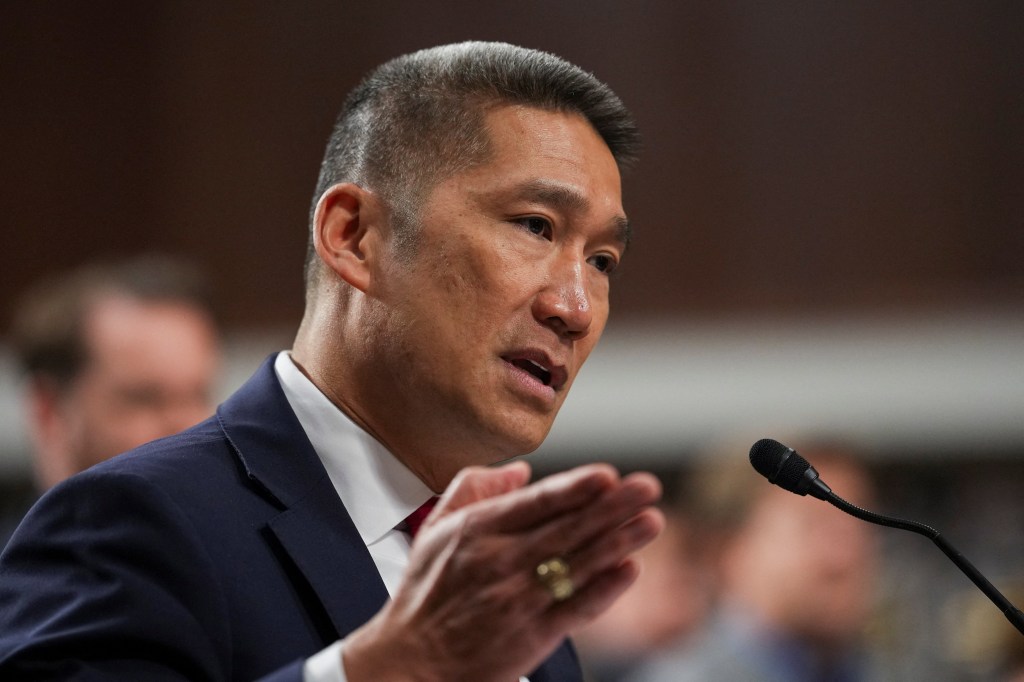
The men and women serving aboard U.S. Navy ships are enduring some of the longest deployments since World War II — and their families, lawmakers, and now a Senate confirmation hearing are demanding answers. Acting Navy Secretary Hung Cao faced pointed questions Tuesday about sailor welfare, mental health crises at sea, food shortages, and a firing aboard a nuclear submarine that Congress was never told about.
Cao appeared before the Senate Armed Services Committee as the nominee for Navy secretary, a position he stepped into after his predecessor, John Phelan, was fired on April 22. A special operations veteran with more than 25 years of military service, Cao brings firsthand combat experience to the role — but senators made clear that experience alone wouldn’t answer their concerns.
Suicide Attempts at Sea Spark Debate
The hearing’s sharpest exchange came over the mental health of sailors aboard the Military Times-reported USS Abraham Lincoln carrier strike group, where sailors were reported jumping overboard during an extended deployment in the Middle East. Cao had previously acknowledged in a letter to lawmakers that eight sailors from the Lincoln strike group had attempted suicide during the Iran war.
At the hearing, Cao reframed the situation, telling Sen. Richard Blumenthal (D-Conn.):
“You see it as eight suicide attempts; I see it as eight suicide mitigations.”
That framing drew an immediate rebuke from Sen. Kirsten Gillibrand (D-N.Y.), who had submitted an inquiry into conditions aboard the ship after the incidents were reported.
Gillibrand responded:
“Please don’t call [them] attempted suicide mitigations. That is such an insult. It’s an insult to these men and women who are devoting their lives to the armed services. When you say it’s mitigation, you’re compartmentalizing something that is clearly a mental health failure.”
Cao, who has publicly affirmed his support for the Navy’s Suicide Prevention and Response Task Force and acknowledged his own struggles with PTSD, defended the Navy’s approach. He noted that most carrier strike groups experience one to two suicides per deployment, while the Lincoln saw zero deaths — a result he attributed to the mental health resources onboard, including chaplains and mental health professionals.
“I have done deployments to Iraq, Afghanistan, Somalia,”
Cao said.
“I understand what our sailors and Marines are going through and I put mental health at the top of my concern.”
Record-Breaking Deployments Strain Sailors and Families
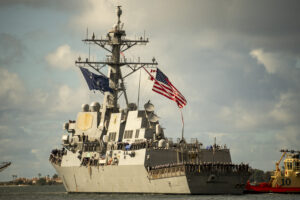
Underlying the mental health conversation is a broader crisis of extended time at sea. The USS Abraham Lincoln’s most recent deployment stretched 321 days, with 286 of those days passing without a single port call. The USS Spruance recently set a post-World War II record for the longest destroyer deployment in modern history. And families of sailors aboard the USS George H.W. Bush were told on November 9 to prepare for a year-long deployment.
Cao linked the deployment strain directly to fleet size. The Navy currently operates 286 ships but has identified a need for 355. To bridge the gap, he said the Navy is working to accelerate shipyard maintenance and deploy unmanned vessels.
“We are trying to accelerate… the unmanned surface vessels in order to relieve the 17 destroyers that are supporting the blockade right now, so we can put unmanned surface vessels out there to take their place and ensure that we can reduce the strain on the fleet,”
Cao said.
Senators Raise Alarms Over Food Shortages
Sen. Mark Kelly (D-Ariz.) raised concerns from family members of sailors aboard the USS George Washington and USS Boxer, saying their children had lost alarming amounts of weight due to insufficient food supplies onboard. One parent reported their child lost more than 45 pounds. Another family member said their sailor was so malnourished that care packages became their primary source of nutrition.
Cao’s initial response sparked pushback. He compared the situation to children being picky at home:
“It’s like my kids opening up the refrigerator door and saying, ‘There’s nothing to eat there.'”
Kelly rejected that comparison, noting that losing 45 pounds is not consistent with picky eating. Cao then clarified that he receives daily briefings on food supply conditions for ships in the Middle East, including how many days of rations remain. He said he monitors individual ships — including the USS Gonzalez, which at one point had only a week’s supply left — and that he does not want that number to drop below two weeks.
“It has never gotten to zero,”
Cao said.
“Not once.”
He pledged to work with Kelly, if confirmed, to ensure sailors have everything they need to stay healthy at sea.
Congress Left in the Dark on Submarine Firings
Senators also confronted Cao about why Congress was never notified when the Navy fired the entire command triad — the commanding officer, executive officer, and chief — aboard the Virginia-class attack submarine USS South Dakota on October 14. The reasons for the dismissals have not been publicly disclosed.
Ranking member Sen. Jack Reed (D-R.I.) said the Senate Armed Services Committee received no notification and had not been debriefed on what led to such an extraordinary leadership shake-up. Cao confirmed there had been a “near mishap issue” and that an investigation remains ongoing. He said the decision to withhold information from Congress was motivated by a desire to protect the fired service members from media exposure and career damage.
Reed acknowledged the concern for the individuals but pushed back on the justification:
“The reality is that when word leaks [about] the commander, the [executive officer] and the chief aboard the South Dakota, those names are easily correlated. So denying us information about a very significant event in the Navy is not justified by protecting those individuals.”
Later in the hearing, Sen. Tim Kaine (D-Va.) pressed Cao again on the lack of communication. This time, Cao conceded the error directly.
“There’s no excuse, Senator,”
Cao said.
“We will come up with procedures so I can inform you in a timely manner. I just didn’t want it to be blasted out on Navy Times.”