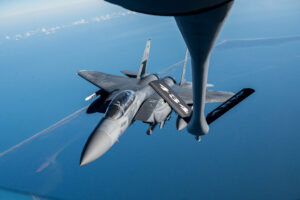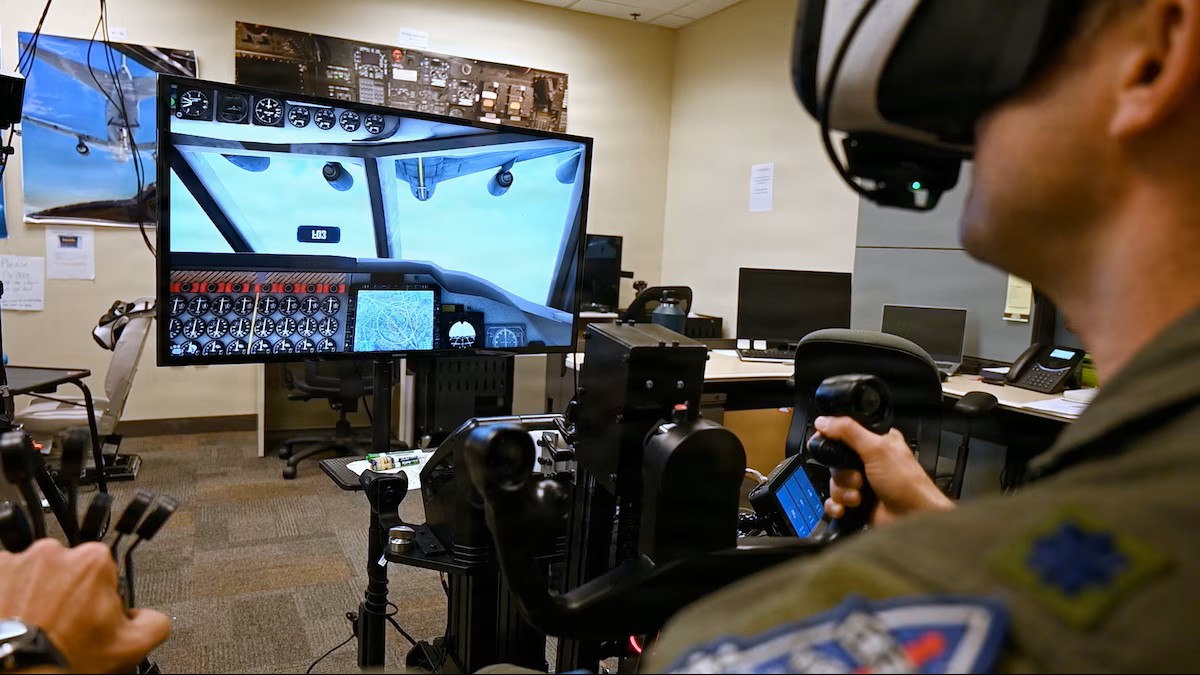
Refueling a fighter jet in midair is one of the most demanding skills a military pilot can master — and until recently, the only way to get good at it was to burn through thousands of pounds of jet fuel in live practice runs. The U.S. Air Force is changing that with a compact virtual reality simulator that’s already reshaping how pilots train across the country.
The system is called EARL — the Experiential Air Refueling Lightweight simulator. Developed by Specular Theory, it has now been adopted by eight operational wings and commands, including Air Force Global Strike Command, Air Force Reserve Command, and Air Mobility Command. It’s also been deployed at strategically vital bases such as Joint Base Elmendorf-Richardson in Alaska, a key hub for U.S. operations in the Arctic, and Minot Air Force Base in North Dakota, the Air Force’s only base hosting two nuclear-capable wings.
EARL is designed to train co-pilots and aircraft commander candidates in the precise aerodynamics and flight controls required for aerial refueling — a notoriously difficult maneuver that requires exceptional skill, focus, and coordination between crew members.
Why Aerial Refueling Training Has Always Been Costly
Mastering in-flight refueling the traditional way is expensive. Live practice sorties have historically consumed tens of thousands of pounds of fuel per session, according to the Air Force — a significant drain on resources, tanker aircraft availability, and flight hours that could otherwise be used for high-stakes combat training.
The risks involved in live refueling practice aren’t just financial. Last July, an F-22 Raptor and a KC-46 Pegasus tanker were involved in a close call when the tanker’s refueling boom became stuck inside the F-22 mid-flight, forcing an emergency breakaway maneuver. No one was hurt, but the incident illustrated just how much can go wrong during what might look like a routine procedure.
Older simulators existed as an alternative, but they were bulky, fixed-location systems that required airmen to travel to specific facilities — adding logistical friction on top of an already demanding training schedule.
A Simulator Small Enough to Fit in a Squadron Bay
EARL takes a different approach. The system is roughly the size of an exercise bicycle, making it easy to transport, set up, and use directly at the squadron level. Despite its compact footprint, it delivers a fully immersive experience — replicating the specific aerodynamics and flight controls of individual aircraft types while walking trainees through instructions step by step using artificial intelligence.
The simulator also supports networked, real-time training between pilots at different installations. A pilot and a boom operator stationed at separate bases can practice a joint refueling mission together using their respective simulators simultaneously — something previously impossible without coordinating actual aircraft.
EARL also comes with a companion system called BART — the Boom Air Refueling Trainer — which focuses specifically on training boom operators, the crew members responsible for physically guiding the refueling connection during flight.
Jim Hartle, associate deputy assistant secretary of the Air Force for operational energy, explained the broader significance of the program in a statement:
“Innovative platforms like EARL are fundamentally altering how we view training and energy resources across the enterprise.”
Hartle emphasized the operational payoff as well:
“Our warfighters need to maximize operational capability with every gallon of fuel we consume. By moving repetitive proficiency rehearsals into trainers directly at the squadron level, we are taking strain off our tanker fleet, saving millions of gallons of fuel and ultimately returning those flying hours to high-end combat and tactical employment.”
Looking ahead, the Air Force says it plans to expand the use of virtual training platforms beyond refueling. Future software development is expected to cover high-pressure combat scenarios including tactical airdrops, takeoffs from rough terrain, and short-field assault landings — extending the cost-saving and readiness benefits of simulator training to a broader range of mission types.