This weekend, families across the United States with Mexican heritage will come together to celebrate Dia de los Muertos, or the Day of the Dead, by honoring their ancestors with traditional customs such as altars, marigolds, and sugar skulls. Despite its deep historical roots, the celebration has recently seen a wave of commercialization, prompting discussions within the community on how to maintain its authenticity while allowing it to grow and adapt.
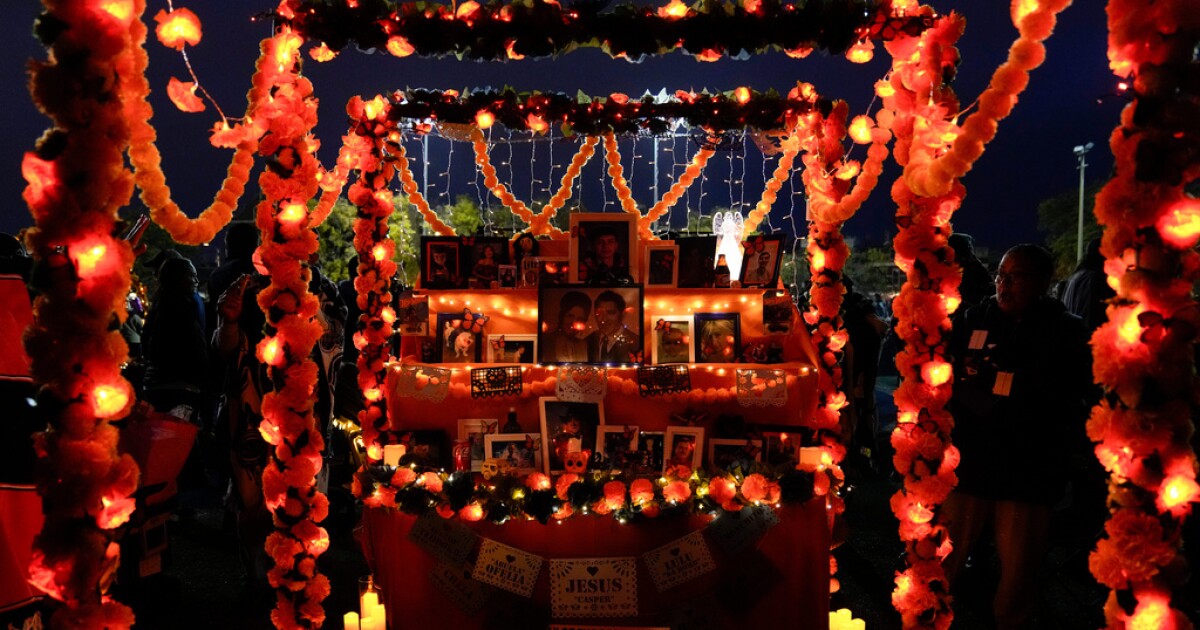
The Day of the Dead is known for being a personal, family-centered occasion, traditionally marked by the creation of home altars, known as ofrendas, and visits to cemeteries to adorn graves with flowers and sugar skulls. Families often bring the favorite foods of their deceased relatives and hire musicians to perform beloved songs.
Centrally featured in these festivities are skeletons, which represent the notion of the dead making a temporary return to the world of the living, akin to seeds that vanish in soil only to reemerge with the harvest.
Photographs of ancestors are placed on the ofrendas, surrounded by paper decorations, candles, and offerings of items once cherished by the departed, such as cigars, a bottle of mezcal, or a plate of mole, tortillas, and chocolates.
From Family Gatherings to Popular Culture
The evolution of Day of the Dead celebrations in both the U.S. and Mexico is ongoing. According to Cesáreo Moreno, chief curator and visual director at the National Museum of Mexican Art, the release of Disney’s animated film “Coco” in 2017 significantly impacted how the holiday is perceived, especially in northern Mexico, while also increasing its popularity and commercialization in the U.S. Cities across America now hold festivals, and Mexico City hosts an annual Dia de los Muertos parade.
Moreno noted that “Coco” has helped people outside of the Mexican American community to appreciate and embrace the tradition’s beauty, albeit making it more marketable. “The Mexican American community in the United States celebrates the Day of the Dead as a cultural expression,” Moreno stated. “It is a healthy tradition and it actually has an important role in the grieving process. But with ‘Coco,’ that movie really thrust it into mainstream popular culture.”
However, as its popularity surges, Day of the Dead often becomes confused with Halloween, which has altered its celebration and public perception, Moreno remarked.
Modernizing Traditional Altars
Recently, some individuals within and outside the Mexican American community have started creating ofrendas with a minimalist design, diverging from the traditional vibrant displays.
These colorful altars are rooted in Mexican and Mesoamerican culture dating back to the Spanish colonization and conversion of Indigenous tribes to Catholicism. Nowadays, certain families opt for altars without the traditional flowers and papel picado—multi-colored, intricate wall hangings with hearts and skulls.
Moreno expressed that such changes are acceptable, provided the essence is preserved. “If people are looking to do something a little bit different, that is fine,” he said. “But if people stop understanding what is at the heart of this tradition, if people start transforming that, that is what I am against.”
Ana Cecy Lerma, a Mexican American residing in Texas, suggests that minimalist ofrendas may be driven by a desire to create visually appealing content for social media platforms like Instagram. “I think you can put what you want in an altar and what connects you to your loved ones,” Lerma explained. “But if your reasoning is merely that you like how it looks then I feel that’s losing a bit of the reason as to why we make altars.”
Respect and Commercialization
Sehila Mota Casper, director of Latinos in Heritage Conservation, a nonprofit organization dedicated to preserving Latinx culture, expressed concerns about American businesses capitalizing on Dia de los Muertos, much like Cinco de Mayo, prioritizing profit over cultural significance. Major retailers like Target and Wal-Mart now offer create-your-own-ofrenda kits, Mota Casper noted. “It’s beginning to get culturally appropriated by other individuals outside of our diaspora,” she added.
Although not of Mexican descent, Beth McRae has lived in Arizona and California, surrounded by Latino culture, and has been creating altars for Day of the Dead since 1994. Her collection of related items exceeds 1,000 pieces, and she hosts an annual celebration.
“This is the coolest celebration because you’re inviting the loved ones that you’ve lost,” McRae said. She emphasized the importance of being respectful by sourcing trinkets from Mexico and centering the celebration on deceased loved ones. “It’s done with respect and love, but it’s an opportunity to raise awareness to people that are not familiar with the culture or are not from the culture,” McRae explained.
Salvador Ordorica, a first-generation Mexican American from Los Angeles, believes that traditions need to be refreshed to appeal to younger generations. “I think it’s okay for traditions to change,” Ordorica said. “It’s a way to really keep that tradition alive as long as the core of the tradition remains in place.”