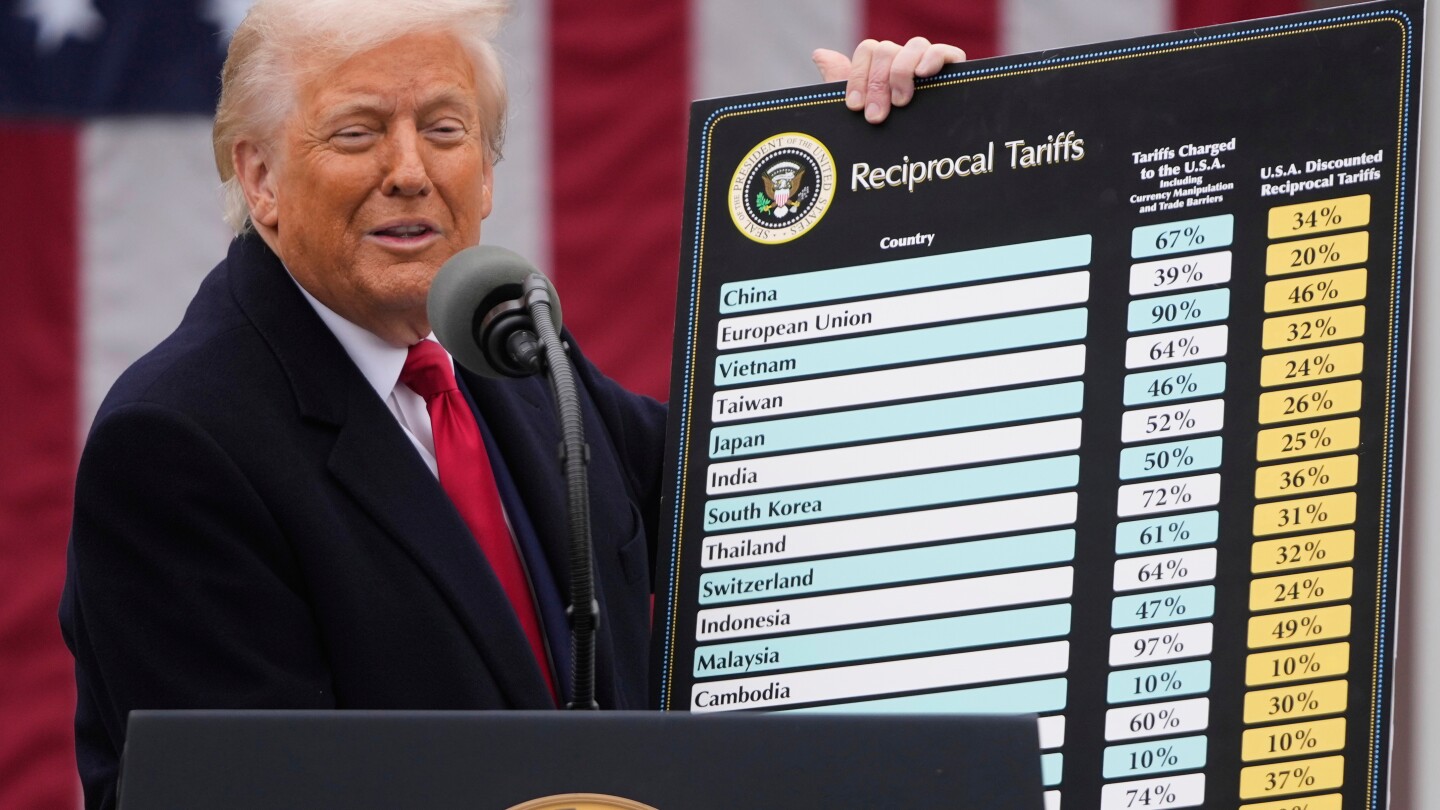
WASHINGTON (AP) — The use of tariffs by President Donald Trump has become a hallmark of his administration’s approach to foreign policy. This strategy, which employs tariffs or the threat thereof, aims to influence international relations significantly.
Tariffs have been central to both Trump’s economic policies and his international strategy since taking office. The President has leveraged these import taxes not only to negotiate ceasefires in conflicted areas but also to pressure countries into tightening border controls against illegal immigration and narcotics.
In certain instances, such as with Brazil, tariffs acted as a political tool when Trump sought to exert pressure following a legal action against an ally. Similarly, a recent dispute with Canada arose from a provocative television advertisement.
The Supreme Court is now deliberating on whether Trump’s tariff implementation has surpassed legal boundaries. A decision unfavorable to the administration could significantly curtail this pivotal aspect of his foreign policy.
Trump has expressed his concern over the case, labeling a potential adverse ruling as disastrous for the nation. He has even hinted at the possibility of attending the court proceedings himself, indicating the gravity he places on this case.
In defense of these tariffs, the Justice Department asserts that they fall within Trump’s jurisdiction over foreign relations, an authority that should remain free from judicial interference.
Earlier judicial rulings, including those from the U.S. Court of Appeals for the Federal Circuit, have contested Trump’s authority under the International Emergency Economic Powers Act (IEEPA), which traditionally grants Congress the power to impose tariffs. Yet, some judges argue the 1977 law provides the president with the ability to regulate imports during emergencies.
Despite the ongoing legal debate, the administration continues to utilize tariffs as a strategic tool, awaiting the Supreme Court’s verdict. White House spokesman Kush Desai stated, “President Trump has acted lawfully by using the tariff powers granted to him by Congress in IEEPA to deal with national emergencies and to safeguard our national security and economy.”
Presidential Use of Tariffs: A Break from Tradition
Historically, U.S. presidents have favored financial sanctions over tariffs to achieve foreign policy and security goals. Josh Lipsky, an international economics expert at the Atlantic Council, notes that Trump’s approach is atypical, as past presidents have employed tariffs with precision rather than as a blunt instrument.
However, Trump’s strategy has woven tariffs into the fabric of his national security and foreign policy agenda, as demonstrated by his recent tariff threats to the European Union, which aimed to secure military and security commitments.
The EU’s decision to settle on a 15% tariff rate, down from a potential 30%, was met with criticism, though Trade Commissioner Maroš Šefčovič defended the outcome, highlighting its broader security implications.
Lipsky contends that while Trump’s tariff strategy has, at times, yielded favorable outcomes, it has also sparked backlash and complicated international relations.
Potential Consequences of the Supreme Court’s Ruling
The upcoming Supreme Court decision could reshape international diplomacy and economic strategies, potentially prompting nations to reconsider recent trade agreements with the U.S.
Businesses and consumers alike have felt the impact of Trump’s tariff policies, as some companies have passed increased costs onto customers, while others await clarity on tariff rates.
Emily Kilcrease, a former U.S. trade representative, highlights the unprecedented nature of Trump’s tariff usage, describing it as an aggressive approach to influencing foreign governments. Despite this, Kilcrease believes there is a possibility the Supreme Court may rule in favor of Trump due to IEEPA’s broad presidential powers.
Should the Court limit Trump’s authority, it may prompt a reassessment of trade agreements, though political considerations could complicate any renegotiations.
Ultimately, while the administration might explore alternative legal avenues to justify tariffs, such processes could prove more cumbersome.
“It certainly doesn’t take tariffs off the table,” Kilcrease remarked. “It just makes them a little bit slower.”