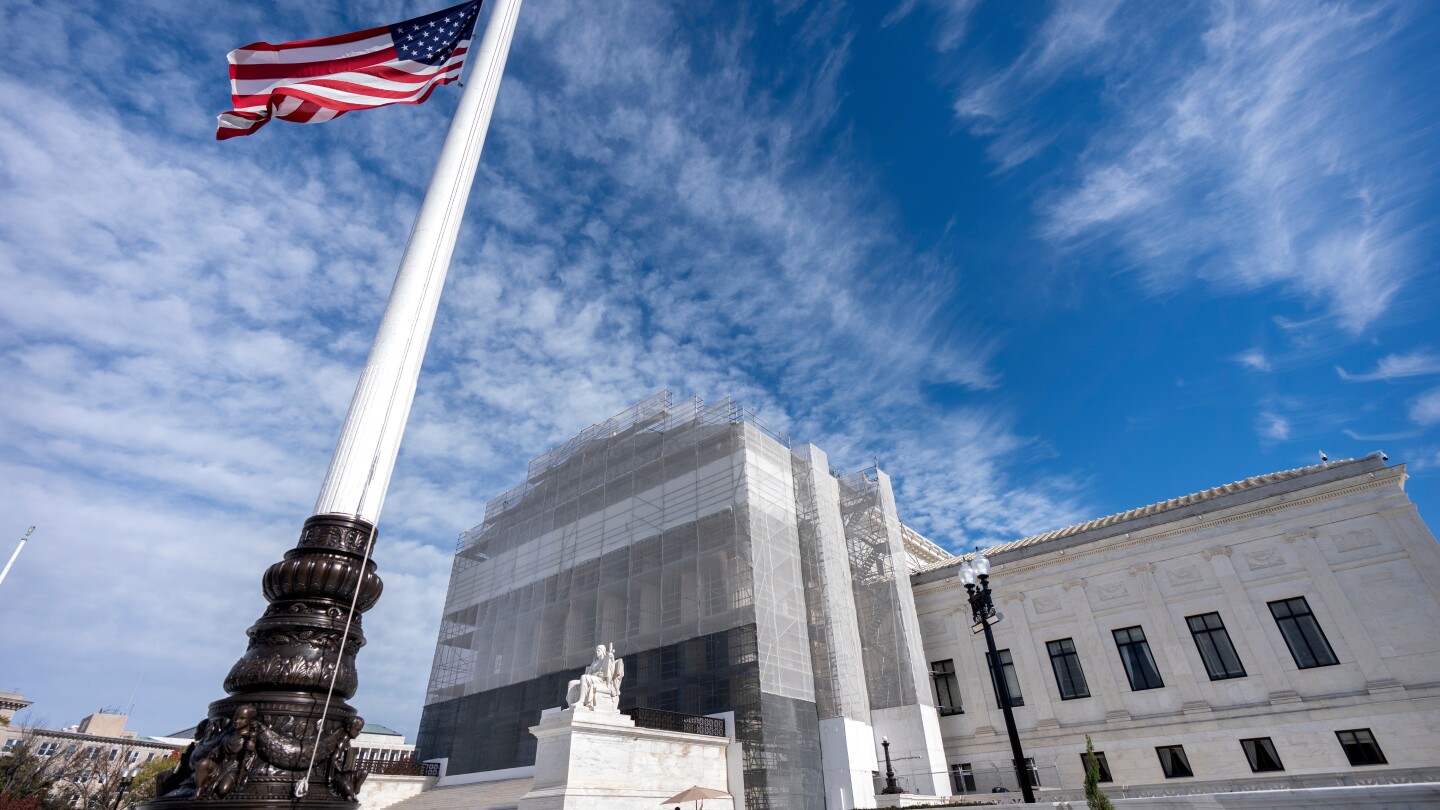
In a dramatic appeal to the Supreme Court, President Donald Trump has cautioned that a decision against his tariffs could leave the United States vulnerable and economically diminished. This legal battle has sparked intense discussions about the extent of presidential authority over trade policies.
During oral arguments held on Wednesday, the Supreme Court justices expressed doubts about the sweeping powers claimed by Trump to impose tariffs. Despite the skepticism, Trump has several avenues to continue his aggressive tariff strategies even if the court rules against him. These include reactivating previous tariff powers and utilizing some dating back to the Great Depression.
Kathleen Claussen, a trade law professor at Georgetown, remarked, “It’s hard to see any pathway here where tariffs end. I am pretty convinced he could rebuild the tariff landscape he has now using other authorities.”
Attorney Neal Katyal, representing small businesses challenging the tariffs, argued that the president does not need unchecked authority under the 1977 International Emergency Economic Powers Act (IEEPA) since Congress has already delegated tariff powers through other specific statutes.
“Congress knows exactly how to delegate its tariff powers,” Katyal stated.
Trump’s foreign policy has heavily relied on tariffs, with significant “reciprocal” tariffs imposed globally due to declared national emergencies over trade deficits. Under his administration, the average U.S. tariff rate surged from 2.5% to 17.9%, reaching levels not seen since 1934, as per Yale University’s Budget Lab.
The president’s unilateral actions raise constitutional questions since the U.S. Constitution designates tariff and tax powers to Congress.
Exploiting Trade Practices Loopholes
The U.S. can wield Section 301 of the Trade Act of 1974 to combat “unjustifiable” or “discriminatory” trade practices. Trump has used this tool aggressively, particularly against China, to impose tariffs on Chinese imports amidst technological dominance disputes. These tariffs can be renewed beyond their initial four-year period.
Although Section 301 is effective against major economies like China, John Veroneau, a former general counsel for the U.S. trade representative, noted its limitations against smaller nations burdened by reciprocal tariffs, citing the exhaustive process of conducting multiple investigations.
Addressing Trade Imbalances
The U.S. Court of International Trade previously nullified Trump’s reciprocal tariffs, ruling that emergency powers cannot be used to counter trade deficits. However, Section 122 of the Trade Act of 1974 authorizes the imposition of tariffs up to 15% for 150 days in response to trade imbalances, without necessitating prior investigations.
National Security Tariffs
Trump has also leveraged Section 232 of the Trade Expansion Act of 1962 to impose tariffs on imports deemed threats to national security, affecting a wide range of products from steel and aluminum to furniture. Despite skepticism about some tariff justifications, courts are typically reluctant to challenge presidential national security determinations.
Reviving Historical Tariffs
The Tariff Act of 1930, known for the controversial Smoot-Hawley tariffs, allows imposing tariffs up to 50% on imports from nations discriminating against U.S. businesses. While unused, this authority could potentially serve as a strategic option if the Supreme Court rules against Trump’s current tariff powers. Treasury Secretary Scott Bessent indicated that Section 338 might be considered as an alternative if needed.
Veroneau pointed out the historical stigma attached to Smoot-Hawley, yet noted Trump might pursue its use for its novelty. “To be the first president to ever use it could have some cache.”