During the waning months of World War II, a story emerged about Sergeant Horace West, an Oklahoma sniper credited with over 130 German kills. However, beneath the surface of this narrative lay a dark secret. In an interview with United Press International, West revealed that his rifle was named after his wife and recounted praying with his family before deployment. He reflected, “A man shouldn’t be too proud of killing another man.”
The 45th Infantry Division and the Biscari Massacre
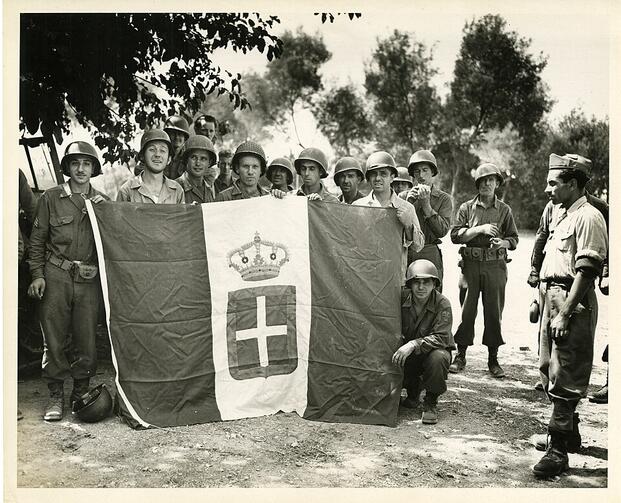
In the summer of 1943, the Allied forces commenced Operation Husky, the invasion of Sicily. The operation placed the untested 45th Infantry Division, commanded by Lieutenant General Omar Bradley under General Patton’s U.S. Seventh Army, against fierce Italian and German resistance. The division’s first significant task was capturing the strategically crucial Biscari airfield.
As the battle for the airfield raged, exhaustion and anger took their toll on the American soldiers. On July 14, amidst this chaos, Sergeant Horace West carried out the cold-blooded execution of 37 prisoners of war, an act that would later be termed the Biscari Massacre. West’s actions were part of a larger atrocity that saw over 70 Axis POWs killed by U.S. forces.
Unveiling the Atrocity
The events of that day were marked by brutality. After capturing 48 prisoners, West led them away under orders to hold them for questioning. Instead, he borrowed a Thompson submachine gun and systematically executed 37 of them, later stating to guards, “Turn around if you don’t want to see it.”
Just hours later, Captain John T. Compton ordered another execution of 36 prisoners at the same airfield. The killings were justified under the pretext that they were snipers, despite the lack of evidence. Compton’s men formed a firing squad, ignoring the pleas of the prisoners, and executed them all.
Aftermath and Accountability
The massacre did not go unnoticed. Lieutenant Colonel William E. King, a chaplain, discovered the bodies the next day. He reported the incident, and soon General Bradley informed General Patton about the war crimes. Initially dismissive, Patton later instructed that those responsible be tried after investigations confirmed the lack of provocation by the prisoners.
West and Compton faced courts-martial. West was convicted of premeditated murder and sentenced to life in prison, although he served only 14 months before being released and returning to combat. Compton, however, was acquitted. The disparity in their fates highlighted the inconsistencies in military justice during the war.
Legacy and Remembrance
The Biscari Massacre remained buried for decades, with records classified as top secret. It wasn’t until the late 20th century that historian James J. Weingartner uncovered the full extent of the crimes. The massacre, involving some of the largest-scale killings by American forces in Europe during the war, remains a somber chapter in military history.
In 2012, a marble plaque was unveiled at Santo Pietro to honor the Italian soldiers killed. Survivor Giuseppe Giannola, who lived to tell the tale, passed away in 2016. The victims, many of whom lie in unmarked graves, received no formal apology, leaving a lasting shadow over the narrative of American involvement in World War II.