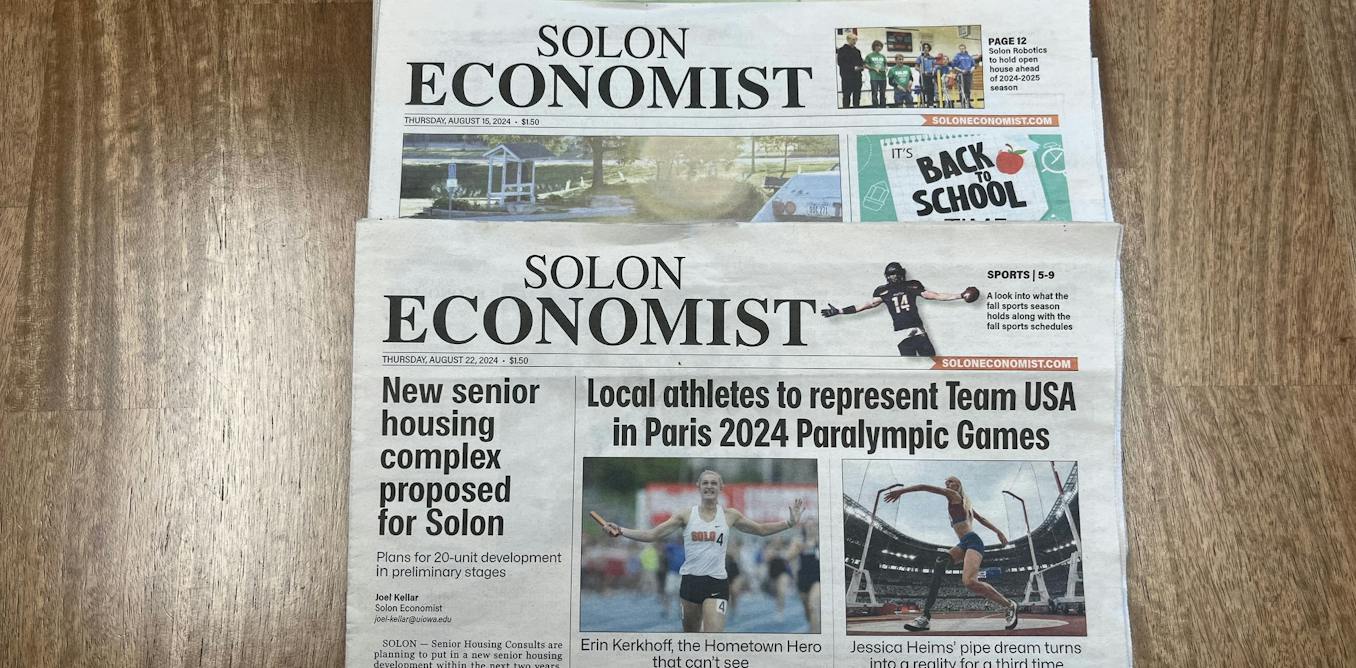
In a surprising turn of events, the Solon Economist, a local newspaper in Iowa, was saved from closure by a unique collaboration with the University of Iowa. This unexpected lifeline sheds light on the growing trend of academic institutions stepping in to preserve local journalism amidst the ongoing “news desert” crisis.
On a seemingly ordinary Friday morning in February 2024, Catherine Bilskie, the advertising and office manager for the Solon Economist, anticipated the end of her role following a wave of local newspaper closures. However, the arrival of new owner Jason Brummond, who promised not only job security but also raises, marked a new chapter for the weekly paper. Brummond’s association with the University of Iowa adds a unique dimension to this story.
This initiative is part of a larger movement where universities across the U.S. are taking active roles in addressing the decline of local newspapers. With thousands of communities losing their local news outlets over the past two decades, academic institutions are collaborating to either support existing publications or launch new ones. Examples include the Spanish-language news site Noticiero Móvil at the University of Nevada, Reno, and “Good Morning Indian Country” at the University of Kansas.
As journalism professors Teri Finneman and Pamela Walck explore in their book, “News Desert U,” such partnerships are being considered as viable solutions to the local news crisis.
Preserving Local News
Over the past 20 years, more than 3,000 newspapers have shut down in the U.S., including approximately 170 in 2025, as reported by Northwestern’s 2026 State of Local News report. The decline is attributed to outdated business models, reduced advertising revenue, and hedge-fund takeovers. Northwestern’s 2025 report highlights a 70% drop in total print newspaper circulation over the last two decades.
The University of Iowa’s partnership with the Solon Economist signifies a promising approach, integrating students into the newspaper’s operations while maintaining existing staff. Brummond, also the publisher of the university’s student newspaper, the Daily Iowan, initiated the acquisition discussions in 2023. The goal was to preserve the newspapers’ professional staff while involving journalism students in various roles.
According to Melissa Tully, the Journalism School’s director, keeping the existing staff was crucial not only from a moral standpoint but also to maintain the newspapers’ connection with their communities. As she stated, “They’re trusted in their communities. They know what’s going on.”
The acquisition of the Solon Economist and its sister paper for $10,000 by Student Publications has stabilized circulation, contrasting with national declines. Students contribute through academic credit and internships, enhancing the newspaper’s operations.
A Model for Success
The University of Georgia followed a similar path to save The Oglethorpe Echo in Georgia. When owner Ralph Maxwell faced closure in 2021, Dink NeSmith, a retired newspaper owner, collaborated with the university to establish a nonprofit, Oglethorpe Echo Legacy, to ensure the paper’s survival.
This nonprofit acquired the Echo for a nominal $10, a symbolic gesture with the check remaining uncashed and framed. The university provides resources and student involvement, revitalizing the paper’s presence with digital products and increased subscriptions.
Under the guidance of journalism professor Amanda Bright, students gain hands-on experience while contributing to the Echo’s content. Bright emphasizes the real-world skills students acquire, which has encouraged many to pursue careers in local journalism.
Challenges and Opportunities
These university partnerships prioritize community service over profit, leveraging institutional resources to support local journalism. Faculty and staff receive their salaries from the university, reducing the financial burden on the news outlets.
While these initiatives offer students practical experience, they require careful planning and adaptability. As Brummond and Tully suggest, a gradual approach is essential to building sustainable projects.
Despite the challenges, the success stories of the Solon Economist and the Oglethorpe Echo demonstrate the potential of academic partnerships to preserve local news and provide valuable training for future journalists.