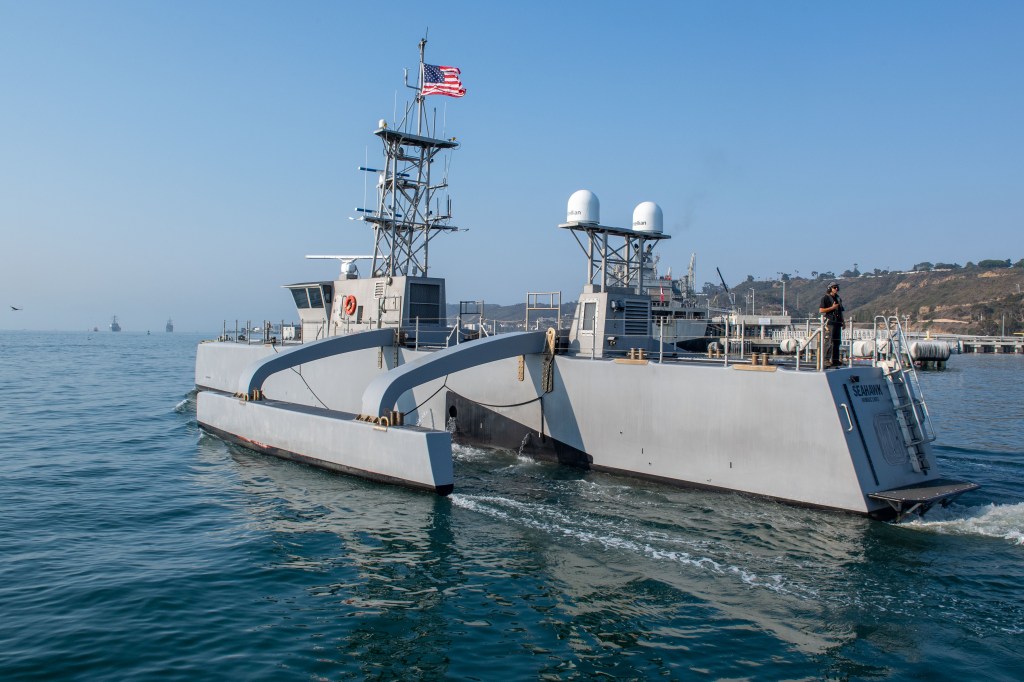
The U.S. Navy is moving closer to making autonomous drone boats a routine part of its combat operations — and for the first time, senior military leaders are explaining exactly how that will work. A top Navy admiral recently offered some of the clearest guidance yet on how these vessels will be certified, deployed, and integrated into the broader fleet.
At an Oct. 8 hearing before the National Commission on the Future of the Navy, Adm. James Kilby, the vice chief of naval operations, outlined the Navy’s evolving plans for medium unmanned surface vessels, or MUSVs — autonomous drone boats designed to expand the Navy’s reach without putting additional sailors at risk.
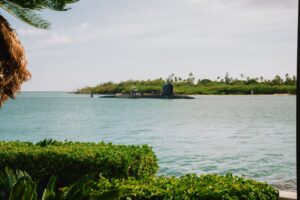
His testimony came on the heels of a significant milestone: the first-ever operational deployment of an MUSV alongside the USS Theodore Roosevelt Carrier Strike Group in the Pacific. Navy Secretary Hung Cao confirmed the deployment, describing the drone boat as a “force multiplier.”
“Imagine having more guns out there,” Cao said.
How the Navy Plans to Use Drone Boats
Rather than assigning MUSVs permanently to specific ships, Kilby described a forward-stationing model in which drone boats would be pre-positioned in strategic locations. Ships would pick them up as needed and be required to demonstrate they can operate them before doing so. He compared this process to how the Navy already certifies ships for various warfighting missions.
“I see a world where it’s part of your certification exercise. You know, there’s elements that we introduce in that exercise where you’ve got to demonstrate that capability, because it’s probably not going to go over with you. You’re going to pick it up over there, and you’ve got to be certified to use it,”
Kilby said.
This approach would make MUSVs modular — adaptable tools that commanders can incorporate into tailored mission packages depending on the operation. Their potential roles are wide-ranging, from reconnaissance and surveillance to serving as remotely controllable weapons platforms, thanks to swappable payload systems. The Navy has been evaluating how best to employ and distribute this capability across the fleet.
A New Training Center Modeled on Top Gun
To support this integration, the Navy recently established the Robotic and Autonomous Systems Warfighting Development Center, known as the RASWDC, at Joint Expeditionary Base Little Creek-Fort Story in Virginia Beach, Virginia. Kilby said the center was modeled on the Navy Fighter Weapons School — famously known as Top Gun — based in Fallon, Nevada.
“The idea, in the case of MUSVs is, the surface community would certify an element to go forward and operate with the fleet. If they work with other [robotic and autonomous systems] entities, the commander of RASWDC will create that total tailored force package,”
Kilby said.
He also signaled that integrating capabilities being developed by other parts of the military — particularly the Army — will require closer coordination.
“The Secretary of War is developing capability very fast, from an unmanned perspective, and the Navy needs to do a better job of integrating with that capability, so we know what we’re receiving. Because we will have a manning, training and equipping responsibility for those things,”
he said.
30 New Vessels on the Way
The Navy currently operates four MUSVs, which were originally built as test platforms and later transferred to the service for operational use. Last month, the Navy announced it had selected three companies to build 30 additional vessels, with formal delivery of all 30 MUSVs expected by the end of fiscal year 2027.
That expansion follows a strategic shift earlier this year, when the Navy pivoted on its MUSV program to accelerate development and incorporate drone boats into its emerging “Golden Fleet” concept — a vision for a more distributed, autonomous naval force.
Despite the progress, Kilby acknowledged that the Navy still has work to do before it’s fully ready to absorb the incoming fleet of uncrewed boats. He said he was “not satisfied” with the current state of preparation, though he believed the Navy has the foundational structure to move forward effectively.
“It is the force development, the employment, the development beyond the [concept of operations] that we need help with. And [having] a sustainable plan so that we can bring that force to bear when we need it,”
Kilby said.