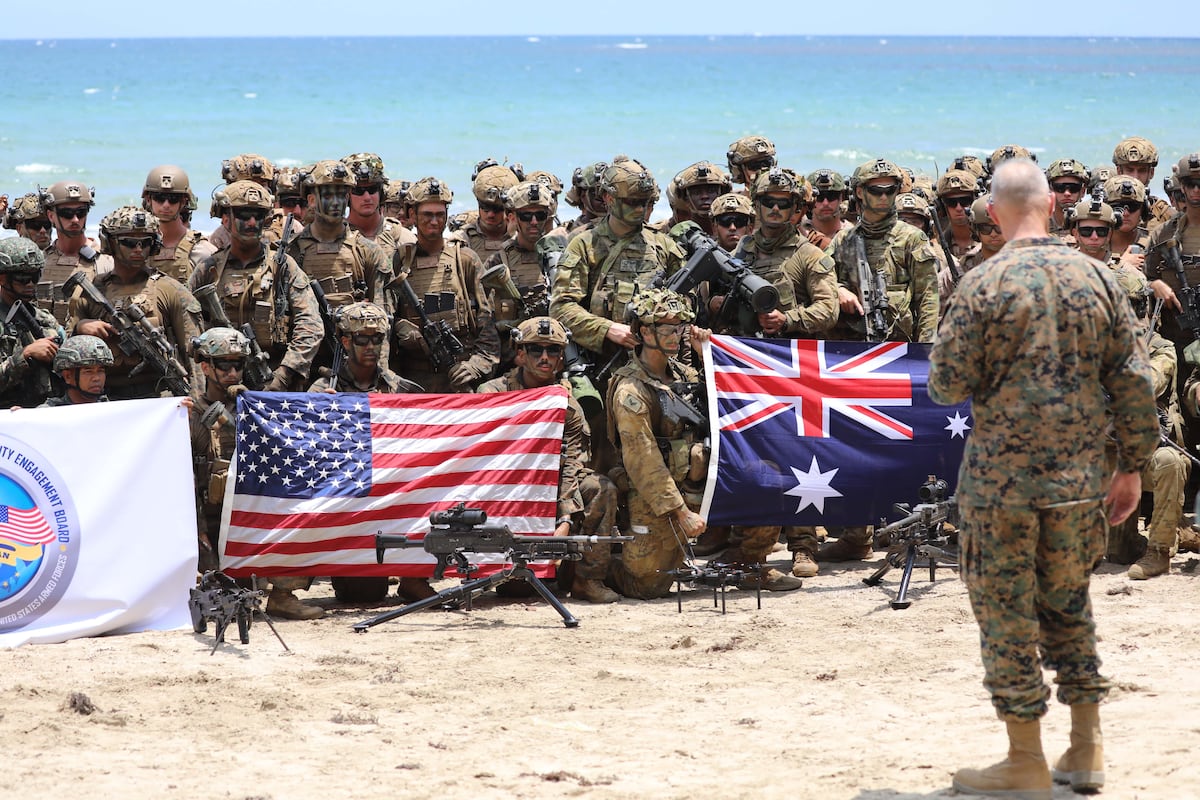
This year, the U.S. Marines’ deployment to Australia under the Marine Rotation Force-Darwin (MRF-D) initiative marked a significant transformation, as it was certified as a Special Purpose Marine Air-Ground Task Force (SPMAGTF) for the first time in its 15-year history.
Col. George Flynn, commanding officer of MRF-D 2026, described the certification as a major milestone, telling Defense News: “This is the first rotation in the 15-year history of the program to be certified as a MAGTF, and that’s a big deal.” He emphasized that certification confirms the force’s readiness to carry out its designated tasks effectively.
Highlighting the strategic positioning of the SPMAGTF, Flynn noted, “What makes it special purpose is just the uniqueness of how it’s placed here in Darwin in support of the Pacific theater.” The force is prepared for a range of operations, from combat to humanitarian aid.
In early May, the certification was achieved during an exercise in the Philippines, showcasing the task force’s readiness to respond to crises. The current deployment involves around 2,000 personnel, including units like the California-based 1/5 Marines and MV-22B Ospreys from the Hawaii-based VMM-268, who arrived in Darwin in March.
Operational Intensity
MRF-D has been operating at a high tempo, with personnel engaging in various missions across multiple countries. Flynn remarked, “We’re busy, but Marines are having a great time. For this deployment, we’ve had 13 planned operations, activities, investments or exercises.” These operations have spanned locations such as the Philippines, Indonesia, and even Tahiti for training with French forces.
In Australia, significant exercises with the Australian Army’s 1st and 3rd Brigades have been conducted, fostering a mutually beneficial relationship, particularly in littoral warfare. Flynn mentioned, “We have a great relationship with 1st Brigade.”
Addressing the challenges of operating in dispersed locations, Flynn saw it as an opportunity to demonstrate the Marines’ capability to maintain operational reach, saying, “I think it goes to demonstrate that, where needed, Marines can show up and provide the support that Marines are capable of providing.”
The SPMAGTF’s ability to maintain readiness throughout deployment is noteworthy. Flynn attributed this to the extensive training areas in Australia, which allow the force to be “most ready when called upon.”
Enhancing Capabilities
Flynn highlighted the robust command-and-control capabilities of the task force, which enable effective communication across various systems. “At no point have I ever felt challenged with being able to command and control the force based on the capabilities that we’re working with,” Flynn stated to Defense News.
To adapt to modern combat needs, the Marine Corps is increasing its capabilities in unmanned systems and counter-drone measures. Flynn noted the experimentation with small UAS and attack drones, particularly during exercises in the Philippines.
While Flynn expressed satisfaction with their operational reach, he mentioned the need for more lift assets to enhance mobility within the theater. He commented, “I’m beyond happy with what we’ve been able to demonstrate with our operational reach.”
Building Relationships
Reflecting on his experience leading the deployment, Flynn shared the positive impact of the Marines’ interactions with local and international partners. “The relationships we’ve built with the Australians and with other nations, allies and partners we’ve got a chance to work with — and just a demonstration of what it means to be a MAGTF operating in the Pacific theater — has just been really powerful for me personally.”
Flynn emphasized MRF-D’s role in maintaining a free and open Indo-Pacific region, respecting the sovereignty of all countries and being ready to support and protect it.
Each MRF-D deployment lasts six months, with the current rotation concluding in October, just ahead of the wet season in northern Australia.