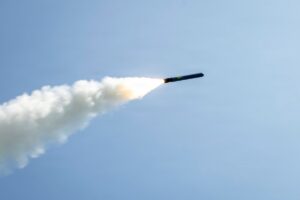
The U.S. Navy is spearheading a collaborative international initiative to advance the Evolved SeaSparrow air defense missile. This ambitious project aims to enhance the missile’s capabilities to meet the diverse needs of the 12-member NATO SeaSparrow Project Office (NSPO) consortium. According to a Sources Sought notice from the Navy, the deadline for submissions is set for October 19.
The NSPO is on the lookout for an adaptable and versatile missile capable of countering a broad spectrum of threats. The next-generation SeaSparrow, referred to as NSV, is expected to handle threats with varying characteristics, including speed, altitude, and maneuverability, and to function effectively in environments with complex electronic warfare scenarios. The Navy emphasized the importance of the missile’s ability to “discriminate and resolve between multiple closely spaced targets” and to adapt to “threat countermeasures.”
In a visual representation included in the notice, a potential threat scenario depicted surface ships, such as aircraft carriers, under attack by a combination of missiles, torpedoes, and hostile aircraft. The graphic showed the friendly vessels utilizing active illumination for defense, while the SeaSparrow relied on its sensors for interception.
The NSPO envisions a missile with a modular, open-source architecture, ensuring that the U.S. government retains “maximum rights in technical data, computer software, and computer software documentation.” This approach is intended to facilitate future upgrades and enhance interoperability across various platforms, thereby staying ahead of emerging threats.
Contractors are required to propose a comprehensive missile system, inclusive of airframe, propulsion, guidance, and software components. The missile design must be compact, with a diameter not exceeding 10 inches, to fit within the Mark 41 vertical launch tube. Furthermore, the technical data should be accessible to all member nations of the NATO SEASPARROW Consortium, which includes countries like Australia, Belgium, Canada, and the United States, among others.
Currently, Raytheon manufactures the Block II RIM-162 Evolved SeaSparrow and has plans to increase production to over 350 missiles by 2025. Given recent tensions in the Persian Gulf and the depletion of allied interceptor stocks, the demand for reliable short-range air defense systems is expected to rise significantly.
The Evolved SeaSparrow, first introduced in 2004, traces its lineage back to the AIM-7 Sparrow from the 1950s. While the original Sparrow had a mixed record in the Vietnam War, its modern descendant serves as an economical defense solution against various threats, boasting an estimated range of approximately 30 miles.