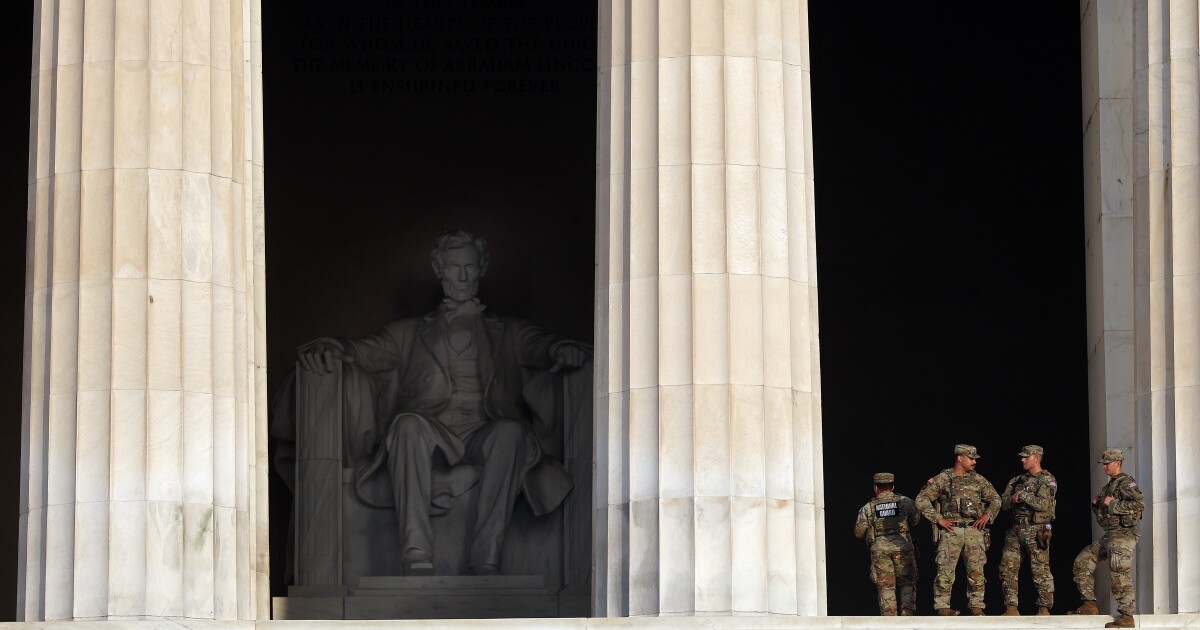
National Guard to Remain in Washington, D.C. Until 2029 for Anti-Crime Mission
The National Guard will continue its deployment in Washington, D.C., until Inauguration Day 2029 as part of President Trump’s anti-crime initiative in the city, confirmed by the Pentagon to NPR. The troop presence, currently numbering close to 5,000 from over 20 states, has doubled in recent weeks following a “summer surge” of law enforcement announced in May.
According to estimates by the Congressional Budget Office, the current daily cost of the deployment exceeds $3 million. Trump initially deployed the National Guard to D.C. in August 2025 after declaring a “crime emergency” and establishing the D.C. Safe and Beautiful Task Force, despite violent crime hitting a three-decade low. Although the emergency declaration ended a month later, the task force and troops’ presence persisted.
Observers have noted the regular presence of armed National Guard members patrolling the city’s residential and business areas for almost a year, sparking controversy. Trump has highlighted the decline in crime since the task force’s inception, a trend that had begun before its launch. Constitutional experts, former military personnel, and activists have expressed concerns about the prolonged military presence on the streets of the nation’s capital.
Elizabeth Goitein, senior director of Liberty and National Security at the Brennan Center for Justice, expressed concerns about Trump’s decision to extend the military presence, suggesting it normalizes military involvement in domestic law enforcement. She also raised the possibility of military involvement during a presidential transition, pointing to the January 6, 2021, Capitol insurrection.
Despite criticisms, Trump did not deploy the D.C. National Guard during the Capitol attack. The White House has not provided immediate comments on the mission’s extension or its necessity. Court challenges have been raised against all of Trump’s domestic National Guard deployments, with a Federal Appeals Court ruling last year in favor of the D.C. deployment’s continuation.
No Impact on Violent Crime Rates
Despite the prolonged National Guard presence, violent crime rates have not seen a significant impact. The deployment, supported by numerous state governors, including Puerto Rico and the U.S. Virgin Islands, continues under Trump’s directive, raising questions about its long-term implications on civil liberties and law enforcement.
In a move that has sparked debate and controversy, several states, including the Virgin Islands, have decided to send members of their National Guard to Washington, D.C. to participate in a joint task force. While many Democrats have insisted that their troops are meant for America 250 celebrations this summer, the joint task force has deputized all National Guard members as special police by the U.S. Marshals Service and issued them firearms, which is uncommon for a domestic National Guard deployment. However, these troops are not authorized to make arrests but can detain individuals until arresting officers arrive.
The primary role of the National Guard troops in D.C. is to conduct “presence patrols,” where they walk in small groups around popular areas of the city to act as a deterrent for crime and allow law enforcement to focus on other areas. These patrols aim to reduce opportunistic crimes such as property crimes and vehicle break-ins, resulting in a 24% decrease in such crimes according to a study by the Niskanen Center. Despite this decrease, critics argue that the deployment of the National Guard is a costly and blunt approach to addressing crime.
Contrary to the positive impact claimed by some studies, a recent report by the Center for American Progress suggests that the National Guard presence in D.C. has had minimal impact on violent crime. Chandler Hall, an associate director at CAP, emphasized that crime trends were already declining before the deployment of the National Guard, indicating that their presence may not be the solution to reducing crime rates.
In response to the criticism, the White House spokesperson, Abigail Jackson, dismissed the CAP report as “partisan hackery,” highlighting the differing conclusions drawn by various studies regarding the effectiveness of the National Guard deployment in D.C. While the presence of National Guard troops may have led to a decrease in certain types of crimes, the overall impact and cost-effectiveness of their deployment remain subjects of ongoing debate. In Washington D.C., the presence of National Guard troops has sparked mixed reactions among residents and politicians alike. Defense Secretary Pete Hegseth recently hosted an event in a city park to commend the troops for their service in securing the city. However, as the deployment of troops has continued and their numbers have grown significantly, anti-National Guard sentiment has also risen.
Activists have displayed signs in prominent areas urging the troops to leave, indicating that they are not welcome. Local politicians, including members of the city council and Mayor Muriel Bowser, have voiced their disapproval of the deployment, citing that they were not consulted or given the opportunity to approve it. Unlike states, where governors have more control, in D.C., the president holds the ultimate authority over such matters.
Ankit Jain, one of D.C.’s nonvoting senators, expressed concern over the deployment, highlighting that the elected representatives of the city were not informed about the troop deployment. While acknowledging the troops’ commitment to serving the country, Jain questioned the necessity of their presence in the city.
The deployment of National Guard troops comes at a significant cost to taxpayers. All state troops in D.C. are operating under Title 32 status, funded by the federal government but under the control of their respective governors. The cost of the deployment is estimated to be around $3 million per day, with projections suggesting a total cost between $2.5 billion and $3.4 billion with the extension to 2029. Virginia Burger, a senior defense policy analyst, anticipates that the cost could escalate further if the troop numbers are not reduced by the end of the summer, as the current deployment exceeds five times its original size.
Despite these figures, Burger emphasizes that the estimated cost does not encompass potential inflation or increased expenses related to lodging, food, and transportation. This estimate is considered conservative, pointing to the possibility of additional expenses if more troops are added to the deployment in the future. The financial implications of the prolonged National Guard presence in Washington D.C. raise concerns among watchdog organizations and taxpayers alike.