President Trump Calls for Tighter Voting Controls in Michigan
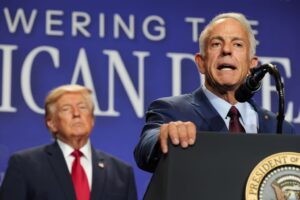
President Donald Trump recently addressed the nation, calling for stricter federal controls on voting and ballot access in preparation for the upcoming 2026 elections. In his address, Trump referenced a six-year-old case of alleged voter registration fraud in Muskegon, Michigan, as evidence that election results in the state cannot be trusted. Despite the case being dropped by federal authorities last year, Trump insisted on the release of new records to support his claims.
The Muskegon case, involving denied voter registration applications due to irregularities indicating fraud, was investigated by the FBI after being flagged by the state authorities. However, the FBI concluded its investigation without filing charges. Trump, unsatisfied with the outcome, requested the FBI director to fully investigate the matter and collaborate with the Department of Justice to prosecute those responsible for any crimes.
Michigan election officials maintain that the Muskegon case demonstrates the system’s success in preventing fraud from affecting elections. Michigan Deputy Secretary of State Aghogho Edevbie emphasized that the false registrants were identified and not given ballots, ensuring no impact on the election outcome.
While Trump’s call for further investigation into the Muskegon case has sparked polarized responses, with Republicans supporting the move and Democrats dismissing it as a distraction from other pressing issues, Michigan officials assert that the state’s elections remain secure. As Michigan gears up for significant upcoming elections, including an open U.S. Senate seat and vacancies for governor, attorney general, and secretary of state, the political landscape continues to be dynamic and contentious.
Michigan Officials Respond to Trump’s Claims
Michigan Attorney General Dana Nessel has vowed to resist any attempts by the Trump administration to exert control over state elections. She emphasized her office’s readiness to challenge unlawful executive orders or demands for private voter information, affirming Michigan’s constitutional right to administer its elections independently.
Despite differing viewpoints between Republicans and Democrats on Trump’s call for revisiting the Muskegon case, Michigan officials and lawmakers remain focused on ensuring the integrity and security of the state’s electoral processes. As political tensions escalate in the lead-up to critical elections, Michigan continues to be a battleground for competing ideologies and strategies.
In the heated political landscape of Michigan, endorsements and rallies are shaping the narrative leading up to the August 4th Primary. Congressman Gary Peters recently announced his support for Congresswoman Haley Stevens, a move that highlights the divide between the Democratic party’s establishment and progressive factions. On the other side, U.S. Senator Bernie Sanders and U.S. Rep. Alexandria Ocasio-Cortez are rallying for Abdul El-Sayed, setting the stage for a contentious battle between the two Democratic candidates.
One of the key issues gaining traction in Michigan is a proposed tax increase on high earners. The state legislature is considering a plan to impose an additional five percent tax on individuals earning above half a million dollars annually or joint filers earning over a million dollars. The aim is to channel this revenue towards crucial sectors like health, housing, and education. However, critics argue that this tax hike could inadvertently impact small business owners due to the unique ways many of them file taxes. Despite the proposal’s potential benefits, achieving a legislative supermajority to present it to voters seems unlikely this year.
As the political fervor intensifies, Michigan residents are gearing up for a crucial Primary that will ultimately determine the candidates for the November election. With endorsements, rallies, and policy proposals taking center stage, the state’s political landscape is set for a significant shift. Stay tuned for more updates as the race unfolds.