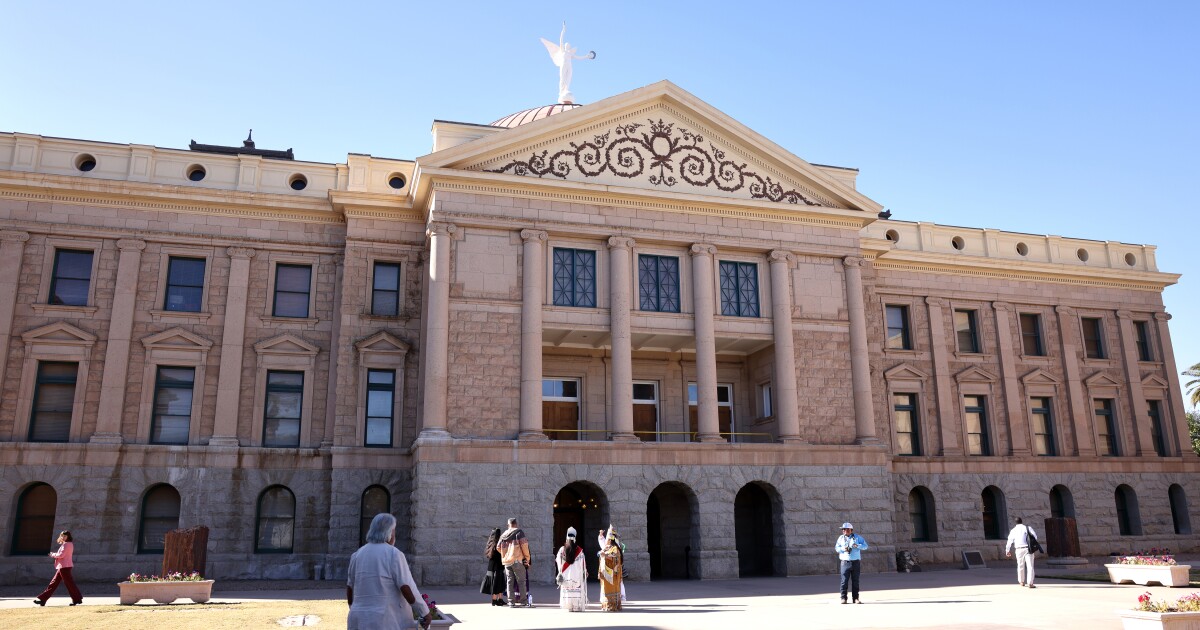
Arizona’s legislature has moved forward with an $18.3 billion state budget proposal, blending bipartisan support with substantial tax cuts and partially restoring previously suggested cuts to state agencies by Republican lawmakers.
In a joint committee hearing, the budget received broad approval, with only three lawmakers opposing it out of a total of 28.
Senate Minority Leader Priya Sundareshan (D-Tucson) commented that Democrats generally rate their satisfaction with the budget at a six or seven on a scale of ten, noting that bipartisan cooperation will be essential for the budget’s approval in both the House and Senate. Votes on the budget are anticipated on Thursday.
Democratic Achievements: DES Staffing and Education Support
Efforts by Democrats have resulted in funding allocations to counterbalance the impact of HR 1, the federal tax cut legislation signed by President Donald Trump. Since the enactment of changes to SNAP food assistance last summer, the program has seen a reduction of more than half of its beneficiaries in Arizona.
The Department of Economic Security, which manages SNAP, has reported staffing shortages that impede its ability to process applications under the new federal guidelines. Rep. Oscar De Los Santos (D-Laveen) highlighted that the budget allocates funds to address these staffing needs.
“So what this budget does is it invests about $21 million to hire new staff at AHCCCS and the Department of Economic Security to help Arizonans navigate this new HR 1 disaster that Donald Trump has put in place,” he said.
Additionally, rural hospitals affected by federal funding changes will receive $11 million.
The budget does not include a renewal of Proposition 123, an education funding initiative important to Gov. Katie Hobbs and Democrats, which previously provided approximately $300 million a year to public schools. Despite this, Democrats achieved funding victories, including $37 million directed to schools serving low-income students.
“House Democrats and Senate Democrats have won $37 million in what’s called the opportunity weight,” De Los Santos said. “This is funding that goes directly to public schools that serve low-income students. That’s a very big deal.”
The budget also includes $2 million to continue a program eliminating co-pays for reduced-price school lunches.
While the budget enacts a 2.5% reduction in most state agency budgets, exceptions are made for certain departments, diverging from a proposed 5% cut in an earlier Republican-only plan. The state benefited from an unexpected increase in capital gains revenue, which helped mitigate the need for broader cuts.
Sundareshan expressed caution regarding the economic outlook, noting, “I say unfortunately because it also signals a lessened confidence in the stock market for the future because investors are souring on the economy and future budgets are going to be very difficult, and that’s a big picture outlook.”
Republican Highlights: Tax Conformity

Arizona residents will not face the hassle of refiling their taxes this year due to a bipartisan budget agreement aligning state tax regulations with federal adjustments. This move sets Arizona apart as the only state to fully adopt federal tax changes, a point of pride for Republicans.
“The budget incorporates full federal tax conformity provisions, making Arizona the only state in the nation to adopt President Trump’s tax cuts at the state level,” GOP senators noted in a statement.
Earlier efforts by Republicans to establish tax conformity before the filing deadline were halted by Governor Hobbs, but the agreement reached in the budget ensures alignment this year, preventing the necessity of refiling.
As part of the budget, changes to the State and Local Tax (SALT) deduction will revert to a $10,000 cap next year, after previously being increased federally. While some lawmakers, like Rep. David Livingston (R-Peoria), expressed dissatisfaction with these federal changes, they acknowledged the need to respect them for the current tax year.
A Temporary Hold on Data Center Tax Incentives

The budget introduces a three-year suspension on new tax breaks for data centers, addressing environmental concerns regarding their energy and water consumption. Although initially advocating for a complete removal of these incentives, Governor Hobbs agreed to the moratorium as a compromise.
“All the existing data centers that have been built and the ones that are building and the ones that have been approved, but haven’t started yet, are grandfathered in. I don’t think it’s a big policy gain or loss,” commented Livingston.
This pause is estimated to save the state approximately $12 million in the coming year. Rep. Oscar De Los Santos (D-Laveen) emphasized the symbolic significance of this measure, stating, “We have completely flipped the script. Today, Arizona takes the next step in becoming the first state in the country to place the toughest moratorium on a data center tax giveaway.”
Despite initial proposals to levy fees on data centers’ water usage to contribute to the Colorado River protection fund, these measures were not included in the final budget.
Missing Elements: School Voucher Reforms and Short-term Rental Policies

While the budget encompasses various initiatives, it excludes reforms to the Empowerment Scholarship Accounts, also known as the universal school voucher program, which Democrats had advocated. Additionally, proposed regulations for short-term rentals, like those offered by platforms such as Vrbo and AirBNB, were not included, despite being part of Governor Hobbs’ agenda at the year’s start.