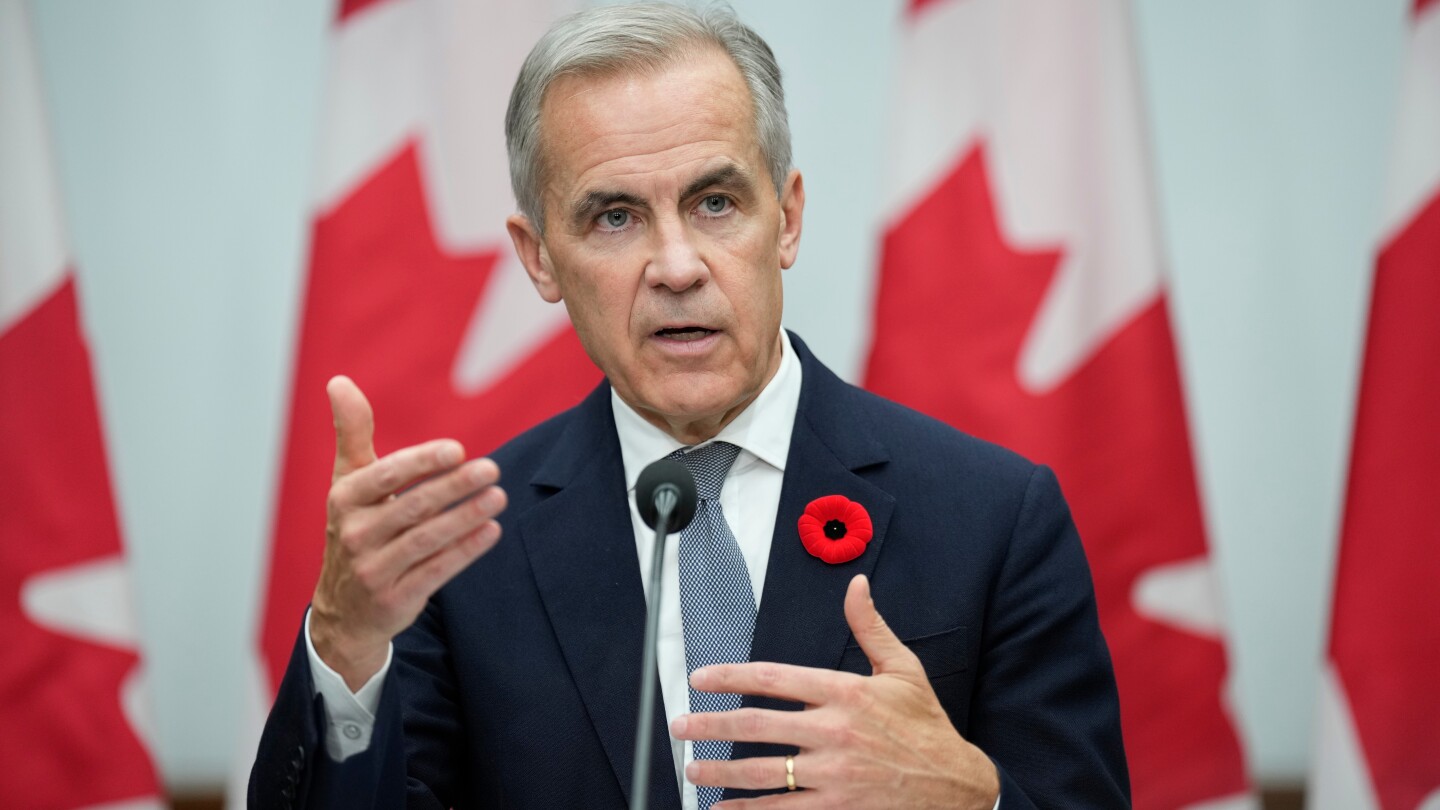
TORONTO (AP) — A political advertisement from Ontario has become the center of a diplomatic kerfuffle between Canada and the United States, leading to a halt in trade negotiations. Canadian Prime Minister Mark Carney revealed that he had advised Ontario’s Premier Doug Ford against airing an anti-tariff ad that irked U.S. President Donald Trump.
Carney took steps to mend fences by apologizing to Trump during a dinner at the Asia-Pacific Economic Cooperation summit, acknowledging that the President was “offended” by the ad.
The contentious advertisement, aired in the U.S., drew upon a speech made by former U.S. President Ronald Reagan to criticize Trump’s tariffs. This provoked Trump to end trade discussions with Canada and announce plans to increase tariffs on Canadian imports by an additional 10%.
When questioned about Ford’s reaction to his counsel, Carney remarked, “Well, you saw what came of it. It’s not something I would have done.” Ford, a populist Conservative, serves as Ontario’s premier, a role similar to that of a U.S. governor, while Carney is aligned with the Liberal party.
Carney emphasized his responsibility as Prime Minister to manage the U.S.-Canada relationship and noted that the federal government handles foreign relations with the U.S. His remarks came during a news conference concluding his nine-day tour of Asia.
Efforts to obtain a comment from Ford’s spokesperson on whether Carney advised against the ad were unsuccessful. Ford, however, stated that both Carney and his chief of staff viewed the ad prior to its release.
Although Ford withdrew the ad last Monday, it was still aired during the first two games of the baseball World Series. Trump contended that the ad inaccurately represented Reagan, a revered figure in the Republican Party, although Reagan’s 1987 speech, featured in the ad, criticized tariffs.
The ad, according to Trump, was intended to sway the U.S. Supreme Court ahead of upcoming arguments concerning his authority to impose extensive tariffs, a cornerstone of his economic policy. Lower courts have previously ruled that Trump exceeded his powers.
Prime Minister Carney has been actively seeking a trade deal to alleviate tariffs in industries such as steel and aluminum. These tariffs are impacting sectors like automotive and lumber.
The U.S. remains a crucial market for Canada, accounting for over three-quarters of its exports, with goods and services worth approximately 3.6 billion Canadian dollars ($2.7 billion) crossing the border daily.
Carney emphasized the need for Canada to reduce its dependence on a single trade partner and announced plans to introduce measures aimed at economic diversification in the upcoming federal budget on Nov. 4.
“We can spend our time watching Truth Social,” Carney commented, suggesting that Canada should focus on controllable factors.