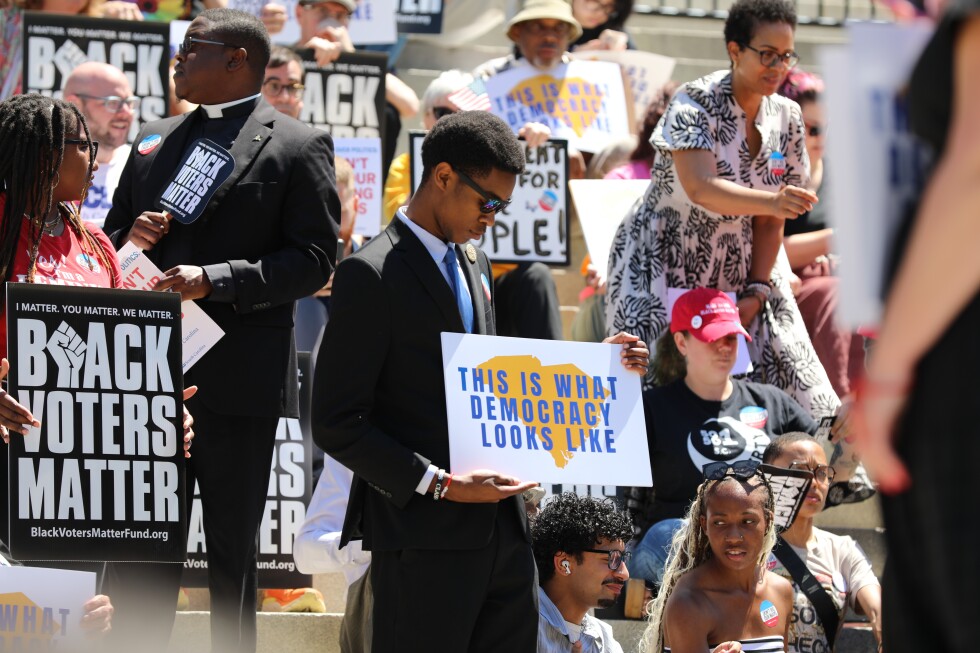
In a renewed rallying cry for civil rights, a diverse coalition of leaders is set to gather in Alabama, aiming to combat efforts perceived as dismantling the progress made under the Voting Rights Act. The movement, described as a continuation of the struggle for equality, seeks to address contemporary challenges posed by recent legislative changes.
NAACP President Derrick Johnson emphasized the urgency of the situation, stating, “We have to respond as quickly as possible.” He further questioned, “How do we as a country really address the effort to shrink us backwards into a 1950s reality?”
Historic Gathering in Alabama
This weekend, numerous organizations are converging in Alabama, not as the climax of a movement, but as a potential springboard for renewed activism. Events are planned in Selma and Montgomery to commemorate the pivotal moments that led to the 1965 Voting Rights Act.
The recent U.S. Supreme Court ruling, which restricts the consideration of race in district drawing, has fueled the call for action. The decision, viewed by many as a weakening of the Voting Rights Act, is a catalyst for this new wave of advocacy.
Challenges Ahead
Civil rights advocates recognize the uphill battle against a conservative network that holds significant influence across federal and state institutions. Jared Evans from the Power Coalition for Equity and Justice remarked on the historical significance of the Voting Rights Act, noting that recent decisions have undermined its foundational role.
Georgia Senator Raphael Warnock, speaking from the Ebenezer Baptist Church, likened the current situation to “Jim Crow in new clothes,” emphasizing the need for political, economic, and personal empowerment.
Congressional Action
Efforts are underway to revive legislative measures, such as the John R. Lewis Voting Rights Act, aimed at curbing partisan gerrymandering and reinstating federal oversight of election procedures. U.S. Rep. Terri Sewell highlighted the importance of developing modern criteria to address discriminatory practices.
The Supreme Court’s stance allows states to argue that redistricting decisions are based on political, not racial considerations, a point praised by former President Donald Trump as aligning with the original intent of the Voting Rights Act.
Mobilization and Future Strategies
Activists and advocacy groups are already engaging with state legislatures to challenge recent redistricting efforts. The anticipation of the Callais decision has prompted states like Florida and Texas to pre-emptively redraw district maps.
South Carolina, however, has seen some resistance from within the Republican ranks, with state Senate Majority Leader Shane Massey opposing plans perceived as disenfranchising Black voters.
Beyond Partisan Politics
While the immediate focus is on electoral representation, Derrick Johnson of the NAACP argues that the broader agenda involves protecting a range of rights that transcend racial lines. The ongoing battle is framed not just as a Black issue, but an American one.
Building a Movement
Despite the challenges, there is a growing engagement among diverse groups, as evidenced by large participation in organizing efforts and legal challenges against new district maps. The historical parallels with the prolonged struggle for desegregation highlight the need for perseverance in the face of adversity.
As the movement evolves, leaders like Johnson reflect on past tensions within civil rights efforts, emphasizing that unity amidst diversity of strategies is crucial for progress.