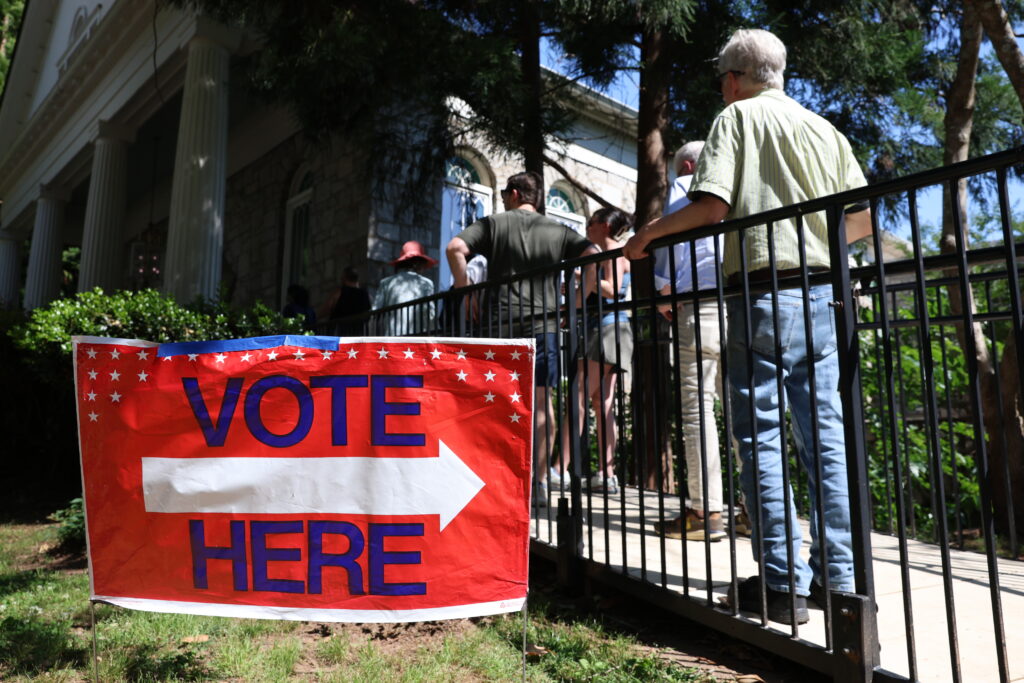
Democratic Voter Surge in Georgia’s Primary Election
ATLANTA — In a surprising turn of events, more Democrats than Republicans participated in Georgia’s recent primary election, reversing the outcome from four years ago when the GOP had a clear advantage.
This significant increase in Democratic turnout could either be an isolated occurrence or indicate a lasting trend as the November general election approaches, where the two parties will face off directly.
The Democratic voter turnout for the governor’s race saw a 50% increase compared to the 2022 primary, while Republican participation decreased by 25%.
Four years ago, Stacey Abrams faced no Democratic opposition for governor, potentially reducing the incentive for her supporters to vote. This year, despite U.S. Sen. Jon Ossoff having no Democratic challengers, voter participation for him rose by over 40% compared to the 2022 Senate race, where fellow Democrat U.S. Sen. Raphael Warnock had faced a challenger. Republican turnout in that race also declined by nearly 25%.

Statewide races reflected similar patterns, with the Democratic turnout for the attorney general race increasing by more than 350,000, while Republican turnout dropped by over 280,000.
Andra Gillespie, a political scientist at Emory University, commented on the shift, stating, “It’s not a good sign for Republicans.” She noted that the results in Georgia mirrored national trends, with rising costs and the country’s conflict with Iran coinciding with declining poll numbers for President Donald Trump.
However, Gillespie also noted that polling indicates Georgia still has a larger Republican voter base. “So Democrats still have to work hard, and harder, to be able to win even under favorable national conditions,” she said.
Voter Trey Conley, 37, who voted at the Dianne Wright Innovation Center in Hiram, chose Jason Esteves among the Democratic candidates for governor. Conley, whose family predominantly votes Republican, stated, “We’re trying to flip the state one person at a time.”
By the following day, Democrats had cause to celebrate, having drawn 1.1 million voters to the polls, making up about 53% of the votes cast. Republicans, on the other hand, garnered approximately 940,000 votes, just over 45%.
In a statement, state Senate Democrats proclaimed, “Georgians overwhelmingly voted for Democrats Tuesday night, sending Republicans, billionaires, special interests, and massive corporations a clear message: Georgians won’t let you push them around anymore.”
Despite the favorable turnout for Democrats, it was a primary election, typically attracting more dedicated voters. Though nearly 2.1 million voters participated, this represented only 28.1% of active voters.
Republicans found a silver lining with former Atlanta Mayor Keisha Lance Bottoms’ decisive win in the Democratic race for governor, securing 56% of the vote. A regional spokeswoman for the Republican National Committee criticized Bottoms, calling her “a defund-the-police lunatic” and predicting her defeat in November.
At an Atlanta polling site, Chris Heller voted for Esteves, citing his “progressive mindset.” However, Heller, who does not identify as a Democrat, expressed skepticism about Bottoms’ ability to secure enough votes to turn Georgia blue in the general election.