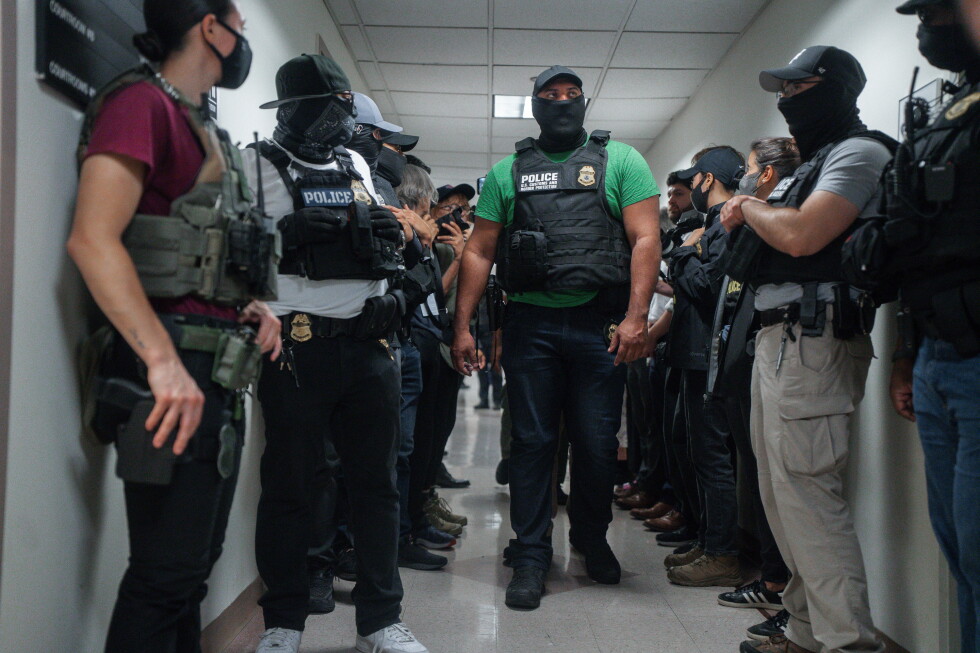
Federal Judge Rules Against New York’s Attempt to Regulate Federal Agents’ Attire
In a significant legal development, a federal judge decided Monday that New York’s attempt to mandate federal agents to wear visible identification and prohibit face coverings is unconstitutional. This follows an earlier decision affecting a comparable law in California.
The case was heard in the Northern District of New York, where U.S. District Judge Mae D’Agostino emphasized that while the state’s aim for transparency in law enforcement is commendable, the core issue is the constitutionality of such measures.
“The issue now before the Court is about constitutionality—not transparency or preferable policy decisions,” Judge D’Agostino clarified in her ruling. She pointed out that the measures likely infringe upon the supremacy clause of the U.S. Constitution, which restricts state authority over federal law enforcement.
The challenged regulations were part of a broader set of law enforcement initiatives included in New York’s state budget, signed by Governor Kathy Hochul in May. The legislation, which became effective in June, was intended to enhance transparency by requiring federal agents to be easily identifiable.
In response to the court’s decision, Governor Hochul and New York Attorney General Letitia James stated, “We stand firm in our belief that masked agents do not make New York safer and our offices are reviewing all legal options at this time.”
California had previously set a precedent with its legislation, becoming the first state to generally ban facial coverings for law enforcement officers. This law was enacted following a series of high-profile immigration raids in Los Angeles and was later blocked by judicial intervention.
The implications of these legal battles extend beyond New York and California. Several states have pursued similar measures to impose regulations on federal immigration agents. For instance, the U.S. Department of Justice filed a lawsuit against Connecticut in May regarding its law against federal agents wearing masks.
The ongoing legal disputes highlight the tension between state initiatives for transparency and federal oversight on law enforcement practices, with potential national repercussions on how states can regulate federal agents within their jurisdictions.