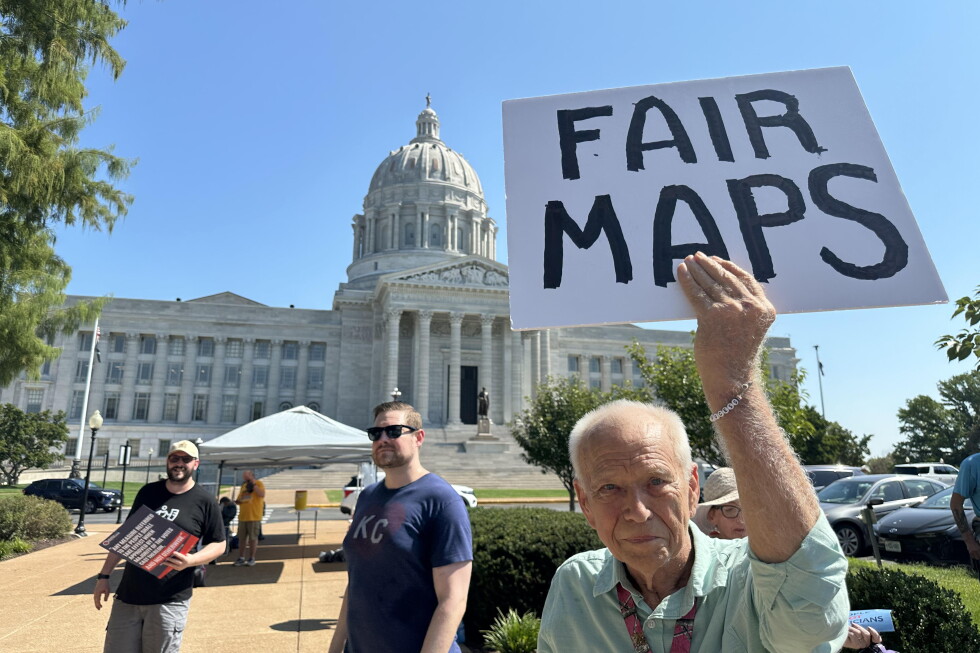
Confusion reigns in Missouri as voters and officials grapple with a prolonged redistricting debacle. On Tuesday, a federal judge in Missouri halted the use of outdated congressional maps for the upcoming November election, intensifying an already complex situation after the U.S. Supreme Court opted not to intervene.
The ongoing saga of Missouri’s redistricting has left many voters uncertain about their congressional districts as Election Day approaches. This complexity was further compounded when the Missouri Supreme Court barred the use of a new U.S. House map endorsed by President Donald Trump, following substantial public opposition and a petition for a statewide vote.
The U.S. Supreme Court’s decision not to hear an appeal from Missouri’s Republican attorney general maintained the Missouri Supreme Court’s injunction. However, U.S. District Judge Stephen Clark issued a temporary order that prevents Missouri from using any maps other than those supported by Republicans, which had been utilized in the August primary.
Although the primary winners were confirmed, uncertainty looms over which districts will be employed for the November election. Clark’s order will stand for 14 days, allowing for further legal proceedings. Missouri Attorney General Catherine Hanaway acknowledged the state’s obligation to adhere to Clark’s directive, stating it mandates the use of the new congressional districts. Meanwhile, Republican Secretary of State Denny Hoskins called the federal court’s order a triumph that averts a major constitutional crisis.
Nevertheless, the Missouri Supreme Court’s ruling against the new map remains effective, according to Chuck Hatfield, legal representative for People Not Politicians, the group responsible for the referendum petition. Hatfield emphasized, “An individual federal judge cannot overrule the Missouri Supreme Court.”
Concerns Over Voter Confusion
Hanaway has argued that altering districts between elections infringes on federal rights and creates voter confusion, a point Judge Clark echoed in his decision. “Using a different map for the general election would wreak havoc on the fairness and orderliness of Missouri’s congressional elections,” Clark wrote, warning of inevitable widespread voter confusion.
Justice Brett Kavanaugh of the U.S. Supreme Court offered no explanation for the refusal to hear the case. Missouri laws set a cutoff to adjust the November ballot on Tuesday, but federal law requires absentee ballots be mailed out by September 19.
Strategic Redistricting and Political Implications
The contested map was created following a special session convened by Missouri Gov. Mike Kehoe, at Trump’s behest, to gain a strategic advantage ahead of midterm elections. This revised map significantly altered the 5th Congressional District, represented by Democratic Rep. Emanuel Cleaver, by reallocating parts of Kansas City to districts held by Republicans and extending Cleaver’s district into rural Republican territories.
State Sen. Rick Brattin, winner of the Republican primary for the altered district, joined a lawsuit leading to Clark’s decision. Brattin applauded the court’s action, pledging continued efforts in his campaign.
Legal Challenges and Ballot Implications
On Missouri’s primary day, Hoskins rejected a petition demanding a referendum on the map, citing constitutional constraints. Though initially supported by a lower court, the Missouri Supreme Court overturned this decision, freezing the new districts when the petition was filed and mandating the inclusion of the redistricting proposition on the ballot as Proposition A.
Missouri, following Texas, responded to Trump’s call to redraw districts last year. Republicans aimed to secure up to 16 new seats across several states, while Democrats hoped to gain up to six seats in states like California and Utah. However, Trump’s approval ratings and typical midterm trends could challenge Republican prospects.