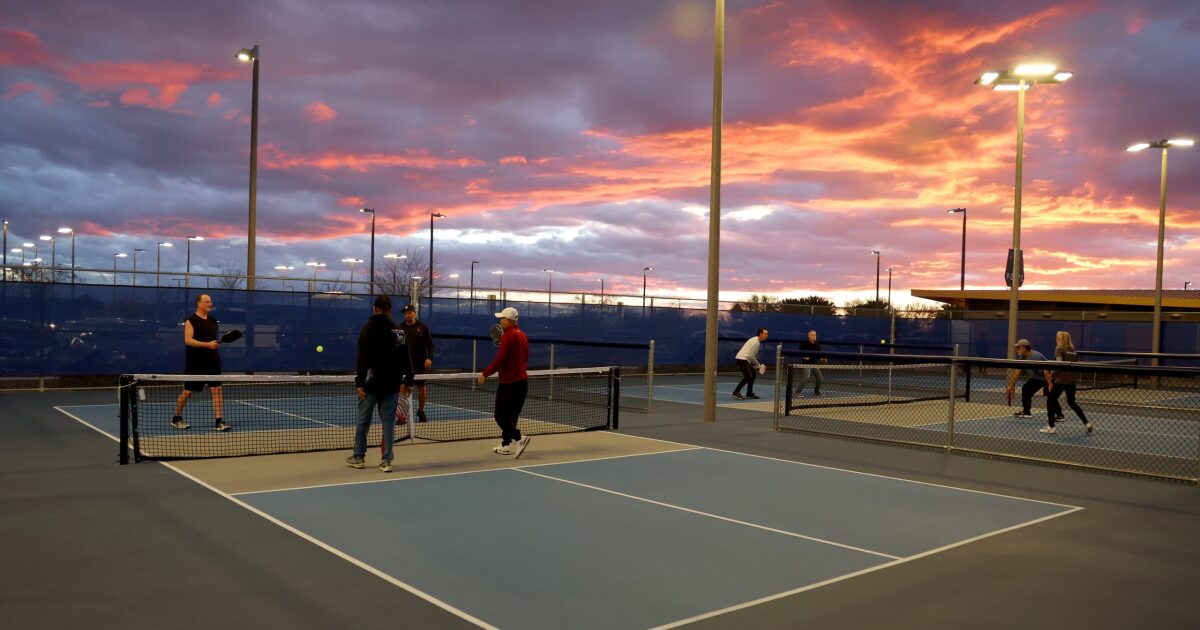
Across the globe, recreation centers reverberate with the distinct sound of a plastic ball hitting a paddle. This once niche activity has now taken over courts everywhere, becoming a staple even at high school levels.
Originating from a casual game on Bainbridge Island near Seattle back in 1965, pickleball has rapidly grown to become the fastest expanding sport in the United States for the past four years, as noted by a study from the Sports and Fitness Industry Association.
The sport’s appeal spans all ages, financial backgrounds, and athletic abilities, drawing an unexpected following among high school athletes. Riley Palmer, who directs pickleball at Mesa’s Dink and Dine Pickle Park, emphasized the growing interest, stating, “There are tons of high school clubs. I’m a junior competitive club coach for Monster Athlete as well, and they had over 180 kids, 18 teams. It is picking up with a lot of speed, hopefully quickly becoming an Olympic sport.”
This weekend, the facility is set to host the inaugural high school pickleball state championships, featuring over 20 club teams and competitions in various categories including boys and girls singles, doubles, and mixed doubles.
The increasing popularity of pickleball is evident, yet for some participants, the focus is more on the journey than the destination. The sport offers a way to engage youth, getting them off their phones and into a social setting where they can forge new friendships, according to Palmer.
As pickleball’s popularity surges, discussions arise about its potential recognition as an Arizona Interscholastic Association (AIA) high school sport. However, this process is complex and gradual. Seth Polansky, AIA’s director of media services, explains, “So if the school’s been playing a sport for a certain while and they say, ‘We want to be part of the AIA oversight,’ the schools will make an application…our executive board will hear the case and see if they want to add it or not.”
Once approved, the sport enters an “emerging status,” meaning it lacks a sanctioned championship initially. Polansky mentions, “Basically, they’ll be playing by the rules they play with and then the AIA would oversee it for typically two years.” During this period, surveys determine broader school interest in adopting the sport.
Kenny Cail, the commissioner of National High School Club Pickleball, is keen to expedite this process. He actively informs schools about pickleball’s benefits, highlighting the sport’s growth at the collegiate level, where teams have surged from 41 to over 250.
Cail, with a background in high school coaching, values sports for their role in young people’s lives. He advocates for a sport like pickleball that doesn’t demand specific physical attributes, allowing broader participation.
Supporting Title IX, Cail sees pickleball as a coed sport that offers equal opportunities. “It’s a great Title IX sport because it’s not separate but equal, but you can have mixed doubles,” he said, noting the social benefits for young athletes.
Although the AIA hasn’t prioritized pickleball, past instances like girls flag football demonstrate how rapid growth in participation can fast-track a sport’s adoption.
Cail envisions a grassroots approach where parents drive the sport’s integration within schools, potentially bypassing lengthy official processes.
Teenagers’ enthusiasm mirrors pickleball’s widespread appeal. Palmer shares, “I’ve been playing with my kids since they were 7, but I can also get out there and play with my dad, who’s almost 80.” The sport serves as an inclusive activity for all ages, promoting physical and mental well-being.
The average player’s age is now around 35, but adults and seniors initially propelled pickleball’s rise. Wendi Sobelman, a dedicated player, observes the trend: “I see the amount of players growing as the kids are getting very into it now and as they grow up with it and keep playing.”
Pickleball’s simplicity and strategic gameplay attract players of all ages, offering a unique blend of challenge and accessibility. Palmer notes, “Whether you are older or younger, you can actually play together because a lot of it has to do with where you’re placing the ball.”
The game’s social aspect further fuels its popularity. Caiden Hardy from Center Court Pickleball Club remarks, “Creating a social group and getting to meet new people grows the sport.”
As the sport continues its exponential growth, enthusiasts like Palmer encourage newcomers, stating, “I would just say, give it a try. I’ve never had anyone – and I’ve taught over 3,500 people – leave and say, ‘I didn’t like that.’”
This article first appeared on Cronkite News and is republished here under a Creative Commons Attribution-NoDerivatives 4.0 International License.
-
Arizona State signed football coach Kenny Dillingham to a five-year contract extension that will raise his average annual salary to $7.5 million, a person familiar with the contract told The Associated Press on Saturday.
-
Revisit the most popular Show stories on KJZZ.org this year.
-
Revisit the most popular business stories on KJZZ.org this year.
-
The franchise is part of the largest professional baseball league in Mexico and was based in Navojoa, Sonora. This year, they announced it would be moving stateside and be known simply as the Tucson Baseball Team.
-
A new women’s health hub will be among the first projects developed in Mesa’s new Palo District.