In a dramatic move to address the escalating migrant crisis, Spain has decided to send military forces to the border of its North African enclave, Ceuta, which borders Morocco. This decision follows the entry of thousands of migrants into the territory, a situation that has already claimed at least nine lives.
Local officials in Ceuta had urgently requested assistance from Madrid as the border situation reached a breaking point on Thursday, with large groups of migrants breaching the fence. To restore order, the Spanish government announced the deployment of the Armed Forces alongside the Civil Guard to enhance security in Ceuta. The Prime Minister of Spain, Pedro Sánchez, is scheduled to visit Ceuta with Interior Minister Fernando Grande-Marlaska.
Rachid Sbihi, leader of the association representing Spain’s Civil Guard at the Ceuta border, described the situation as “absolute chaos” and noted that the border was “totally collapsed” with “thousands of migrants crossing.”
Achraf Maimouni, part of the Moroccan Association for Human Rights, called the situation “exceptional,” noting that the Tarajal border was opened under unusual conditions, allowing people to cross.
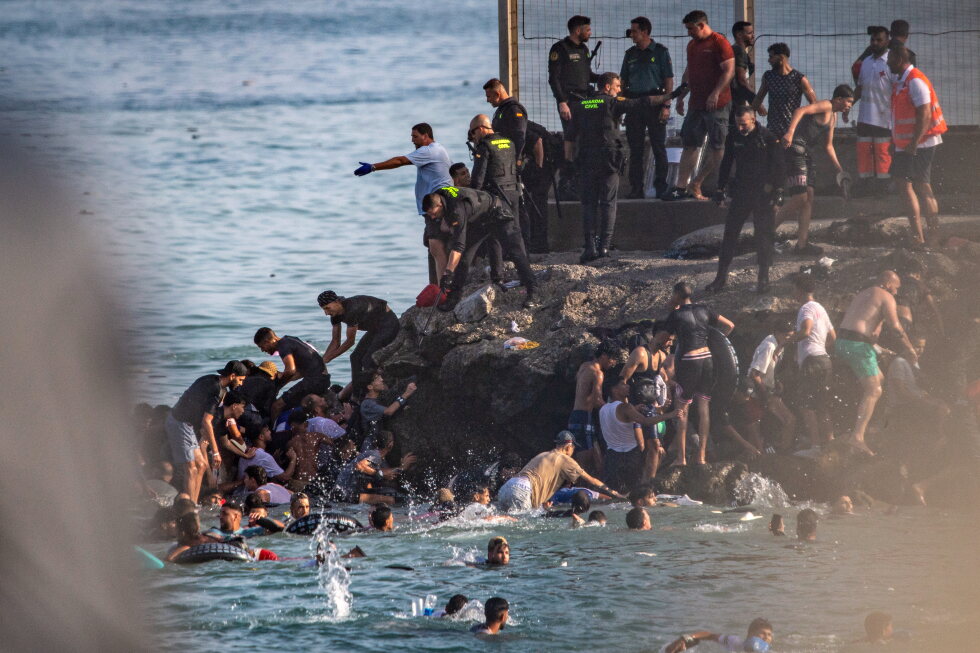
Footage captured large numbers of mostly Moroccan individuals, including families, crossing over the breakwaters at Tarajal beach. Some were heard shouting “Viva España!” though the reasons behind the sudden increase in crossings remain uncertain.
Unclear Motives Behind Migrant Surge
The surge in migrant arrivals marks an escalation following an increase in attempts to reach Ceuta by swimming. Despite the chaos, Morocco has not commented on the situation, though Spain’s Interior Ministry acknowledged that Moroccan authorities were cooperating to address the issue. Both nations have committed to expedite the return of individuals who entered Ceuta illegally.
Although Ceuta’s regional leader, Juan Jesús Vivas, requested a national emergency declaration, the Spanish government deemed such a step unnecessary, focusing instead on coordinating a rapid response. The Supreme Court’s recent ruling, which prevents the immediate return of sea-arriving migrants without due process, was thought to influence the situation but is doubted by activists as a primary cause.
In Italy, the situation has prompted Premier Giorgia Meloni to threaten suspending the Schengen agreement with Spain, despite the lack of a direct border, to protect national security.
The movement of migrants across the border echoes a similar crisis in May 2021 when diplomatic tensions between Morocco and Spain allowed thousands of migrants to enter Ceuta. This previous influx was linked to Spain providing medical treatment to a Polisario Front leader, leading to accusations against Morocco for loosening border controls.
As of mid-July, approximately 3,000 migrants have entered Ceuta this year, according to Spain’s Interior Ministry, with many attempting the perilous journey by swimming from nearby Moroccan towns.