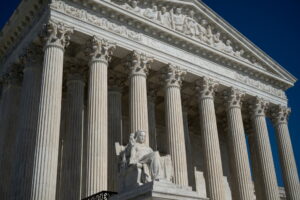
In a significant development impacting businesses nationwide, the U.S. Supreme Court has ruled that former President Donald Trump’s decision to impose heightened import taxes lacked constitutional authority. This decision has resulted in companies beginning to receive refunds on tariffs paid during that period.
Nonetheless, this process may face delays due to the Trump administration’s announcement of their intention to challenge a federal judge’s ruling. The ruling permits all companies affected by the invalidated duties to seek refunds, not only those who initiated lawsuits.
The refund system, managed by U.S. Customs and Border Protection, had been functioning efficiently until the Department of Justice announced its appeal plans. According to CBP, the first applicants received their refunds on May 12, just a few weeks after the start of the online claims submission process.
As of May 22, applications for $85 billion in refunds, over half of the $166 billion owed to businesses, had been accepted for processing. CBP has instructed the Treasury Department to issue $20.6 billion in refunds thus far.
Despite the administration’s decision to appeal, Judge Richard K. Eaton has demanded answers from CBP Commissioner Rodney Scott regarding the timeline for repaying the 330,000 eligible importers. The judge has scheduled a hearing for June 9 to address the matter and explore ways to accelerate the refund process.
Justice Department lawyers have requested that deputies appear instead of Scott, citing the CBP chief’s high-ranking position as a presidential appointee. They also argued that Judge Eaton overstepped his authority in March by ruling that the Supreme Court’s decision entitled “all importers of record” to refunds.
The legal team stated, “For that reason, defendants intend to appeal the court’s universal injunction,” while confirming that CBP would continue processing refunds promptly for businesses involved in ongoing trade court complaints.
Judge Eaton emphasized the importance of refunding the unlawfully collected duties, stating, “This case involves $166 billion. It is undisputed that the remedy for this unlawful collection is for the United States government to refund the unlawfully collected duties.”
Some large retail chains have announced plans to use their tariff refunds to reduce customer prices. Walmart’s CFO, John David Rainey, mentioned price cuts, although the maximum refund could be less than half a percent of Walmart’s annual U.S. sales, which total $483 billion.
Smaller companies have expressed intentions to allocate partial refunds toward covering remaining tariffs, reducing debt, or maintaining operations amid financial uncertainty. Basic Fun CEO Jay Foreman reported receiving $450,000, about 7% of his claim, and urged the release of funds to support business operations.
Foreman commented, “It’s time to release the funds back into the economy, especially given how much we and others need these funds to support our businesses and fund our operations.”