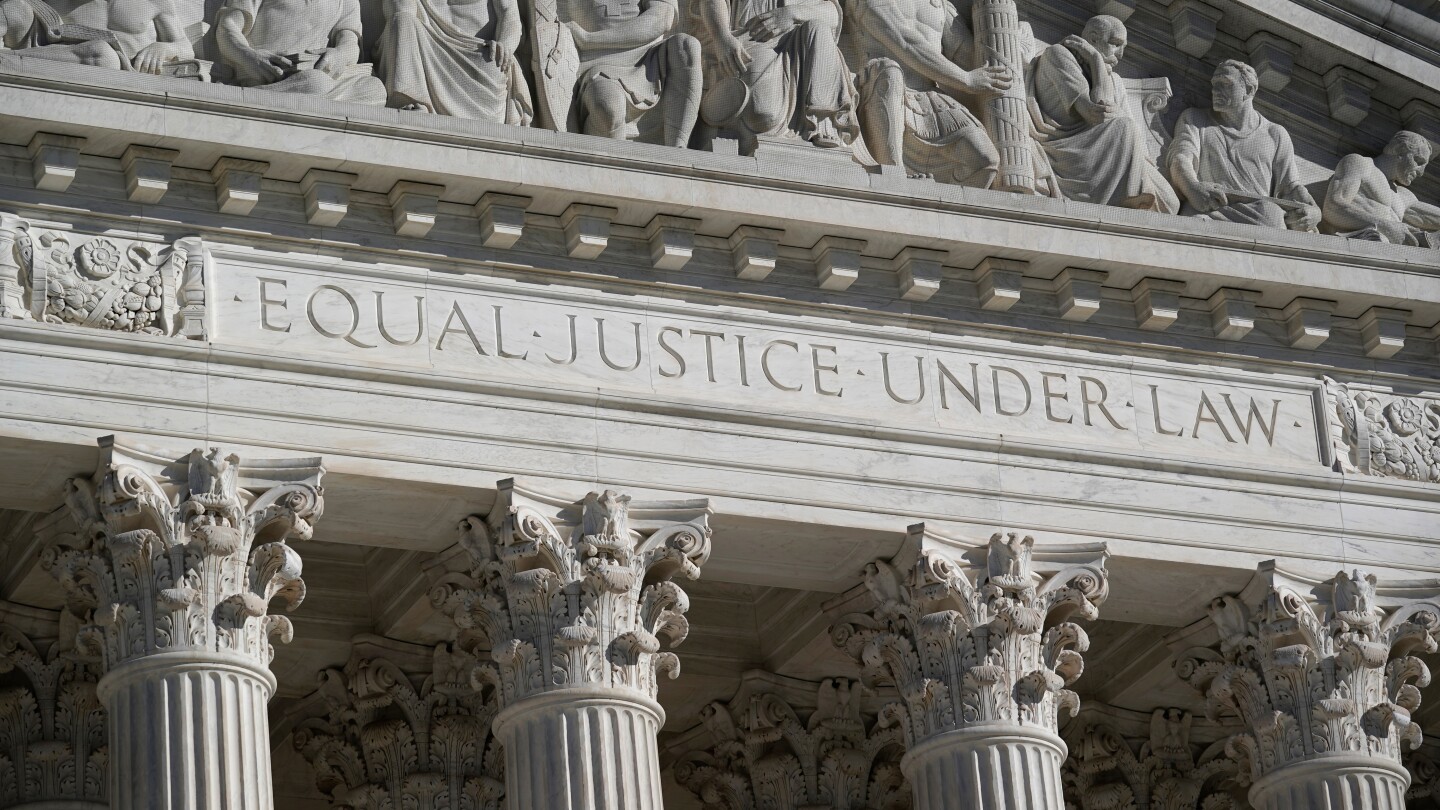
As the Supreme Court gears up to deliberate on a pivotal case, a critical issue emerges: will the conservative-dominated court apply the same stringent criteria to President Trump’s administration as it did to limit the initiatives of his Democratic successor, Joe Biden? The case in question revolves around Trump’s extensive tariffs, a signature element of his economic strategy.
The legal arguments at the center of the challenges to Trump’s tariffs are similar to those used against significant Biden-era policies and are set to be debated at the Supreme Court this coming Wednesday. Business entities and states challenging the tariffs are even calling out the three conservative justices appointed by Trump, hoping to gain their support in overturning a key aspect of his economic agenda.
Trump’s Justification for the Tariffs
Trump utilized the International Emergency Economic Powers Act (IEEPA), asserting that ongoing trade deficits had led the U.S. to the brink of an “economic and national-security crisis.” Additionally, the administration highlighted a separate crisis stemming from the deaths attributed to imported fentanyl. While the IEEPA does not explicitly mention tariffs, the administration claims its provisions are sufficient to justify them.
Congress’s Clarity Requirement on Major Policies
In recent years, conservative majorities have made it more challenging for the Biden administration to enact significant policies, like those aimed at combating climate change. The court has also dismissed efforts related to the pandemic, such as halting evictions and mandating vaccines for large companies, and has struck down Biden’s student loan forgiveness program.
In each instance, the court maintained that Congress had not granted explicit authorization for actions of substantial economic and political importance, a principle known as the major questions doctrine. The U.S. Court of Appeals for the Federal Circuit applied this precedent to the tariff case, suggesting the tariffs have a far greater economic impact than previous cases.
Challengers to the tariffs are leaning heavily on past Supreme Court opinions. Lawyers for Learning Resources Inc., a toy company, referenced Justice Neil Gorsuch’s opinion, warning against legislation becoming merely the will of the sitting president. Similarly, other businesses pointed to Justice Amy Coney Barrett’s opinion on the student loan case, arguing that Trump’s invocation of IEEPA goes beyond what Congress intended.
Further, a dissent by Justice Brett Kavanaugh in another pandemic-related case was highlighted, emphasizing the risks of unchecked emergency powers.
Debate Over the Major Questions Doctrine’s Relevance
The Trump administration contends that the major questions doctrine is not relevant in the tariffs case. Judge Richard Taranto, in a dissenting appellate opinion joined by three other judges, argued that presidents have significant leeway in foreign affairs and national security, which should extend to emergency statutes like IEEPA.
Taranto stated that Congress made a deliberate choice to grant the president extensive authority, and therefore, the major questions doctrine should not apply. Kavanaugh supported this view, noting that the doctrine has never been used in foreign policy or national security contexts and that substantial presidential authority is typically assumed in such matters.
Taranto’s view drew from a 1981 Supreme Court decision during the Iranian hostage crisis that supported President Carter’s use of emergency powers to unfreeze assets, with Justice William Rehnquist authoring the opinion.
For continuous updates on the Supreme Court, visit the AP’s Supreme Court coverage.