Educational Gains in Modesto Amidst National Reading Challenges
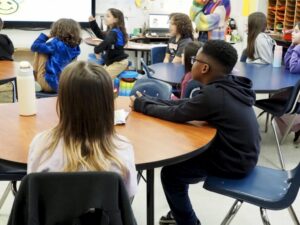
In Modesto, California, classrooms are buzzing with energy as students prepare for tests with lively dance sessions, thanks to the creative approach of teacher Nancy Barajas. Her sixth graders enjoy a “pre-celebration” before exams, which may be contributing to the district’s rising academic scores.
While Modesto celebrates increasing scores in reading and math, a national “reading recession” looms, with many districts struggling to recover from pre-pandemic levels. A comprehensive study by Harvard, Stanford, and Dartmouth highlights the disparity, revealing that only a handful of states, alongside the District of Columbia, have shown meaningful progress in reading from 2022 to 2025.
The study, which analyzed data from over 5,000 districts across 38 states, underscores a lackluster national performance where students lag nearly half a grade level in reading compared to pre-pandemic metrics, with math showing slight improvements.
Critics argue that traditional reading methods, which often overlooked phonics, contributed to declining scores over the past decade. Recent shifts toward phonics-based instruction aim to reverse this trend, yet success varies. For instance, states like Florida, Arizona, and Nebraska, despite adopting new methods, saw scores drop.
Thomas Kane of Harvard University, a co-creator of the Education Scorecard, described the pandemic as exacerbating an ongoing decline that had begun years prior. Efforts are underway to bridge these educational gaps, with some states finding success through phonics and additional support for struggling readers.
Most states reported improvements in math from 2022 to 2025, with reduced student absenteeism. Notably, over 400 districts, including Modesto, surpassed state averages in reading or math growth compared to similar demographics.
Phonics and Educational Support Driving Change
Researchers continue to debate the underlying factors of the reading decline, pointing to increased smartphone use and decreased recreational reading as potential influences. Moreover, states have lessened punitive measures for schools failing to meet test score benchmarks, according to Kane.
However, states like Louisiana, Maryland, Tennessee, Kentucky, and Indiana have seen success by mandating phonics-based instruction, known as the “science of reading.” In Modesto, this approach has been part of a broader strategy, including the establishment of a new department for English learners and enhanced teacher training through programs like LETRS.
Modesto’s efforts have translated into significant academic gains, equating to an additional 18 weeks of learning in math and 13 weeks in reading. Despite these improvements, the district acknowledges more work is needed to raise overall scores to grade-level standards.
Detroit’s Attendance Focus Bears Fruit
Detroit’s school district has also made strides, bolstered by concerted efforts to improve attendance and educational conditions. A landmark $94 million settlement from a 2016 lawsuit, which addressed poor school conditions, has supported these initiatives.
Superintendent Nikolai Vitti emphasized the ongoing challenge of motivating students, despite notable progress in test scores. At Munger Elementary-Middle School, targeted support from 18 educators and proactive attendance measures have contributed to improved outcomes.
Southern States Leading Educational Reforms
Southern states have emerged as leaders in educational reforms, moving swiftly to adopt research-backed teaching methods. Louisiana and Alabama, for instance, have implemented phonics-based approaches, with Louisiana exceeding its pre-pandemic reading scores and Alabama making significant gains post-pandemic.
Alabama’s Numeracy Act, inspired by its reading successes, has standardized math instruction and introduced regular testing and interventions for students lacking math skills. Schools like Oxmoor Valley Elementary in Birmingham have benefited from these reforms, steadily improving despite ongoing challenges.
Experts, including Stanford’s Sean Reardon, highlight the potential for nationwide educational improvement, citing historical progress that saw significant gains in test scores and reduced racial disparities until the mid-2010s.
In Modesto, Barajas’s students engage in daily reading exercises, pairing English learners with native speakers to enhance fluency. A student summed up the experience: “Eventually, you get through the word like it’s water. You just say it smooth.”