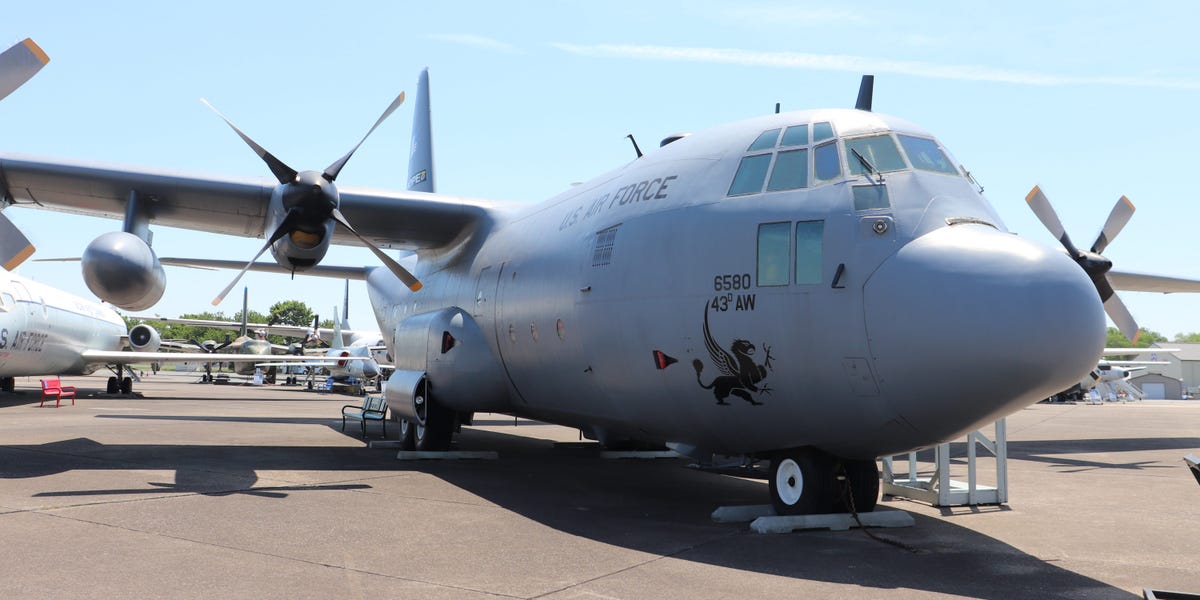
The C-130 Hercules stands as a testament to aviation versatility and endurance. Known for its unparalleled adaptability, this aircraft has served militaries and civilians alike for over seven decades. Michael Hurlburt, operations manager at the Air Mobility Command Museum and a US Air Force veteran, stated, “A lot of people, including myself, claim this is the best airplane ever built, period. Military, civilian, cargo, passenger, fighter — I don’t care. It can do anything, go anywhere.”
C-130: A Legacy of Longevity and Versatility
Since its first flight in 1954, the C-130 Hercules has maintained the longest continuous production run in military aviation history. Lockheed Martin continues to produce this aircraft, with the C-130J model introduced in 1996, costing $75.5 million in 2017 according to the Air Force. The larger C-130J-30 variant can carry an extra 2,000 pounds of cargo.
Multi-Mission Capability
The C-130 Hercules is celebrated for its ability to be tailored for diverse missions. It can transport cargo, troops, and airdrop humanitarian aid. It is also used for medical evacuations, disaster relief, firefighting, and can be converted into gunships. The US Air Force has even experimented with using them as improvised bombers.
Refueling and Terrain Flexibility
Certain C-130 models can refuel mid-air, extending their operational range. The KC-135 Stratotanker is one such aircraft that facilitates in-flight refueling. Furthermore, C-130s can take off and land in varied climates, including icy terrains, thanks to their ski-equipped versions.
Global and Domestic Use
The C-130 is utilized by almost every branch of the US Armed Forces and over 40 countries worldwide. “Every single branch of service uses these, except for the Space Force — they don’t yet, but I’m sure they will soon,” Hurlburt remarked. The latest defense appropriations bill includes funding for C-130s for the Air National Guard, Marine Corps, and Navy Reserve.
Exhibition and Specifications
The Air Mobility Command Museum in Delaware features a retired C-130E Hercules, which served the US Air Force from 1969 until its retirement in 2004. Visitors can explore this aircraft daily, with free admission. Its fuselage still displays the fighting gryphon, symbolizing the 43rd Airlift Wing.
Technical Features and Crew Roles
The C-130E Hercules is powered by four turboprop engines, each with four-bladed propellers. These engines are optimized for low altitude, durable performance. The flight deck accommodates pilots, a flight engineer, and a navigator, who traditionally uses a sextant, though newer models now rely on GPS.
Onboard Experience
While the C-130 excels in many areas, comfort is not its strong suit. Hurlburt noted, “There’s one thing the C-130 does not do well: bathrooms. A single bucket serves as the only restroom on the plane.” The galley is minimal, with a small oven for reheating food brought by service members.
Legacy of the C-130
Despite the retirement of older models, the C-130 continues to be a vital asset for global military operations. At its 70th anniversary celebration in 2024, the Air Force praised the enduring legacy of the C-130, highlighting its ongoing service in numerous roles.