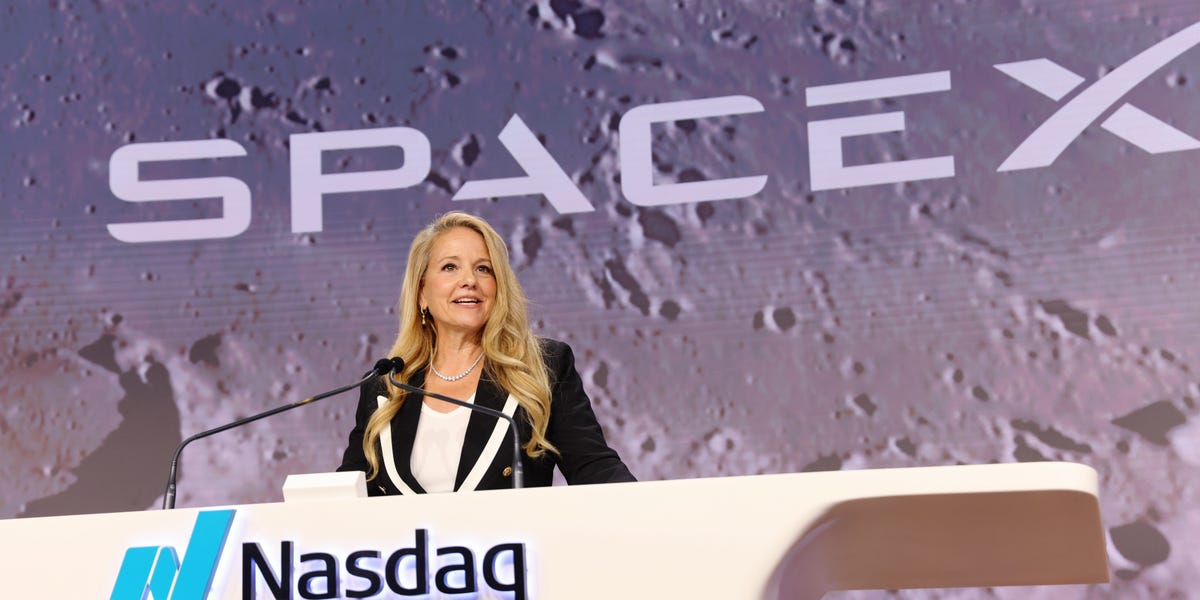
SpaceX is setting its sights on the mobile industry by transforming Starlink Mobile into a comprehensive mobile carrier, aiming to challenge the dominance of major wireless providers in the process. The company is gearing up for this ambitious venture with plans to enhance its satellite services significantly.
During SpaceX’s initial earnings call following its June IPO, President Gwynne Shotwell revealed the company’s roadmap to deploy next-generation Starlink Mobile satellites by 2027. The company anticipates offering upgraded services by the year’s end.
This initiative will capitalize on the additional 65 megahertz of spectrum SpaceX has agreed to procure from EchoStar. According to Shotwell, this acquisition will make Starlink Mobile’s service “100 times better” than its current offering.
Shotwell explicitly mentioned the leading wireless carriers in the U.S.—AT&T, Verizon, and T-Mobile—asserting that Starlink aims to provide superior service. “I anticipate us to be able to acquire quite a few of their customers because I think our service will be better,” she stated.
At present, Starlink Mobile primarily serves as a satellite backup for phone carriers. Operating like space-based cell towers, these satellites link up with phones when terrestrial services are compromised, especially in isolated or emergency scenarios.
In the U.S., T-Mobile collaborates with SpaceX to provide satellite-to-cellular connectivity under the T-Satellite brand. This service, however, does not fully replace conventional 4G or 5G plans.
A T-Mobile representative highlighted CEO Srini Gopalan’s remarks during the company’s second-quarter earnings call in July. Gopalan noted that satellite-to-cell services complement traditional networks, as they accounted for merely 0.0003% of T-Mobile’s network usage during the peak summer period.
SpaceX is also contemplating building a terrestrial network to work in conjunction with its satellite system. Shotwell mentioned that the company could roll out cost-effective, compact cellular base stations equipped with Starlink dishes.
SpaceX CEO Elon Musk suggested that the resultant network would offer better connectivity and higher bandwidth “than what is currently available from cellular providers.” He expressed confidence in deploying numerous small stations, avoiding the need for costly, large cellular base stations.
In May, the Federal Communications Commission approved the transfer of EchoStar spectrum to SpaceX, paving the way for SpaceX to utilize it for satellite, terrestrial, or hybrid networks.
Shotwell did not provide details regarding the project’s capital investment. Representatives for Verizon and AT&T were unavailable for comment.