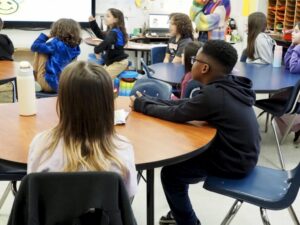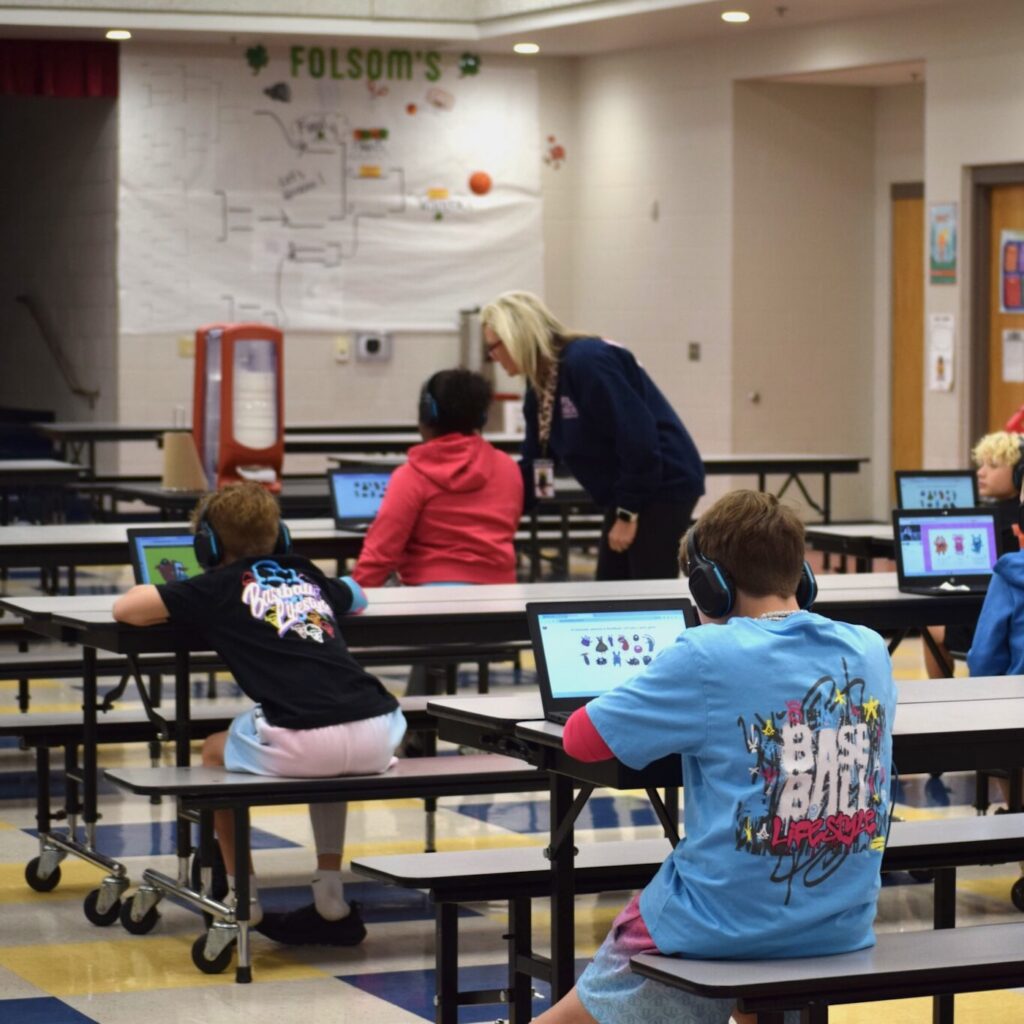

Students study on laptops inside an elementary school in Farmington, Arkansas, on March 19, 2026. School districts nationwide are grappling with which artificial intelligence tools to invest in. (Photo by Antoinette Grajeda/Arkansas Advocate)
As the academic year kicks off, the integration of artificial intelligence in classrooms is increasingly prevalent, with some schools employing AI to monitor student performance and attendance, or to enhance literacy skills. However, the myriad of AI options available leaves many educational leaders feeling overwhelmed as they decide where to allocate their budgets.
Despite some states and districts providing guidelines for evaluating AI investments, the burden largely falls on the districts themselves. The rapid evolution of AI technology outpaces the ability of school systems and state agencies to keep up, presenting a unique challenge unlike previous educational technology decisions, according to Mark Schneider of the American Enterprise Institute. “There’s always an asymmetry between what the providers know and what the districts know,” Schneider shared with Stateline.
With billions of dollars at stake, the U.S. education technology market, which encompasses computers, software, and digital content, was valued at nearly $48 billion in 2024. It is projected to surpass $90 billion by 2030, according to Grand View Research. The AI segment alone is expected to grow from $2.5 billion in 2024 to more than $15 billion by 2033 (source).
AI Application in Education
Scott Langford, Superintendent of Sumner County Schools in Tennessee, explained that his district began experimenting with AI to tackle stagnant middle school reading scores. They initiated a pilot project with Coursemojo, an AI-driven literacy tool that provides real-time feedback to students and teachers, and found it beneficial for classroom instruction. Langford emphasized the importance of identifying specific needs in the overwhelming AI edtech market: “The (AI edtech) market is so overwhelming for districts and for vendors. … Most of them don’t really do much that drives any kind of change for students.”
In Pennsylvania, Allentown School District, led by Superintendent Carol Birks, adopts a cautious approach to AI, focusing on student safety and data protection. Vendors are required to ensure that student data remains the property of the district, and cannot be sold or used to train AI models. Birks highlighted the challenge: “A significant challenge is that the onus of making these decisions is placed entirely back on the individual school district.”
Vetting AI Tools
Before AI tools can be used in classrooms, vendors are typically required to sign data processing agreements and pass rigorous security and privacy checks. Some states have established laws for traditional educational technology purchases, yet many school districts lack defined best practices for AI tool procurement.
Controversies have arisen over AI applications in schools. In Arizona and Kansas, lawsuits have been filed against school districts using Gaggle, a student-safety monitoring software. Additionally, the Los Angeles district faced backlash after a $3 million AI chatbot purchase went awry.
State education boards, like Pennsylvania’s, have begun issuing guidance on AI usage in schools. New York City Public Schools have updated their privacy and security standards to include AI, while Chicago Public Schools have implemented an AI Guidebook and blocked unapproved AI products.
The Southern Regional Education Board offers an AI procurement and evaluation checklist to assist K-12 schools, while experts recommend that AI tools be tested by adults before student use. “Anything with AI is a risky click,” cautioned Leslie Eaves of the Southern Regional Education Board.
Challenges and Considerations
Education expert Sue Thotz from Common Sense Media notes that districts face a significant challenge in ensuring compliance with privacy laws, often with limited resources. California’s approach with a standardized data privacy agreement provides a model for easing this burden.
Districts are also reviewing their existing technology inventories to prioritize tools that truly enhance education. An Instructure report reveals that districts have access to an average of 3,001 digital tools, but typically only a few are actively used.
As federal pandemic-era funding diminishes, school districts are scrutinizing every potential purchase. Dacia Toll, co-founder of Coursemojo, advises districts to align AI tool investments with proven cognitive science and teaching methods, emphasizing safety, usability, and efficacy.