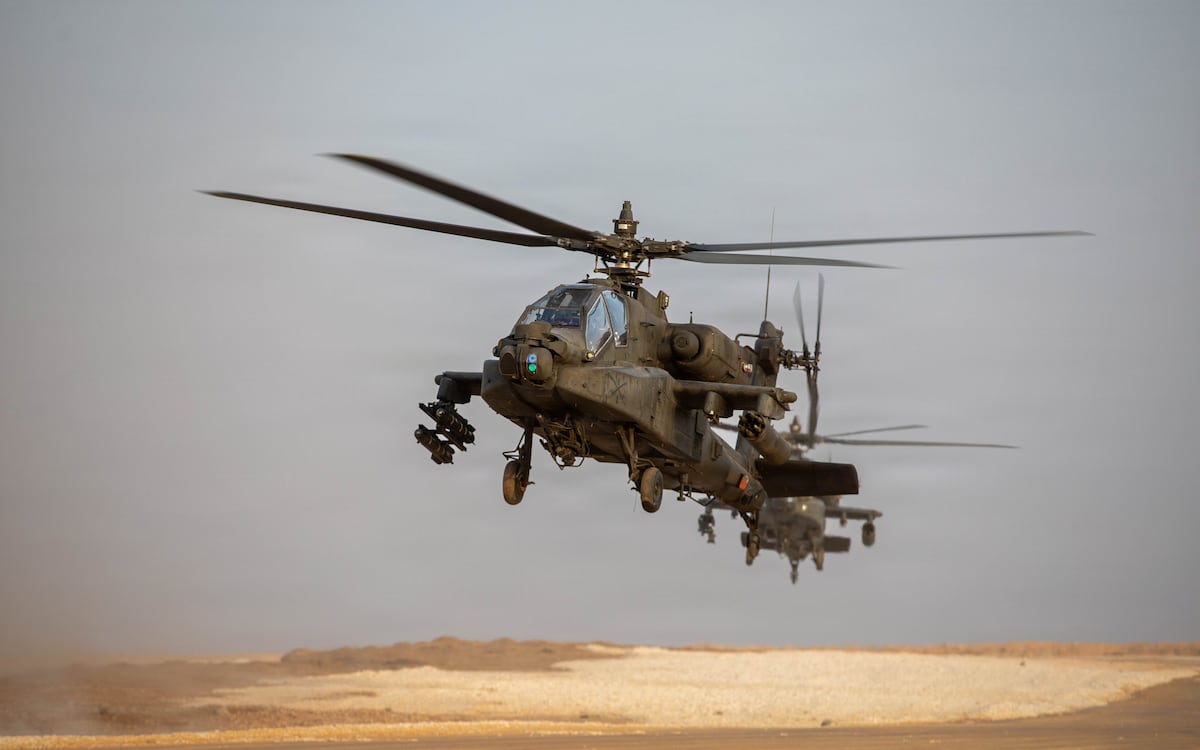
Hundreds of the Army’s most advanced attack helicopters are currently sitting on the ground — and they could stay there for months. The widespread grounding of AH-64E Apache helicopters raises real questions about U.S. combat readiness at a time when the military cannot afford gaps in its aviation capabilities.
The Army announced on October 2 an “immediate, temporary pause in flight operations” for its AH-64E Apache attack helicopters — the latest and most capable variant in the Apache family. The pause is not a minor inconvenience. It affects roughly 400 aircraft out of the Army’s total fleet of approximately 700 Apaches, touching every active-duty and National Guard Apache unit across the service.
The specific issue centers on helicopters equipped with Improved Drive System (IDS) transmissions. According to the Army, the grounding stems from ongoing technical and airworthiness concerns that have been building for some time.
“This action follows ongoing Army technical and airworthiness assessments of the Improved Drive System transmission, including information developed through prior Safety of Flight actions, inspection results, maintenance reporting, and ongoing engineering analysis,”
officials said in the announcement.
A Problem That Has Been Brewing
The transmission concerns are not new. Defense One reported in May that an Army investigation had found that the AH-64E’s improved drive system main transmissions
“can experience an internal failure resulting in loss of accessory gearbox drive, which can result in loss of tail rotor thrust, electrical power, and hydraulics,”
though the root cause remained unclear at the time.
The situation came to a head following a fatal crash on August 12, when an AH-64 Apache went down in a field near Fort Hood, Texas, killing both pilots aboard. That incident triggered a brief grounding of the entire Apache fleet. Army officials were subsequently able to determine that transmission problems did not cause the Fort Hood crash — that aircraft was an older Apache variant — but the event kept scrutiny on the AH-64E’s drive system at an elevated level.
Army safety reports show four major flight mishaps involving the AH-64E in the last fiscal year alone. Officials noted that one of those incidents involved a “catastrophic transmission failure” — a detail that added urgency to the Army’s response.
Before the full grounding order was issued, the Army had already sent out a safety-of-flight message requiring inspections of all AH-64E transmissions. Those inspection results appear to have been the tipping point. As an Army official explained to Military Times:
“That triggered a decision point for Army senior leaders who said, you know, let’s accelerate this and just put us on a glide path to do this as quickly as possible while maintaining operational readiness — let’s just go ahead and inspect and repair these as quickly as we can.”
The official added:
“So that’s where we are now.”
What Happens Next
With such a large portion of the Apache fleet sidelined, the Army is now working through a process it is calling a “rebalancing” — redistributing aircraft between squadrons to make sure the service can still meet minimum capability requirements and fulfill ongoing missions. Aviation leaders will evaluate how many aircraft in each unit are affected, how long inspections are likely to take, and where helicopters need to be shifted to keep operations running.
The grounding is expected to last months, according to officials. That timeline reflects the scale of the task: hundreds of aircraft must be individually inspected, and any that need repairs will require additional time before returning to service.
The situation also intersects with a broader shift already underway in Army aviation. Army officials had been moving forward with a plan, announced roughly a year ago, to accelerate the retirement of older AH-64D Apache models in order to build what they called a “pure fleet” of AH-64E helicopters. The current grounding affects that very aircraft — the one the Army was betting on as the cornerstone of its future attack aviation capability.
For more coverage of military readiness and veteran issues, visit Army Times. Related stories include 2 veterans battling in court over defamation and for-profit claims processing, nearly 500,000 veterans receiving a 3-month break from life insurance premiums, the AAFES director’s legacy of expanded veteran benefits, Trump’s new commission targeting quality of life for military spouses, and a warning to troops about ‘Good Samaritan’ scams targeting military goodwill. You can also load more stories from Army Times for the latest defense news.
Recent video coverage includes Ukraine’s ‘Army of Robots’ concept and what it means for modern warfare, a retired Green Beret’s mine-clearing mission in Ukraine, a report on NORAD’s new warning system contract, and a Money Minute on electric vehicles.