Deep in the Panamanian jungle, American soldiers are learning that survival comes down to knowledge earned the hard way — and their best teachers aren’t from the United States. The U.S. Army has revived its Jungle Operations Training Course in Panama, and at the heart of the program is something unusual: a deliberate effort to learn from partner forces rather than simply lead them.
The 18-day course, held at Aeronaval Base Cristóbal Colón, ran for decades before closing in 1999. Its revival has been built on a joint partnership with Panama’s armed forces, and nine Panamanian instructors — drawn from three branches of the country’s military — now teach alongside their American counterparts. More than 10 Panamanian service members also participated as students in the course session observed by reporters.
Experts of the Environment
Lt. Col. Andrew Eagen, who commands the U.S. Jungle Operations Training Center in Panama, is direct about where the expertise lies.
“They are the experts of this environment. We will never catch up,”
he said during an interview at the jungle school. He pointed to the canopy overhead to illustrate why American forces can’t replicate what Panamanians know instinctively:
“This does not exist in the continental United States. We do not have an exposure to it. They do, and they have incredible techniques and an incredible level of comfort that the average American [does not].”
Panamanian First Sergeant Albis Fajardo is one of those instructors. Now 47, Fajardo’s path to the jungle school was shaped by a near-fatal encounter early in his military career. During a counter-drug mission along Panama’s Pacific coastline, his team came under fire while aboard a boat targeting a cartel leader. The mission failed to achieve its objective, and a bullet struck one of Fajardo’s fellow soldiers. His friend survived, but the experience left a lasting mark — driving Fajardo to master every skill the jungle environment demanded.
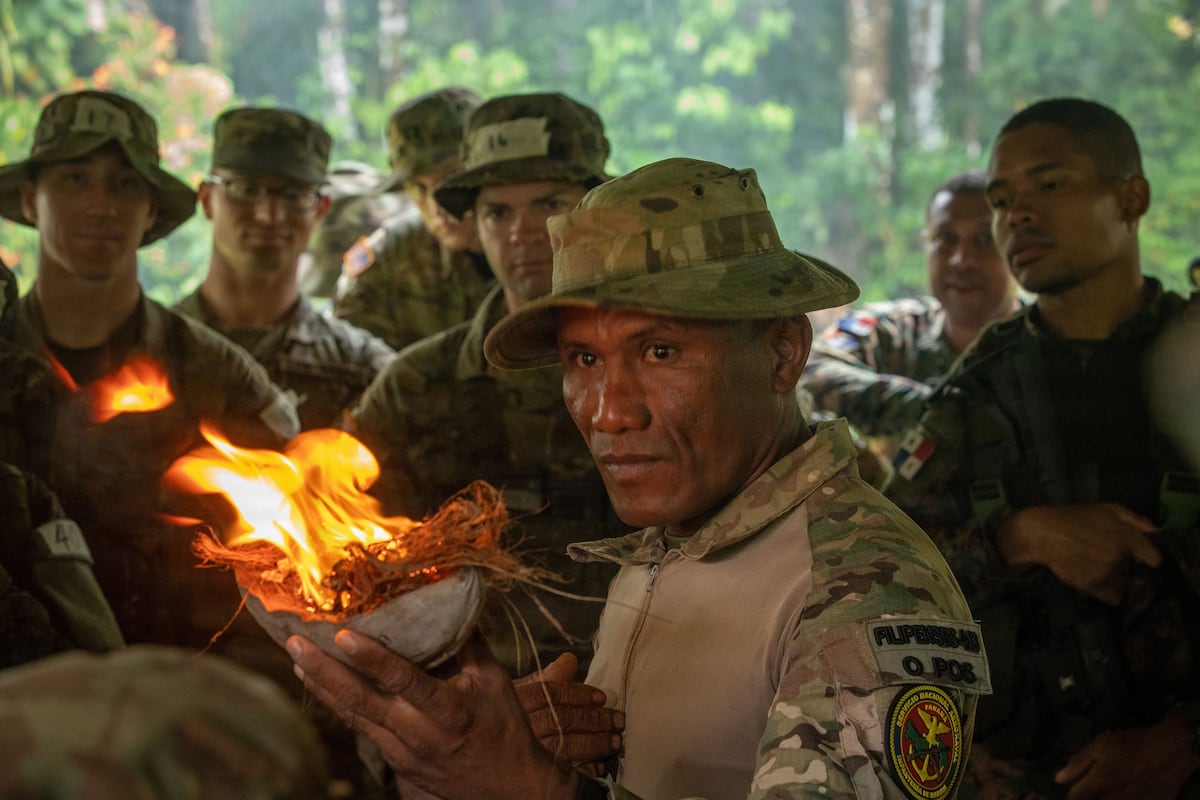
Today, Fajardo leads instruction in jungle survival, where Panamanian instructors take the primary role. Their machetes — kept razor-sharp and sheathed in hand-carved leather coverings — are a symbol of that mastery. To Fajardo, the machete is the single most important tool for staying alive in the jungle. He refers to it, with a smile, as “mi esposa” — my wife.
What the Jungle Teaches
Several Panamanian instructors, including Fajardo, have completed Panama’s own elite jungle course, known as Panajungla. Held in the remote Teribe region of Bocas del Toro province, the course pushes participants to the limit — demanding they hunt, forage, and prepare everything they consume using only what the forest provides and the blade at their side. Fajardo still speaks of the ordeal with a visible shudder.
His favorite find in the jungle? Ñame, a tropical root vegetable similar to a yam. He also has a taste for grubs, which he compares to butter.
That lived experience translates directly into classroom instruction. During one field exercise at the course, a Panamanian student — before receiving any formal instruction on the subject — set up a functioning vine tripwire to alert his squad of approaching threats. The lanewalker only discovered this after debriefing both squads following a tense exercise in tactical tracking and concealment. A tripwire class had been scheduled for later that same afternoon.
When that class did meet, an American instructor walked students through constructing early-warning systems from jungle materials — rattling cans, fauna, and vines. He also shared accounts from Panamanian cadres who had operated in the Darién Gap, the roughly 60-mile stretch of roadless, dense jungle connecting Panama and Colombia that has long been a corridor for drug and human trafficking. The message was blunt: cartel members are using tripwires there right now.
Building Toward a Regional Network
The course currently holds 120 slots, with at least 20 reserved for partner forces and at least 15 specifically for Panamanian students. No other countries have sent soldiers yet, but Eagen said Colombian participation is close. The U.S. already partners with Colombia’s Lancero course — a program comparable to Ranger School — and information is shared among all three nations.
Panama, Eagen noted, actively supports bringing in Colombian troops given the history between the two neighbors.
“They have a lot of shared bilat right there at the Darién, so both Panamanian leaders and Colombian leaders want them to be first.”
Interest has also come from Costa Rica and Brazil. Eagen said the curriculum is being shaped in part around threat characteristics that Panamanian service members have actually encountered in the field — though he was careful to draw a distinction between training for jungle combat and replicating Panama’s specific security situation.
“That is not the premise of us being in Panama,”
Eagen said.
“We try to make sure there are clear boundaries of understanding for the students that this is about the skills required of the environment, not about the situation in Panama.”
Relations between the U.S. and Panama carry a complicated history. Panama formally abolished its standing army in 1994, several years after a U.S. military invasion removed military dictator Manuel Noriega from power. Public sentiment between the two countries has shifted over the decades since. But Eagen said the Army has been intentional about approaching this renewed partnership with humility — framing the collaboration as one where Americans come to learn, not simply to instruct.
Among the service members observed during the course, that spirit appeared evident. Panamanian and American troops trained side by side, divided into mixed squads, navigating both language barriers and dense jungle together.