In an era when foreign adversaries are waging sophisticated campaigns to shape what American citizens see, read, and believe — including during elections — the U.S. military’s ability to counter disinformation and information warfare has never mattered more. The Army’s restructuring of its psychological operations forces reflects a growing recognition that the battle for democratic information environments is not theoretical; it is happening right now, at a pace that American institutions are struggling to match.
On September 29, the Army formally inactivated the 8th Psychological Operations Group (Airborne) in a ceremony at Fort Bragg, North Carolina — closing the book on a unit that spent more than a decade developing the tools and tactics America uses to operate in contested information spaces. The move is part of a broader restructuring of how the Army approaches psychological operations, not a permanent dissolution of the mission itself.
Col. Robert Cusick, the group’s commanding officer, addressed the soldiers gathered for the ceremony with a sense of pride and forward-looking purpose:
“I could not be prouder of the men and women that stand before us today and those that came before us to inactivate the unit. 8th PSYOP Group introduced new concepts that will remain for years to come.”
What the 8th POG Did — and Why It Mattered
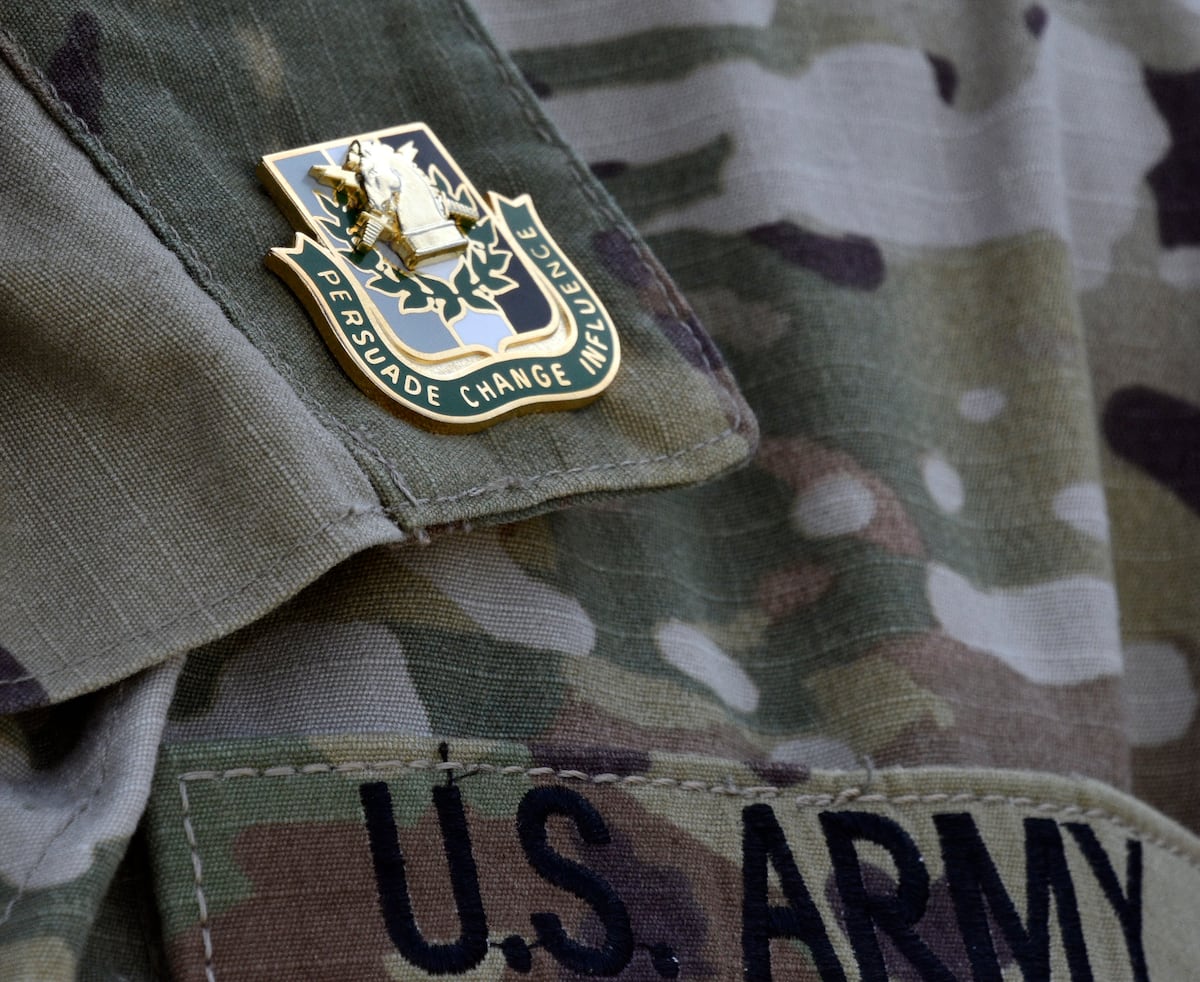
Known as the “Phantom Knights,” the 8th POG was formally activated on November 16, 2013, after two years of provisional operation. It was one of four Army PSYOP groups, alongside the active-duty 4th Psychological Operations Group (Airborne) and the Army Reserve’s 2nd and 7th Psychological Operations Groups.
The group’s two main battalions each played a distinct role in the broader information mission. The 3rd PSYOP Battalion (Airborne) managed print, radio, and broadcast information operations around the world — the kind of work that directly shapes what populations in conflict zones hear and see. The 9th PSYOP Battalion (Airborne) focused on more direct-action information work: dropping leaflets, engaging local communities, and supporting Special Forces operations in the field.
Also under the 8th POG’s umbrella was the Information Warfare Center, organized in 2020, which combined intelligence operations and information warfare capabilities specifically for Army Special Forces. Its mission — to understand, engage, and counter adversarial narratives — speaks directly to the kind of influence operations that now routinely target democratic societies, including through social media manipulation and coordinated foreign disinformation aimed at undermining public trust in elections and civic institutions.
Restructuring for Speed in a Faster Information War
The inactivation of the 8th POG comes just two months after the Army activated Delta Company, 7th Psychological Operations Battalion — a unit now assigned to the 3rd Special Forces Group (Airborne) and focused on operations under U.S. Africa Command. That realignment signals that military leaders believe the current structure is not optimally built for the speed and complexity of modern information threats.
The core problem, as analysts and military officials have described it, is a dangerous gap between how fast adversaries can deploy information operations and how slowly the U.S. can respond. For democratic nations where public trust in institutions — including elections — is a strategic asset worth protecting, that gap is consequential.
Maj. Ryan Walters, an active-duty U.S. Army Psychological Operations officer, laid out the challenge plainly in Small Wars Journal in January. His analysis carries direct implications for how adversaries are able to shape the information environments in which democratic citizens make decisions:
“What is most concerning is not simply that adversaries invest in information warfare, but that they can often employ it faster and more coherently than we can respond. In practice, adversaries win by compressing the time between sensing, shaping, and exploiting, while U.S. forces remain constrained by approval latency, fragmented execution, and inconsistent assessment. The result is a temporal mismatch in which effects arrive after decisions are already made.”
That phrase — effects arrive after decisions are already made — is not just a military planning problem. It describes the very mechanism by which foreign information operations can influence public opinion, erode confidence in democratic institutions, and distort the information landscape that American voters depend on. When adversaries can shape narratives faster than they can be corrected, the democratic process itself becomes a target.
The Army’s ongoing restructuring of its psychological operations and information warfare capabilities — retiring older organizational structures like the 8th POG while standing up more agile, regionally focused units — is a direct response to this threat. Whether the new architecture can close that temporal gap remains the critical question for military planners and, ultimately, for the health of the democratic information environment that American citizens rely on every day.