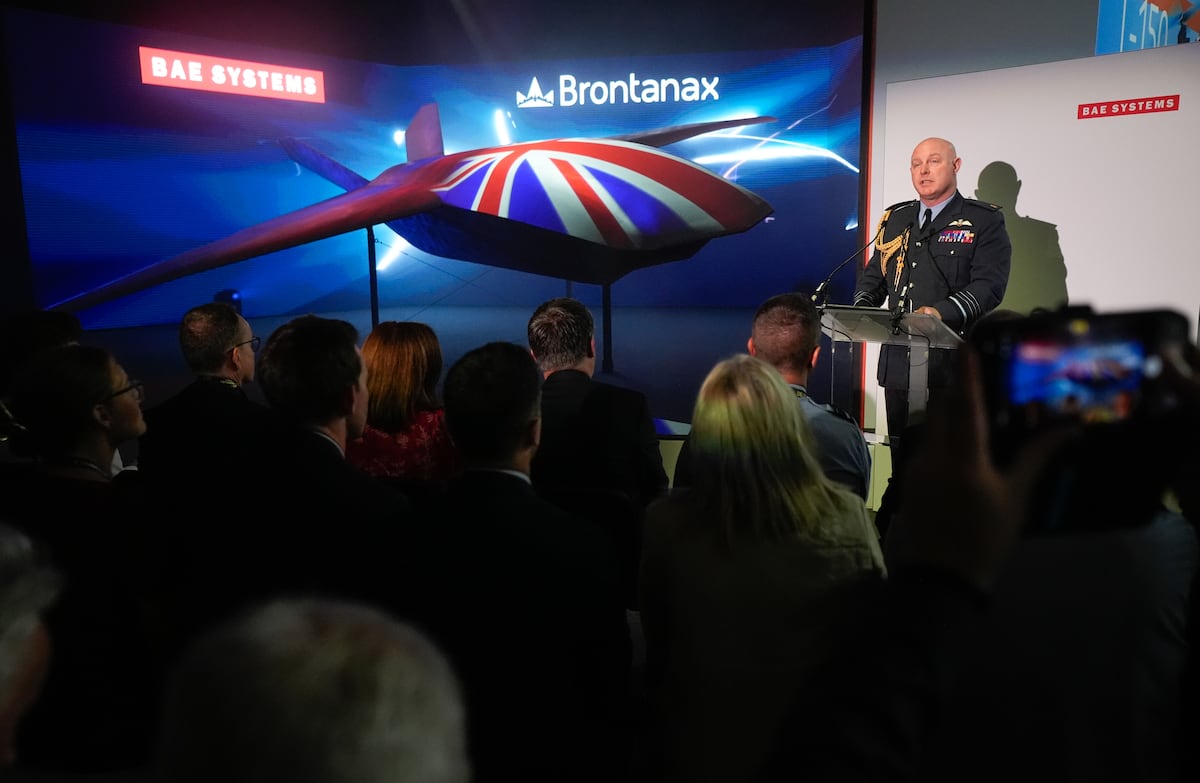
In a significant move for the defense sector, BAE Systems has unveiled a new unmanned fighter jet, Brontanax, at the renowned Farnborough Airshow. This development marks a bold step for Britain as it enters the competitive market of unmanned aerial combat technology.
The Brontanax, named from the Greek words for thunder and king, is designed to be the size of a Hawk trainer. BAE Systems, the UK’s largest defense company, has announced that flight testing is expected to commence next year. This comes at a time when global tensions are rising, prompting Western nations to bolster their air forces to maintain aerial supremacy and prevent conflicts like the ongoing war in Ukraine.
BAE is entering the bustling arena of Collaborative Combat Aircraft (CCA), a sector witnessing rapid growth with competitors such as Airbus, Boeing, Anduril, and General Atomics. These CCAs, often referred to as “loyal wingmen,” are engineered to accompany piloted aircraft and are expected to be significantly more affordable, costing about one-third of traditional fighter jets.
Crowded Marketplace
Wes Streeting, the newly appointed Defence Secretary of Britain, described the unveiling as a “groundbreaking moment.” He added, “We will adopt this as our operational concept demonstrator, and we’re going to get it in the air in 2027.” This ambitious timeline is backed by BAE’s substantial investment of hundreds of millions of pounds into the CCA project, despite the absence of governmental co-investment, which is typically crucial for new defense platforms.
BAE’s CEO Charles Woodburn emphasized the company’s proactive approach: “We’ve put our money where our mouth is.” He expressed optimism about securing orders from the UK and potential interest from countries in Europe and the Middle East.
Developed in collaboration with the Royal Air Force, Brontanax has been in the works since 2022 and is expected to be operational by 2030. Currently, a fully assembled aircraft is housed at BAE’s Warton facility in northwest England. The timeline positions Brontanax against Boeing’s MQ-28 Ghost Bat, which is already undergoing flight tests and may be operational in Australia by 2028.
BAE claims its CCA boasts enhanced stealth capabilities compared to its competitors, aiming to provide 70% to 80% of a fighter jet’s capabilities at less than 25% of the cost. This could position the Brontanax at around $25 million per unit. Its open architecture and modular design facilitate easy software upgrades, with BAE exploring partnerships with non-military suppliers to aid in its construction.
In an earlier announcement, the UK government outlined a £300 million ($401 million) defense investment plan to initiate a sovereign CCA program named Storm Fighter.